
We read your photo as:
Describe the observations when aqueous ammonia is added first a few drops and then in excess to copper(II) sulphate solution. (b) State the formula of the precipitate formed. 13. (a) State why glass i
ScanSolve AI Answer
Step-by-step solution
3 stepsAddress question 12(a).
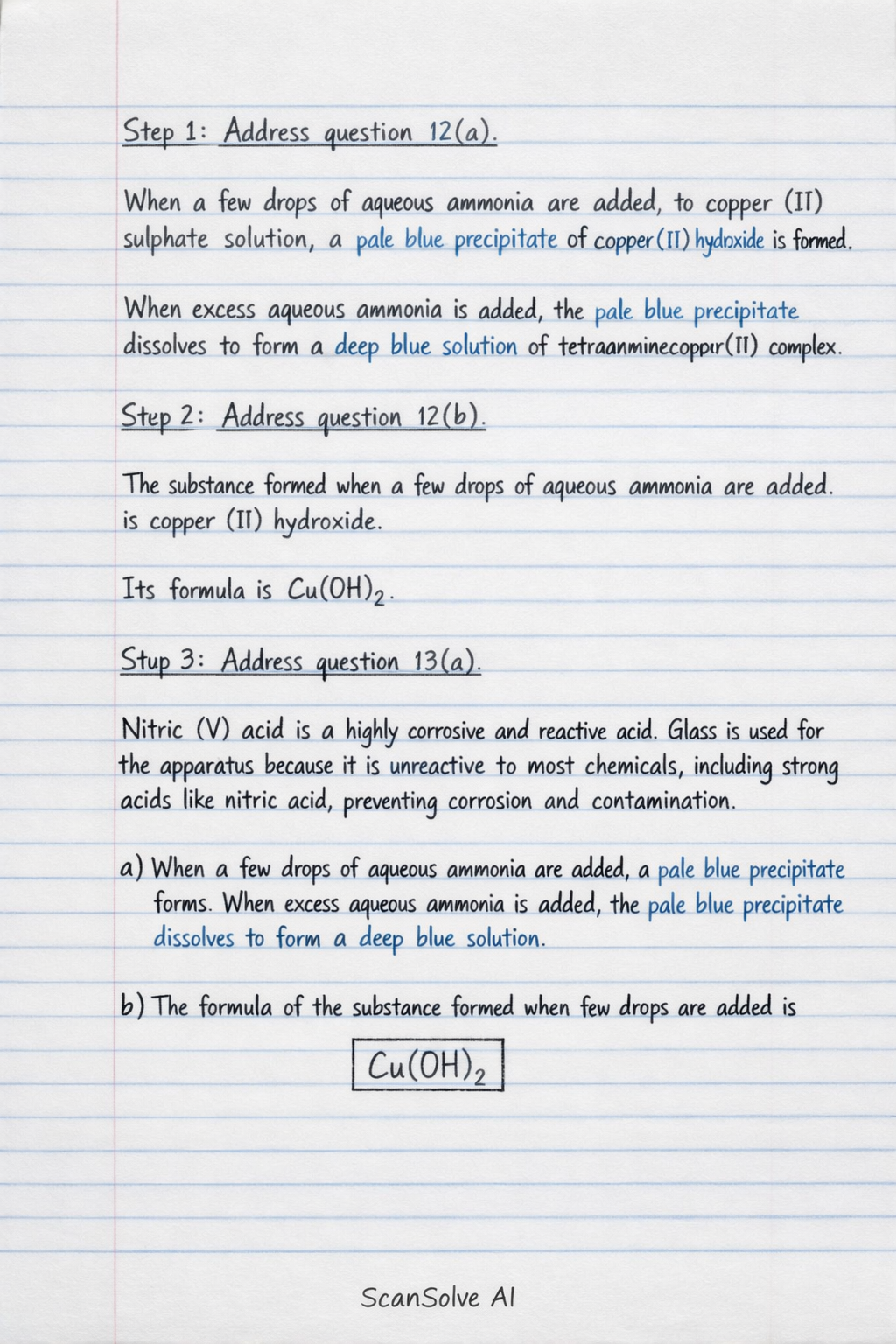
When a few drops of aqueous ammonia are added to copper (II) sulphate solution, a pale blue precipitate of copper (II) hydroxide is formed.
When excess aqueous ammonia is added, the pale blue precipitate dissolves to form a deep blue solution of tetraamminecopper(II) complex.Address question 12(b).
The substance formed when a few drops of aqueous ammonia are added is copper (II) hydroxide.
Its formula is .Address question 13(a).
Nitric (V) acid is a highly corrosive and reactive acid. Glass is used for the apparatus because it is unreactive to most chemicals, including strong acids like nitric acid, preventing corrosion and contamination.
a) When a few drops of aqueous ammonia are added, a pale blue precipitate forms. When excess aqueous ammonia is added, the pale blue precipitate dissolves to form a deep blue solution.
b) The formula of the substance formed when few drops are added is .
a) All apparatus used during the preparation of nitric(V) acid are made of glass because glass is unreactive to most chemicals, including concentrated nitric acid, preventing corrosion.
Still stuck on this one?
Ask a follow-up, and the answer starts from this question.
More Chemistry Questions
Handwritten Step-by-Step Solution
Get this as a handwritten image on WhatsApp — like a tutor wrote it for you.
Try on WhatsApp