
We read your photo as:
Name the reagent which would react with dilute sulphuric (VI) acid and give off: i) Hydrogen gas ii) Carbon (IV) oxide. (b) What name is given to the reaction between sodium hydroxide and the two acid
ScanSolve AI Answer
Answers
3 partsStep-by-step solution
26 stepsHere are the solutions to the questions:
5. (a) Name the reagent which would react with dilute sulphuric (VI) acid and give off:
Part i· 2 steps
Hydrogen gas
Identify reagents that react with dilute sulphuric acid to produce hydrogen gas.
Metals above hydrogen in the reactivity series react with acids to produce hydrogen gas.
From the given list (Sodium sulphate, copper (II) carbonate, copper (II) oxide, dilute hydrochloric acid, calcium granules, sodium hydroxide solution, and dilute sulphuric (VI) acid, distilled water), calcium granules is a metal that reacts with dilute sulphuric acid to produce hydrogen gas.
Answer: Calcium granules
Part ii
Carbon (IV) oxide
Identify reagents that react with dilute sulphuric acid to produce carbon (IV) oxide (carbon dioxide).
Carbonates react with acids to produce carbon dioxide.
From the given list, copper (II) carbonate is a carbonate that reacts with dilute sulphuric acid to produce carbon (IV) oxide.
Answer: Copper (II) carbonate
5. (b) What name is given to the reaction between sodium hydroxide and the two acids in separate boiling tubes?
Sodium hydroxide is a base, and the two acids are dilute sulphuric (VI) acid and dilute hydrochloric acid.
The reaction between an acid and a base is called neutralization.
Answer: Neutralization5. (c) Write an ionic equation for the reaction between solid copper (II) oxide and dilute hydrochloric acid
Write the balanced chemical equation for the reaction.
Write the complete ionic equation by dissociating aqueous compounds into ions.
Solid copper (II) oxide does not dissociate.
Cancel out spectator ions (ions that appear on both sides of the equation).
In this case, is the spectator ion.
Answer:5. (d) Name three reagents in the list above that can be used to efficiently prepare calcium sulphate
Calcium sulphate can be prepared by reacting a calcium compound with a sulphate compound or sulphuric acid.
From the list, identify a calcium compound and a sulphate compound or sulphuric acid.
- Calcium granules (a calcium compound)
- Dilute sulphuric (VI) acid (a source of sulphate ions)
- Sodium sulphate (a source of sulphate ions) Answer:
- Calcium granules
- Dilute sulphuric (VI) acid
- Sodium sulphate
5. (e) Describe how calcium sulphate may be prepared using the reagents named in (d) above.
Calcium sulphate is sparingly soluble, so it can be prepared by precipitation.
React a soluble calcium salt with a soluble sulphate salt or sulphuric acid.
Mix a solution of a soluble calcium compound (e.g., from calcium granules reacting with an acid) with a solution containing sulphate ions (e.g., sodium sulphate solution or dilute sulphuric acid).
Filter the precipitate, wash it with distilled water, and dry it.
Answer:
Dissolve calcium granules in dilute hydrochloric acid to form calcium chloride solution. Then, mix the calcium chloride solution with sodium sulphate solution. A precipitate of calcium sulphate will form. Filter the precipitate, wash it with distilled water, and dry it. Alternatively, react calcium granules directly with dilute sulphuric (VI) acid to form calcium sulphate and hydrogen gas. Filter, wash, and dry the calcium sulphate.6. When a 10g sample of zinc carbonate was heated in a boiling tube, 6.48g of residue was left.
Part a· 2 steps
State the observation made in the boiling tube during reaction.
Zinc carbonate decomposes upon heating.
The decomposition of zinc carbonate produces zinc oxide and carbon dioxide gas.
Zinc oxide is yellow when hot and white when cold. Carbon dioxide is a colorless gas.
Answer: A colorless gas is produced, and a yellow solid (zinc oxide) is formed which turns white on cooling.
Part b
Write a chemical equation representing the reaction in (a) above.
Write the reactants and products.
Zinc carbonate () decomposes into zinc oxide () and carbon dioxide ().
Balance the equation.
The equation is already balanced.
Answer:
Part c(i)· 2 steps
The expected colour change in the reaction vessel if methyl orange indicator was used.
If 25cm³ of hydrochloric acid reacted completely with the residue determine
The residue is zinc oxide, which is a basic oxide.
Hydrochloric acid is an acid.
Methyl orange is an indicator that is red in acidic solutions and yellow in alkaline/neutral solutions.
When an acid reacts with a basic oxide, the solution becomes less acidic or neutral.
Answer: From red to yellow.
Part c(ii)
The concentration of the acid. (Zn = 65, C = 12, O = 16, Cl = 35.5)
Calculate the moles of initially.
Molar mass of
Moles ofCalculate the moles of formed from the residue mass.
Molar mass of
Moles of (residue)The reaction in 6(b) is .
From the stoichiometry, 1 mole of produces 1 mole of .
Since 0.08 mol of was heated, 0.08 mol of was produced. This matches the mass of the residue.Write the balanced chemical equation for the reaction between (residue) and hydrochloric acid.
From the equation, 1 mole of reacts with 2 moles of .
Calculate the moles of that reacted.
Moles of
Calculate the concentration of the hydrochloric acid.
Volume of
Concentration of
Answer:
Try one yourself
A new problem that tests the same skill.
Still stuck on this one?
Ask a follow-up, and the answer starts from this question.
More Chemistry Questions
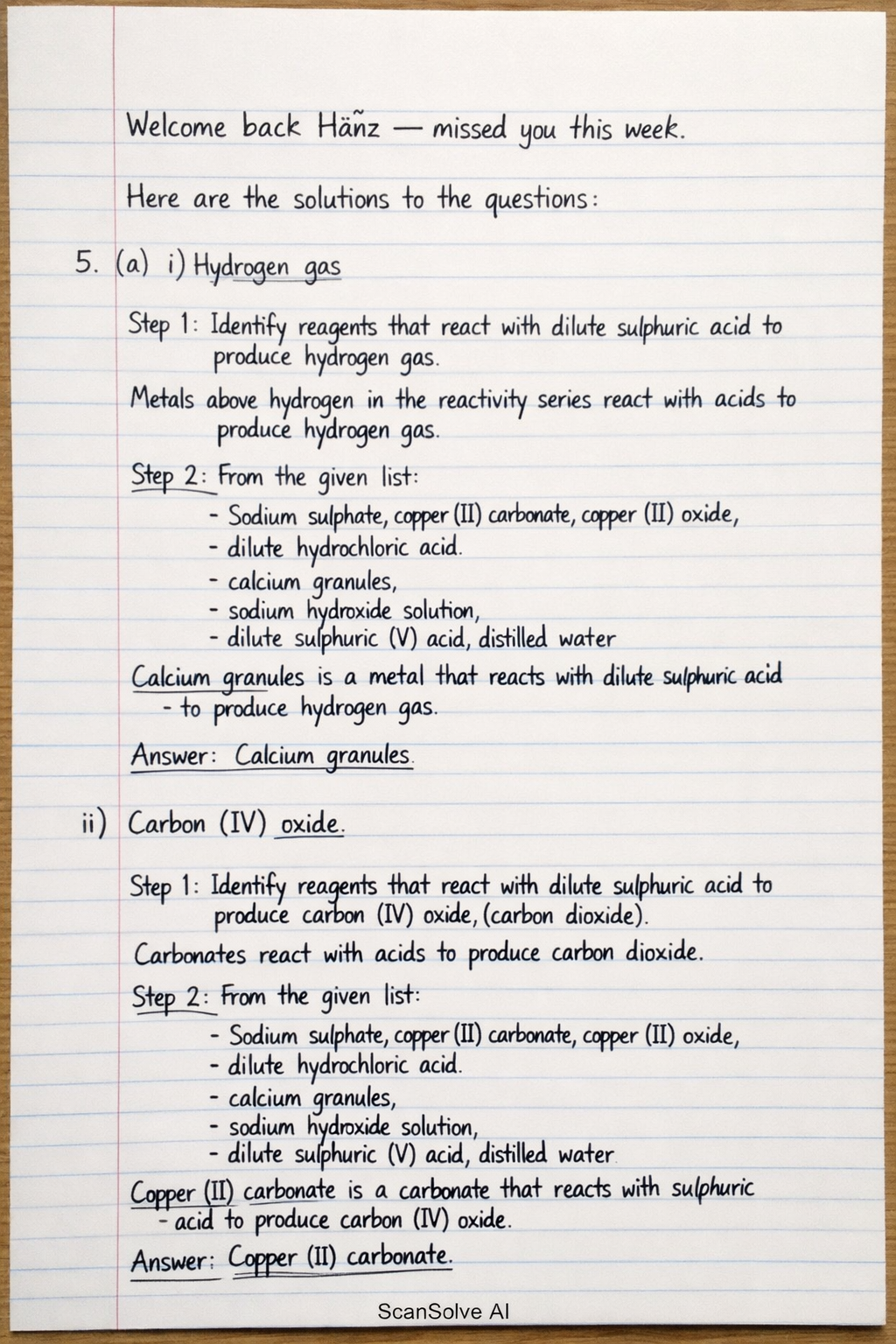
Handwritten Step-by-Step Solution
Get this as a handwritten image on WhatsApp — like a tutor wrote it for you.
Try on WhatsApp