

This chemistry question involves key chemical concepts and calculations. The detailed solution below walks through each step, from identifying the reaction type to computing the final answer.
ScanSolve AI Answer
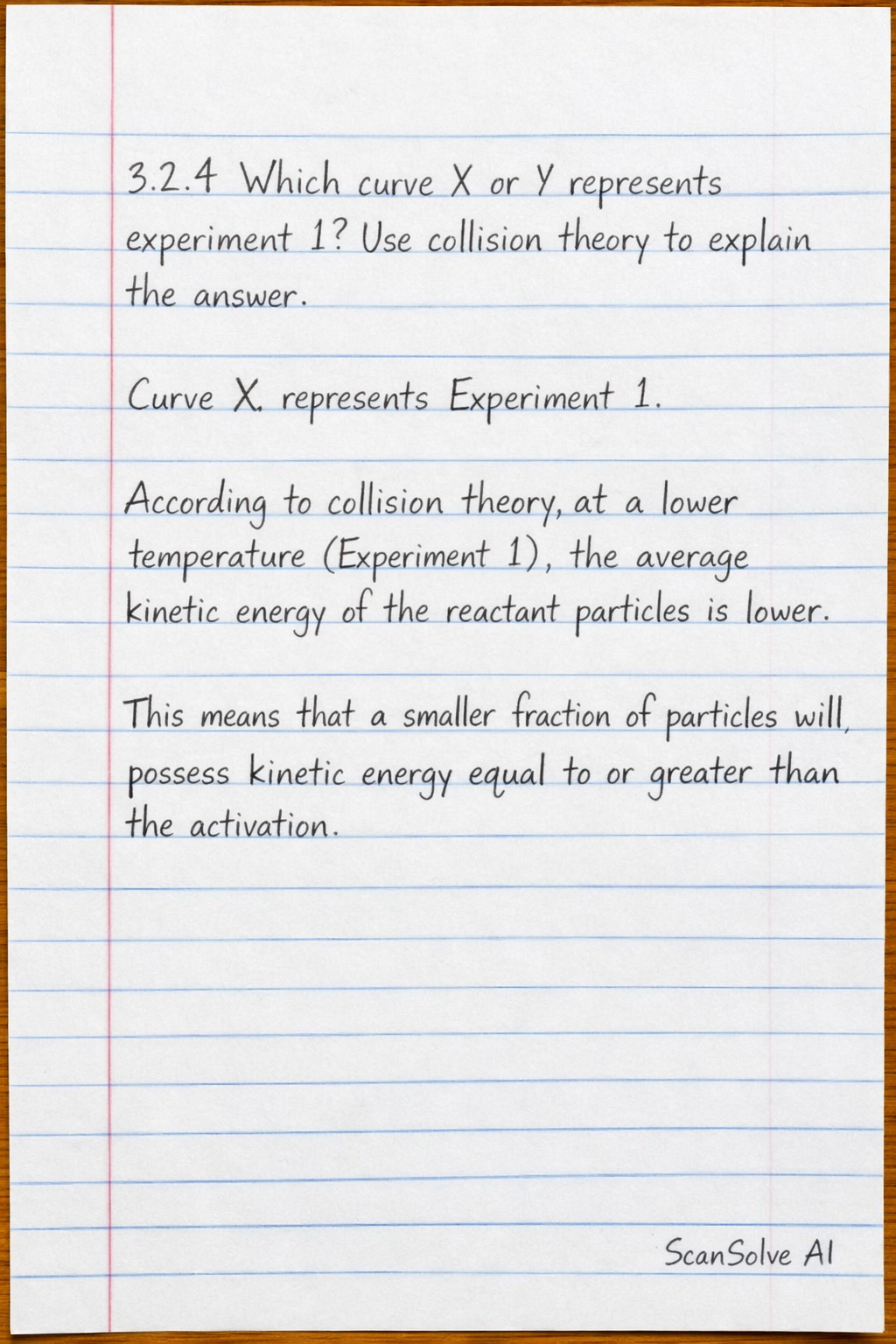
Here are the solutions for the questions: 3.2.4 Which curve X or Y represents experiment 1? Use collision theory to explain the answer. (Note: The curves X and Y are not provided in the image, but typically in Maxwell-Boltzmann distribution graphs, one curve represents a lower temperature (more peaked, shifted left) and the other a higher temperature (flatter, shifted right). Assuming Experiment 1 is at a lower temperature than Experiment 2, and X represents the lower temperature curve.) Curve X represents Experiment 1. According to collision theory, at a lower temperature (Experiment 1), the average kinetic energy of the reactant particles is lower. This means that a smaller fraction of particles will possess kinetic energy equal to or greater than the activation