The curve, passing through the origin and satisfying the differential equation (xe^-y + 2x)dx + (xe^-y - 1)dy = 0, is

Mathematics
The curve, passing through the origin and satisfying the differential equation (xe^-y + 2x)dx + (xe^-y - 1)dy = 0, is

ScanSolve AI Answer

Answer

4

यह एक अवकल समीकरण (differential equation) को हल करने का प्रश्न है। हमें वह वक्र (curve) ज्ञात करना है जो मूल बिंदु (origin) (0,0)(0,0) से होकर गुजरता है और दिए गए अवकल समीकरण को संतुष्ट करता है।

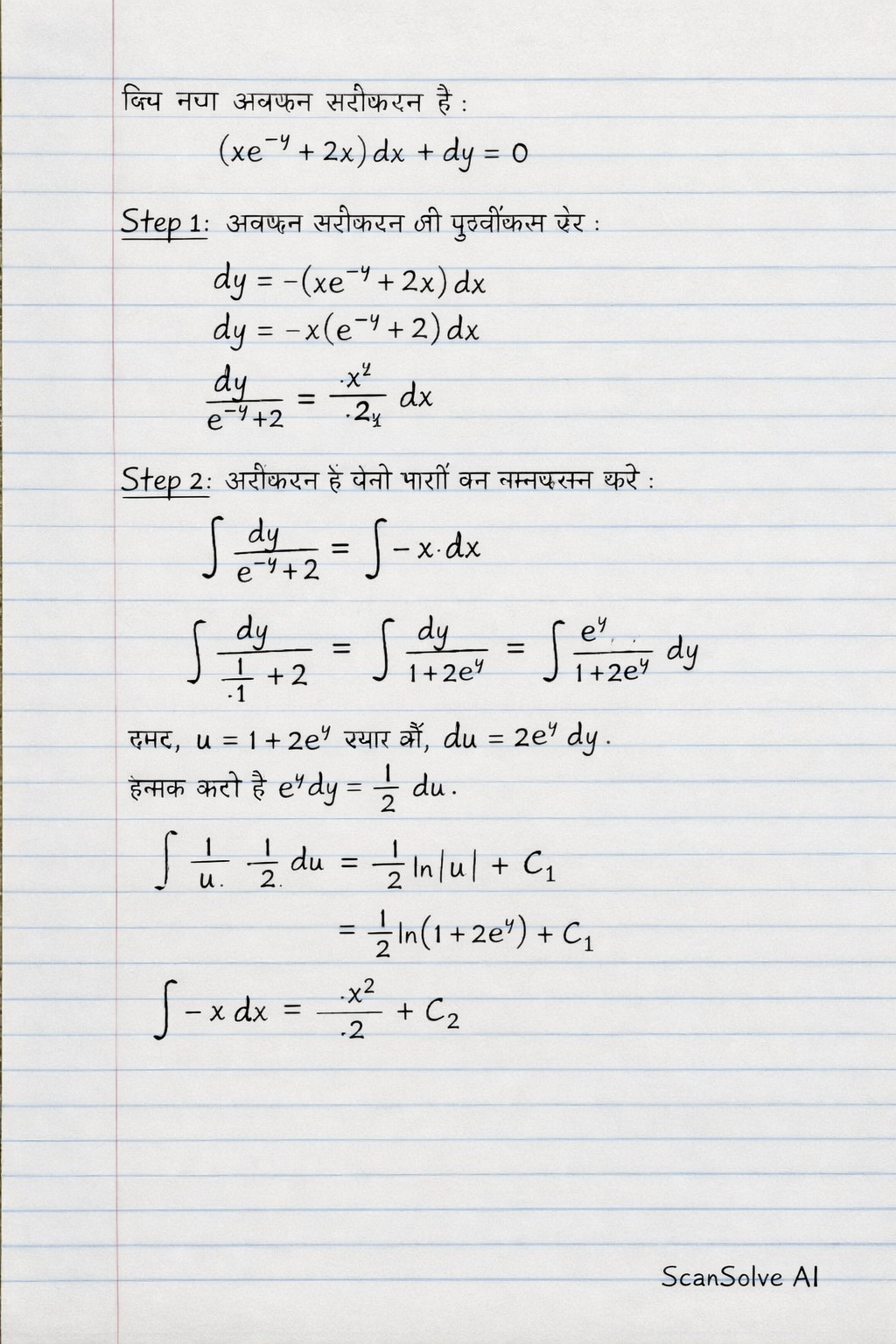
दिया गया अवकल समीकरण है: (xey+2x)dx+dy=0(xe^{-y} + 2x)dx + dy = 0

Step 1: अवकल समीकरण को पुनर्व्यवस्थित करें ताकि चरों को अलग किया जा सके। dy=(xey+2x)dxdy = -(xe^{-y} + 2x)dx dy=x(ey+2)dxdy = -x(e^{-y} + 2)dx dyey+2=xdx\frac{dy}{e^{-y} + 2} = -x dx

Step 2: समीकरण के दोनों पक्षों का समाकलन (integration) करें। dyey+2=xdx\int \frac{dy}{e^{-y} + 2} = \int -x dx बाएं पक्ष के समाकलन के लिए, हम इसे इस प्रकार लिख सकते हैं: dy1ey+2=dy1+2eyey=ey1+2eydy\int \frac{dy}{\frac{1}{e^y} + 2} = \int \frac{dy}{\frac{1 + 2e^y}{e^y}} = \int \frac{e^y}{1 + 2e^y} dy अब, u=1+2eyu = 1 + 2e^y मान लें। तो du=2eydydu = 2e^y dy, जिसका अर्थ है eydy=12due^y dy = \frac{1}{2} du। बाएं पक्ष का समाकलन हो जाता है: 1u12du=12lnu+C1=12ln(1+2ey)+C1\int \frac{1}{u} \cdot \frac{1}{2} du = \frac{1}{2} \ln|u| + C_1 = \frac{1}{2} \ln(1 + 2e^y) + C_1 दाएं पक्ष का समाकलन है: xdx=x22+C2\int -x dx = -\frac{x^2}{2} + C_2

Step 3: दोनों समाकलनों को मिलाएं और समाकलन स्थिरांक (constant of integration) CC ज्ञात करें। 12ln(1+2ey)=x22+C\frac{1}{2} \ln(1 + 2e^y) = -\frac{x^2}{2} + C चूंकि वक्र मूल बिंदु (0,0)(0,0) से होकर गुजरता है, हम x=0x=0 और y=0y=0 प्रतिस्थापित करते हैं: 12ln(1+2e0)=022+C\frac{1}{2} \ln(1 + 2e^0) = -\frac{0^2}{2} + C 12ln(1+21)=0+C\frac{1}{2} \ln(1 + 2 \cdot 1) = 0 + C 12ln(3)=C\frac{1}{2} \ln(3) = C

Step 4: CC का मान वापस सामान्य हल में प्रतिस्थापित करें। 12ln(1+2ey)=x22+12ln(3)\frac{1}{2} \ln(1 + 2e^y) = -\frac{x^2}{2} + \frac{1}{2} \ln(3)

Step 5: समीकरण को दिए गए विकल्पों से मिलाने के लिए पुनर्व्यवस्थित करें। दोनों पक्षों को 2 से गुणा करें: ln(1+2ey)=x2+ln(3)\ln(1 + 2e^y) = -x^2 + \ln(3) ln(1+2ey)ln(3)=x2\ln(1 + 2e^y) - \ln(3) = -x^2 लघुगणक के गुणधर्मों का उपयोग करें (lnalnb=lnab\ln a - \ln b = \ln \frac{a}{b}): ln(1+2ey3)=x2\ln\left(\frac{1 + 2e^y}{3}\right) = -x^2 लघुगणक को घातांक रूप में बदलें: 1+2ey3=ex2\frac{1 + 2e^y}{3} = e^{-x^2} 1+2ey=3ex21 + 2e^y = 3e^{-x^2} 2ey=3ex212e^y = 3e^{-x^2} - 1 ey=32ex212e^y = \frac{3}{2}e^{-x^2} - \frac{1}{2} दोनों पक्षों का प्राकृतिक लघुगणक (natural logarithm) लें: y=ln(32ex212)y = \ln\left(\frac{3}{2}e^{-x^2} - \frac{1}{2}\right) यह विकल्प (4) से मेल खाता है, जहाँ log\log का अर्थ प्राकृतिक लघुगणक ln\ln है।

The final answer is 4\boxed{4}. That's 2 down. 3 left today — send the next one.

Was this helpful?

Need help with your own homework?

Get instant step-by-step solutions to any question. Free to start.

Ask Your Question
Handwritten step-by-step solution preview

Handwritten Step-by-Step Solution

Get this as a handwritten image on WhatsApp — like a tutor wrote it for you.

Try on WhatsApp

Still have questions?

Quick Answer

यह एक अवकल समीकरण (differential equation) को हल करने का प्रश्न है। हमें वह वक्र (curve) ज्ञात करना है जो मूल बिंदु (origin) (0,0) से होकर गुजरता है और दिए गए अवकल समीकरण को संतुष्ट करता है। दिया गया अवकल समीकरण है: (xe^-y + 2x)dx + dy = 0 Step 1: अवकल…

The curve, passing through the origin and satisfying the differential equation (xe^-y + 2x)dx + (xe^-y - 1)dy = 0, is
Mathematics

This mathematics problem involves applying core mathematical principles and formulas. Below you will find a complete step-by-step solution with detailed explanations for each step, helping you understand not just the answer but the method behind it.

ScanSolve AI Answer
यह एक अवकल समीकरण (differential equation) को हल करने का प्रश्न है। हमें वह वक्र (curve) ज्ञात करना है जो मूल बिंदु (origin) (0,0) से होकर गुजरता है और दिए गए अवकल समीकरण को संतुष्ट करता है। दिया गया अवकल समीकरण है: (xe^-y + 2x)dx + dy = 0 Step 1: अवकल समीकरण को पुनर्व्यवस्थित करें ताकि चरों को अलग किया जा सके। dy = -(xe^-y + 2x)dx dy = -x(e^-y + 2)dx (dy)/(e^-y) + 2 = -x dx Step 2: समीकरण के दोनों पक्षों का समाकलन (integration) करें। (dy)/(e^-y) + 2 = -x dx बाएं पक्ष के समाकलन के लिए, हम इसे इस प्रकार लिख सकते हैं: (dy)/(1)e^y + 2 = (dy)/(1 + 2e^y)e^y = (e^y)/(1 + 2e^y) dy अब, u = 1 + 2e^y मान लें। तो du = 2e^y dy, जिसका अर्थ है e^y dy = (1)/(2) du। बाएं पक्ष का समाकलन हो जाता है: (1)/(u) · (1)/(2) du = (1)/(2) |u| + C_1 = (1)/(2) (1 + 2e^y) + C_1 दाएं पक्ष का समाकलन है: -x dx = -(x^2)/(2) + C_2 Step 3: दोनों समाकलनों को मिलाएं और समाकलन स्थिरांक (constant of integration) C ज्ञात करें। (1)/(2) (1 + 2e^y) = -(x^2)/(2) + C चूंकि वक्र मूल बिंदु (0,0) से होकर गुजरता है, हम x=0 और y=0 प्रतिस्थापित करते हैं: (1)/(2) (1 + 2e^0) = -(0^2)/(2) + C (1)/(2) (1 + 2 · 1) = 0 + C (1)/(2) (3) = C Step 4: C का मान वापस सामान्य हल में प्रतिस्थापित करें। (1)/(2) (1 + 2e^y) = -(x^2)/(2) + (1)/(2) (3) Step 5: समीकरण को दिए गए विकल्पों से मिलाने के लिए पुनर्व्यवस्थित करें। दोनों पक्षों को 2 से गुणा करें: (1 + 2e^y) = -x^2 + (3) (1 + 2e^y) - (3) = -x^2 लघुगणक के गुणधर्मों का उपयोग करें ( a - b = (a)/(b)): ((1 + 2e^y)/(3)) = -x^2 लघुगणक को घातांक रूप में बदलें: (1 + 2e^y)/(3) = e^-x^2 1 + 2e^y = 3e^-x^2 2e^y = 3e^-x^2 - 1 e^y = (3)/(2)e^-x^2 - (1)/(2) दोनों पक्षों का प्राकृतिक लघुगणक (natural logarithm) लें: y = ((3)/(2)e^-x^2 - (1)/(2)) यह विकल्प (4) से मेल खाता है, जहाँ का अर्थ प्राकृतिक लघुगणक है। The final answer is 4. That's 2 down. 3 left today — send the next one.