Exercise 2: For each of the two crosses, determine the mode of transmission of the two hereditary characters. Provide the chromosomal interpretation of the second cross by establishing the Punnett square. Determine the phenomenon responsible for the appearance of rabbits with long fur and spotted coat color, and rabbits with short fur and uniform coat color in generation F2. Explain this phenomenon using a diagram. Establish the factorial map of the two genes studied, showing the steps involved in this realization.

Biology
Exercise 2: For each of the two crosses, determine the mode of transmission of the two hereditary characters. Provide the chromosomal interpretation of the second cross by establishing the Punnett square. Determine the phenomenon responsible for the appearance of rabbits with long fur and spotted coat color, and rabbits with short fur and uniform coat color in generation F2. Explain this phenomenon using a diagram. Establish the factorial map of the two genes studied, showing the steps involved in this realization.

ScanSolve AI Answer

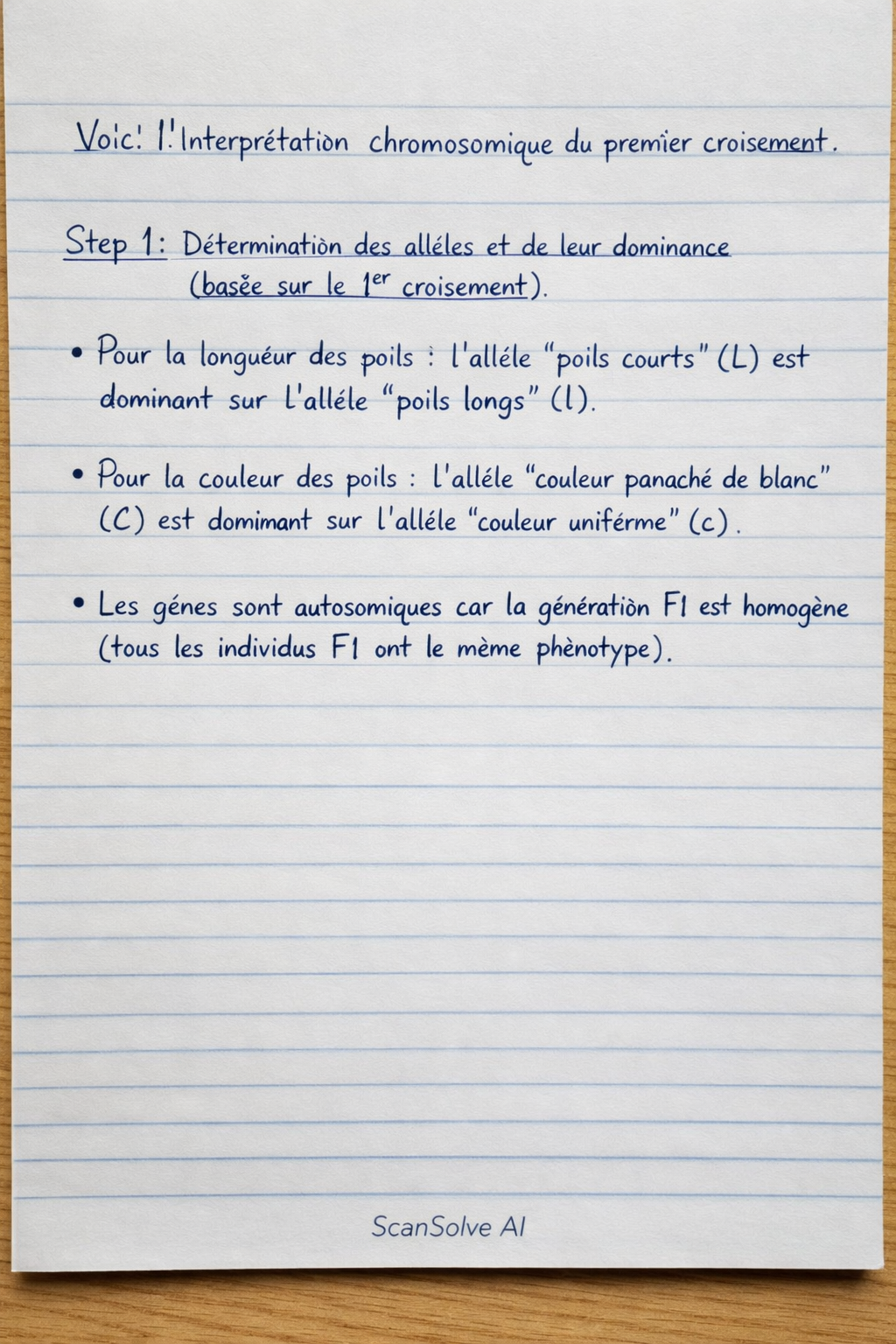
Voici l'interprétation chromosomique du premier croisement.

2. Interprétation chromosomique du premier croisement

Step 1: Détermination des allèles et de leur dominance (basée sur le 1er croisement)

  • Pour la longueur des poils : l'allèle "poils courts" (L) est dominant sur l'allèle "poils longs" (l).
  • Pour la couleur des poils : l'allèle "couleur panaché de blanc" (C) est dominant sur l'allèle "couleur uniforme" (c).
  • Les gènes sont autosomiques car la génération F1 est homogène (tous les individus F1 ont le même phénotype).

Step 2: Génotypes et représentation chromosomique des parents (P)

  • Parent 1 ([Poils longs, couleur uniforme], race pure) :
    • Génotype : llccllcc
    • Interprétation chromosomique : Les allèles ll sont portés par une paire de chromosomes homologues (un ll sur chaque chromosome) et les allèles cc sont portés par une autre paire de chromosomes homologues (un cc sur chaque chromosome).
  • Parent 2 ([Poils courts, couleur panaché de blanc], race pure) :
    • Génotype : LLCCLLCC
    • Interprétation chromosomique : Les allèles LL sont portés par une paire de chromosomes homologues (un LL sur chaque chromosome) et les allèles CC sont portés par une autre paire de chromosomes homologues (un CC sur chaque chromosome).

Step 3: Gamètes des parents

  • Parent 1 (llccllcc) produit un seul type de gamètes : lclc. Chaque gamète contient un chromosome portant l'allèle ll et un chromosome portant l'allèle cc.
  • Parent 2 (LLCCLLCC) produit un seul type de gamètes : LCLC. Chaque gamète contient un
Was this helpful?

Need help with your own homework?

Get instant step-by-step solutions to any question. Free to start.

Ask Your Question
Handwritten step-by-step solution preview

Handwritten Step-by-Step Solution

Get this as a handwritten image on WhatsApp — like a tutor wrote it for you.

Try on WhatsApp

Still have questions?

Quick Answer

Voici l'interprétation chromosomique du premier croisement. 2.

Exercise 2: For each of the two crosses, determine the mode of transmission of the two hereditary characters. Provide the chromosomal interpretation of the second cross by establishing the Punnett square. Determine the phenomenon responsible for the appearance of rabbits with long fur and spotted coat color, and rabbits with short fur and uniform coat color in generation F2. Explain this phenomenon using a diagram. Establish the factorial map of the two genes studied, showing the steps involved in this realization.
Biology

This biology question covers important biological concepts and processes. The step-by-step explanation below helps you understand the underlying mechanisms and reasoning.

ScanSolve AI Answer
Voici l'interprétation chromosomique du premier croisement. 2. Interprétation chromosomique du premier croisement Step 1: Détermination des allèles et de leur dominance (basée sur le 1er croisement) Pour la longueur des poils : l'allèle "poils courts" (L) est dominant sur l'allèle "poils longs" (l). Pour la couleur des poils : l'allèle "couleur panaché de blanc" (C) est dominant sur l'allèle "couleur uniforme" (c). Les gènes sont autosomiques car la génération F1 est homogène (tous les individus F1 ont le même phénotype). Step 2: Génotypes et représentation chromosomique des parents (P) Parent 1 ([Poils longs, couleur uniforme], race pure) : Génotype : llcc Interprétation chromosomique : Les allèles l sont portés par une paire de chromosomes homologues (un l sur chaque chromosome) et les allèles c sont portés par une autre paire de chromosomes homologues (un c sur chaque chromosome). Parent 2 ([Poils courts, couleur panaché de blanc], race pure) : Génotype : LLCC Interprétation chromosomique : Les allèles L sont portés par une paire de chromosomes homologues (un L sur chaque chromosome) et les allèles C sont portés par une autre paire de chromosomes homologues (un C sur chaque chromosome). Step 3: Gamètes des parents Parent 1 (llcc) produit un seul type de gamètes : lc. Chaque gamète contient un chromosome portant l'allèle l et un chromosome portant l'allèle c. Parent 2 (LLCC) produit un seul type de gamètes : LC. Chaque gamète contient un