
This chemistry question involves key chemical concepts and calculations. The detailed solution below walks through each step, from identifying the reaction type to computing the final answer.
ScanSolve AI Answer
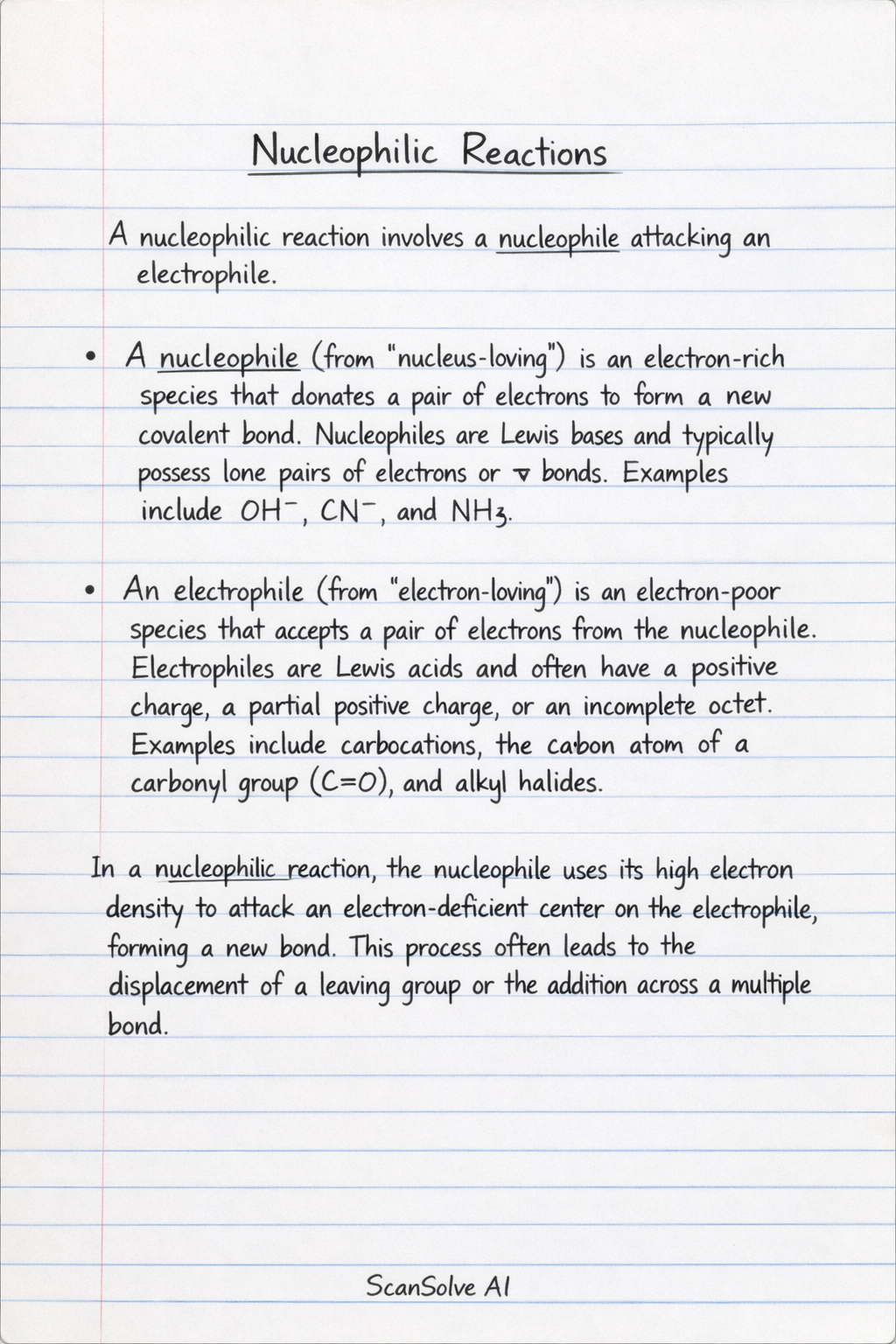
Nucleophilic Reactions A nucleophilic reaction involves a nucleophile attacking an electrophile. A nucleophile (from "nucleus-loving") is an electron-rich species that donates a pair of electrons to form a new covalent bond. Nucleophiles are Lewis bases and typically possess lone pairs of electrons or bonds. Examples include OH^-, CN^-, and NH_3. An electrophile (from "electron-loving") is an electron-poor species that accepts a pair of electrons from the nucleophile. Electrophiles are Lewis acids and often have a positive charge, a partial positive charge, or an incomplete octet. Examples include carbocations, the carbon atom of a carbonyl group (C=O), and alkyl halides. In a nucleophilic reaction, the nucleophile uses its high electron density to attack an electron-deficient center on the electrophile, forming a new bond. This process often leads to the displacement of a leaving group or the addition across a multiple bond. Example: Nucleophilic addition to a carbonyl group The carbon atom in a carbonyl group (C=O) is electrophilic due to the electronegativity of oxygen. A nucleophile, such as CN^-, attacks this electron-deficient carbon. R_2C=O + CN^- R_2C(O^-)CN Electrophilic Reactions An electrophilic reaction involves an electrophile attacking an electron-rich center, which acts as a nucleophile. An electrophile (from "electron-loving") is an electron-poor species that accepts a pair of electrons from an electron-rich center. Electrophiles are Lewis acids. Examples include H^+, Br^+, and NO_2^+. The electron-rich species, often an alkene, alkyne, or aromatic ring, acts as a nucleophile by donating its electrons to the electrophile. In an electrophilic reaction, the electrophile seeks out and attacks a region of high electron density. The electrons of a double or triple bond, or the delocalized electrons of an aromatic ring, are particularly susceptible to electrophilic attack. Example: Electrophilic addition to an alkene The bond in an alkene is a region of high electron density. An electrophile, such as H^+ (from HBr), attacks the bond, forming a carbocation intermediate. R_2C=CR_2 + H^+ R_2C^+-CHR_2 This carbocation then reacts with a nucleophile (e.g., Br^-) to complete the addition. That's 2 down. 3 left today — send the next one.