
We read your photo as:
Design and test a simple filtration system using household materials to purify AC water. Discuss whether the filtered water is safe to drink.
ScanSolve AI Answer
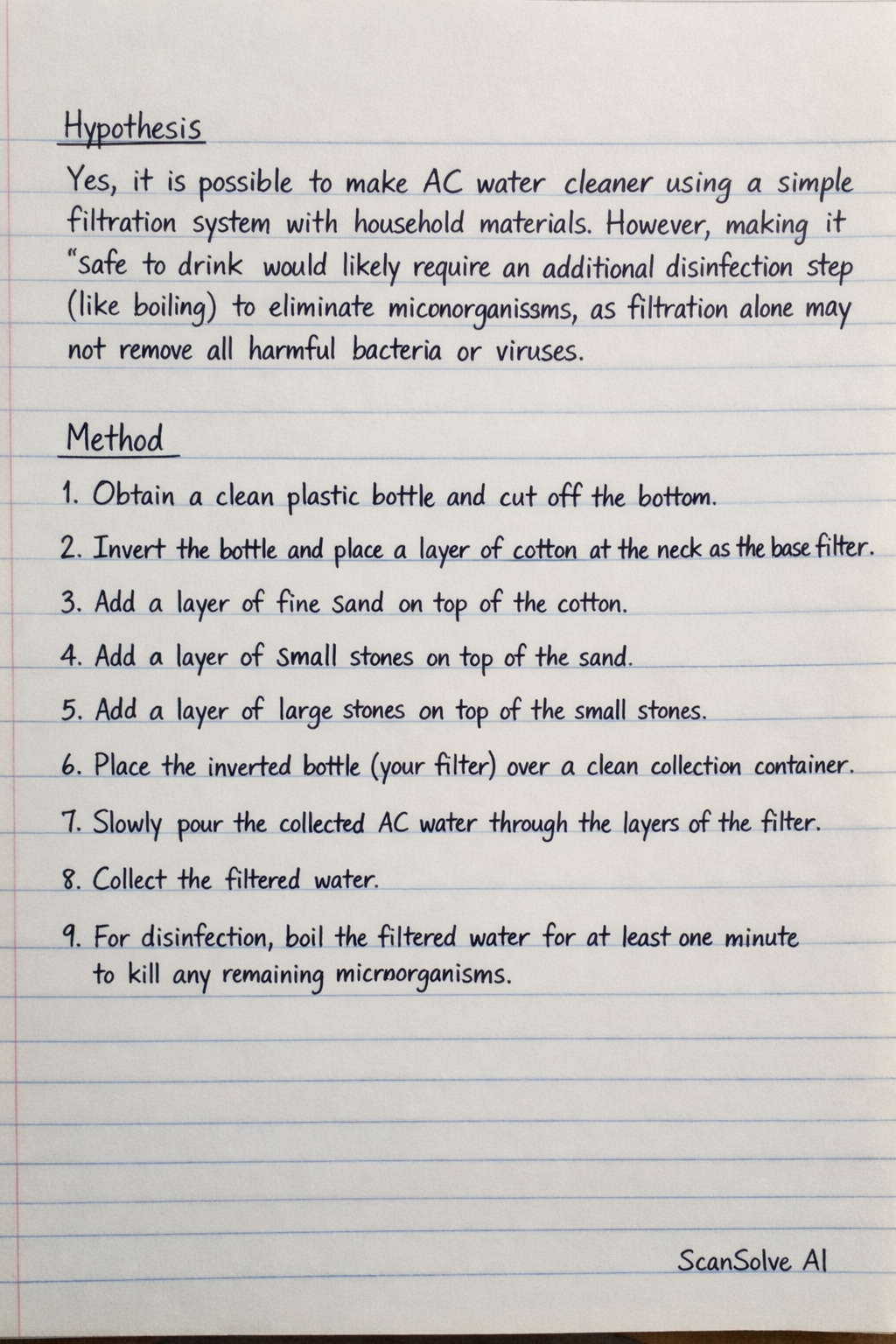
Hypothesis
Yes, it is possible to make AC water cleaner using a simple filtration system with household materials. However, making it safe to drink would likely require an additional disinfection step (like boiling) to eliminate microorganisms, as filtration alone may not remove all harmful bacteria or viruses.
Method
- Obtain a clean plastic bottle and cut off the bottom.
- Invert the bottle and place a layer of cotton at the neck, acting as the base filter.
- Add a layer of fine sand on top of the cotton.
- Add a layer of small stones on top of the sand.
- Add a layer of large stones on top of the small stones.
- Place the inverted bottle (your filter) over a clean collection container.
- Slowly pour the collected AC water through the layers of the filter.
- Collect the filtered water.
- For disinfection, boil the filtered water for at least one minute to kill any remaining microorganisms.
Observations
- Collection (Field work): Please fill in the Start Time, End Time, and Volume of Water Collected (mL) for each time interval, then calculate the Total water collected based on your experiment.
- Water purification (Lab work): Please record your observations Before Filtering and After Filtering for Water colour, Smell, and Dirt/particles, along with any Notes / Changes observed during your experiment.
The science (Why it works)
a) How is AC water created in the air conditioning unit?
AC water is created through condensation. When warm, humid air from a room passes over the cold evaporator coils inside the air conditioning unit, the water vapor (gas) in the air cools down, loses energy, and changes into liquid water droplets. These droplets then collect and drain out of the unit.
b) What changes in states of matter can you observe in the water?
The primary change in the state of matter observed is condensation, where water vapor (a gas) in the air transforms into liquid water.
c) Why is filtering and disinfecting necessary?
Filtering is necessary to remove physical impurities such as dust, dirt, and debris that may have been present in the air or accumulated within the AC unit's drainage system. Disinfecting is crucial because AC water can still contain harmful bacteria, mold, and other microorganisms that could make it unsafe to drink.
d) How does each layer of your filter work? (large stones, small stones, sand, and cotton)
Large stones act as the first layer, removing the largest particles and debris. Small stones filter out smaller suspended particles. The sand layer provides finer filtration, trapping even smaller particles due to its smaller pore spaces. Cotton is the final and finest filtration layer, designed to remove very fine suspended particles and prevent the sand from washing out.
Conclusion
- a) Was your hypothesis correct? You will answer this based on your observations and whether the filtered and disinfected water appeared cleaner and safer.
- b) Did the filter work? Was the water cleaner or safer to drink? You will answer this by comparing your "Before Filtering" and "After Filtering" observations and considering the effectiveness of your disinfection step.
Still stuck on this one?
Ask a follow-up, and the answer starts from this question.
More Chemistry Questions
Handwritten Step-by-Step Solution
Get this as a handwritten image on WhatsApp — like a tutor wrote it for you.
Try on WhatsApp