
We read your photo as:
Explain disproportionation reactions and provide examples. Explain why HI cannot be prepared from NaI and conc. H2SO4. What is the oxidation state change of sulfur in the oxidation of SO2 to SO3?
ScanSolve AI Answer
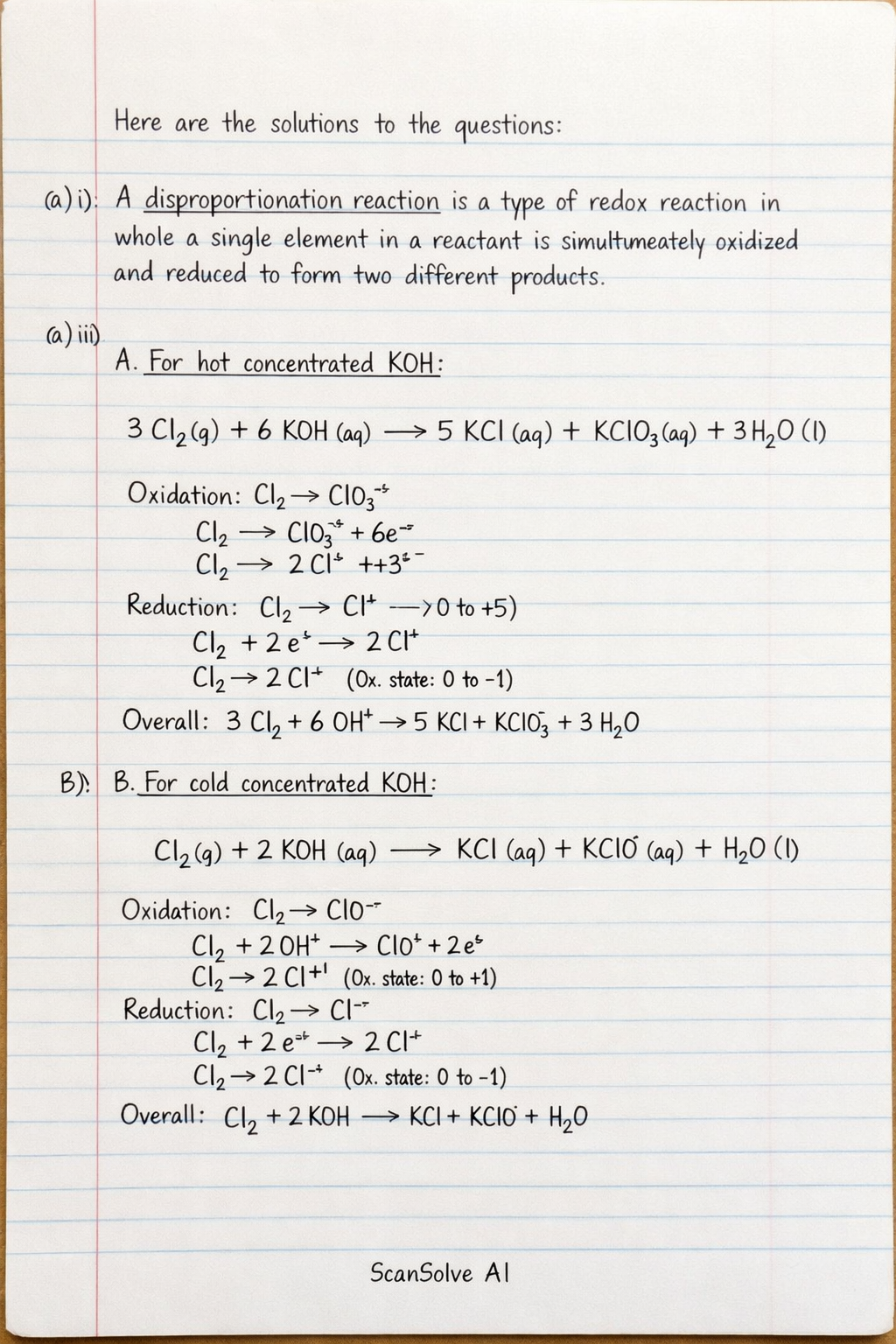
Here are the solutions to the questions:
a) ii) A disproportionation reaction is a type of redox reaction in which a single element in a reactant is simultaneously oxidized and reduced to form two different products.
a) iii)
A. For hot concentrated :
B. For cold concentrated :
a) iv) Hydrogen iodide cannot be prepared from the reaction between sodium iodide and concentrated sulfuric acid because concentrated sulfuric acid is a strong oxidizing agent, and iodide ions () are strong reducing agents. Instead of forming hydrogen iodide, the concentrated sulfuric acid oxidizes the iodide ions to elemental iodine (), while the sulfuric acid itself is reduced (e.g., to , , or ).
b) i)
A. Increase in oxidation state of sulfur from reactant to product:
(Sulfur oxidation state changes from +4 to +6)
B. Decrease in oxidation state of sulfur from reactant to product:
(Sulfur oxidation state changes from +4 to 0)
b) ii) One consequence on the environment of the release of sulfur dioxide into the atmosphere is the formation of acid rain. Sulfur dioxide reacts with water and oxygen in the atmosphere to form sulfuric acid, which then falls as acid rain, damaging forests, aquatic life, and infrastructure.
b) iii) One important use of urea () in agriculture is as a nitrogenous fertilizer. It provides a readily available source of nitrogen for plant growth, promoting healthy foliage and increased crop yields.
c) i) Allotropy is the property of some chemical elements to exist in two or more different forms, known as allotropes, in the same physical state. These allotropes have different structural arrangements of atoms and thus exhibit different physical and chemical properties.
Two Group IV elements that exhibit allotropy are:
- Carbon (e.g., diamond, graphite, fullerenes)
- Tin (e.g., white tin, grey tin)
c) ii) Carbon forms a wide range of hydrides (hydrocarbons) due to its unique ability to undergo catenation, which is the formation of strong covalent bonds with other carbon atoms to create long chains, branched structures, and rings. The carbon-carbon bond is strong and stable. Other Group IV elements like silicon and germanium can also catenate, but their element-element bonds are weaker, and their hydrides are less stable and fewer in number compared to carbon.
c) iii)
A. Reaction of lead dioxide with an acid (e.g., concentrated hydrochloric acid):
B. Reaction of lead dioxide with a base (e.g., hot concentrated sodium hydroxide):
c) vi) Silicon tetrachloride () is hydrolyzed by water while carbon tetrachloride () is not because silicon has vacant 3d orbitals, which can accept lone pairs of electrons from water molecules to form an intermediate complex. This allows for nucleophilic attack by water and subsequent hydrolysis. Carbon, being in the second period, does not have accessible d-orbitals and cannot expand its octet, thus preventing the initial attack by water molecules and making it resistant to hydrolysis.
Still stuck on this one?
Ask a follow-up, and the answer starts from this question.
More Chemistry Questions
Handwritten Step-by-Step Solution
Get this as a handwritten image on WhatsApp — like a tutor wrote it for you.
Try on WhatsApp