
We read your photo as:
Distinguish between covalent and dative bonds.
ScanSolve AI Answer
Step-by-step solution
5 stepsDistinguish between covalent and dative bonds.
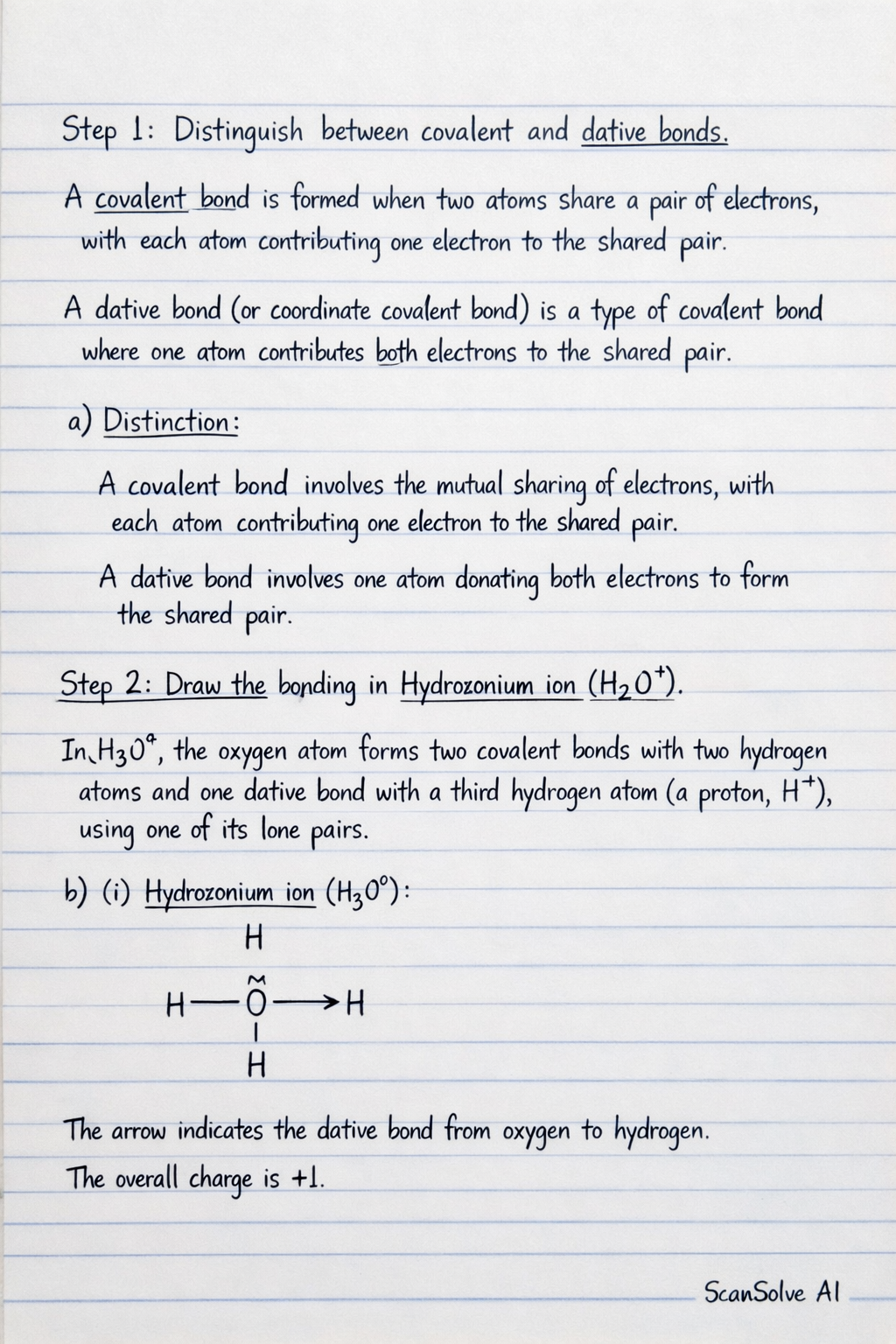
A covalent bond is formed when two atoms share a pair of electrons, with each atom contributing one electron to the shared pair. A dative bond (or coordinate covalent bond) is a type of covalent bond where one atom contributes both electrons to the shared pair.
a) Distinction:
A covalent bond involves the mutual sharing of electrons, with each atom contributing one electron to the shared pair. A dative bond involves one atom donating both electrons to form the shared pair.Draw the bonding in Hydroxonium ion ().
In , the oxygen atom forms two covalent bonds with two hydrogen atoms and one dative bond with a third hydrogen atom (a proton, ), using one of its lone pairs. The oxygen atom has one remaining lone pair.
b) (i) Hydroxonium ion ():
The arrow indicates the dative bond from oxygen to hydrogen. The overall charge is +1.
Draw the bonding in Carbon (II) Oxide (CO).
Carbon monoxide has a triple bond between carbon and oxygen. Two of these are covalent bonds, and one is a dative bond from oxygen to carbon. Carbon has one lone pair, and oxygen has one lone pair.
b) (ii) Carbon (II) Oxide (CO):
(One of the bonds in the triple bond is a dative bond from oxygen to carbon, though not explicitly shown with an arrow in this simplified representation, it is implied by the octets and formal charges.)
State the observation when chlorine gas is passed into moist hydrogen sulphide.
Chlorine is a stronger oxidizing agent than sulphur. It will oxidize hydrogen sulphide to elemental sulphur. Elemental sulphur is a yellow solid.
a) Observation: A yellow precipitate is formed.
Write the balanced chemical equation for the reaction.
Chlorine gas () reacts with hydrogen sulphide () to produce hydrochloric acid () and solid sulphur ().
b) Equation:
Still stuck on this one?
Ask a follow-up, and the answer starts from this question.
More Chemistry Questions
Handwritten Step-by-Step Solution
Get this as a handwritten image on WhatsApp — like a tutor wrote it for you.
Try on WhatsApp