

This chemistry question involves key chemical concepts and calculations. The detailed solution below walks through each step, from identifying the reaction type to computing the final answer.
ScanSolve AI Answer
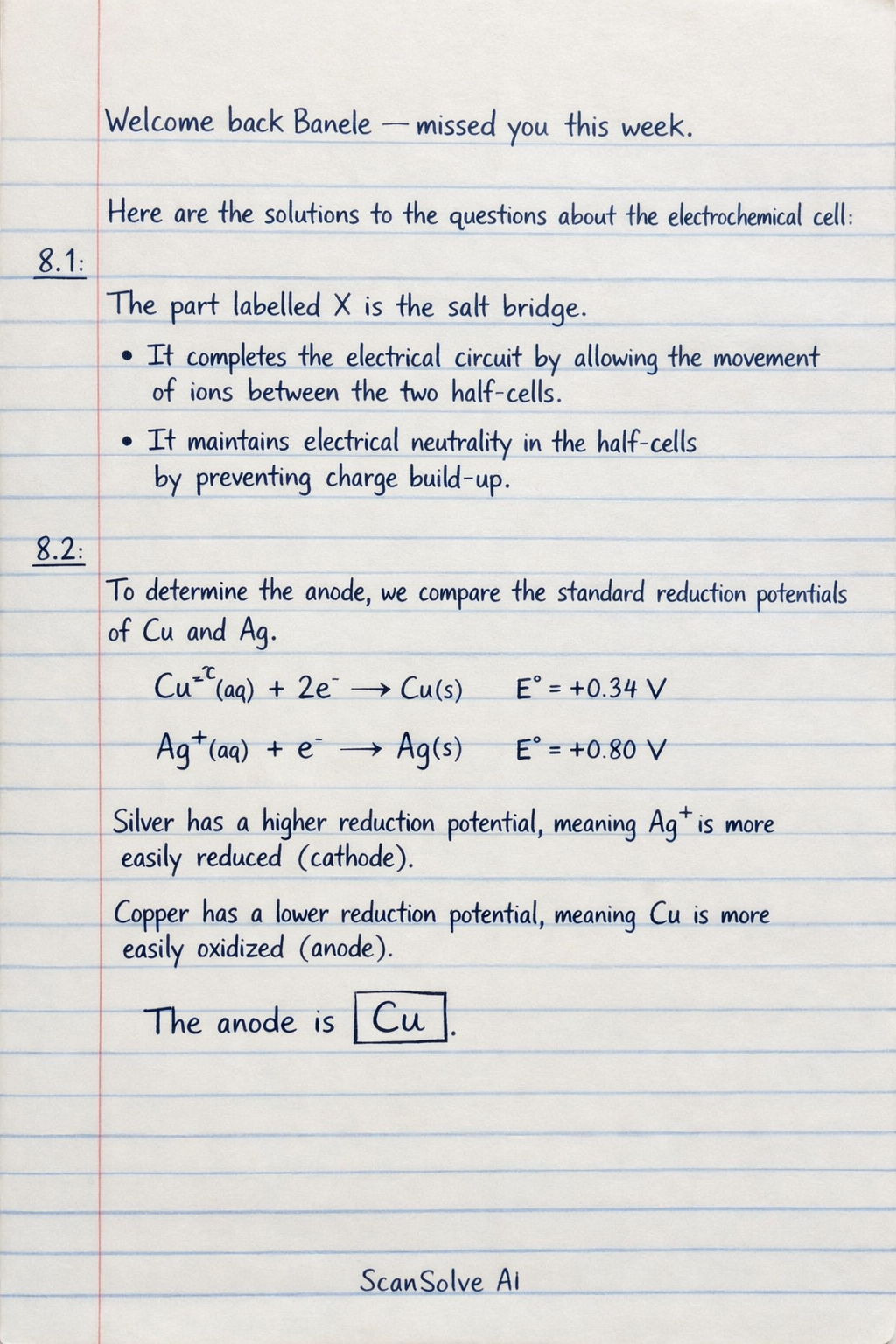
Here are the solutions to the questions about the electrochemical cell: 8.1: The part labelled X is the salt bridge. • It completes the electrical circuit by allowing the movement of ions between the two half-cells. • It maintains electrical neutrality in the half-cells by preventing charge build-up. 8.2: To determine the anode, we compare the standard reduction potentials of Cu and Ag. Cu^2+(aq) + 2e^- Cu(s) E^ = +0.34 V Ag^+(aq) + e^- Ag(s) E^ = +0.80 V Silver has a higher reduction potential, meaning Ag^+ is more easily reduced (cathode). Copper has a lower reduction potential, meaning Cu is more easily oxidized (anode). The anode is Cu. 8.3: 8.3.1: The electrolyte in the Cu half-cell must contain Cu^2+ ions. The formula is CuSO_4 (or Cu(NO_3)_2). 8.3.2: The electrolyte in the Ag half-cell must contain Ag^+ ions. The formula is AgNO_3. 8.4: Step 1: Write the half-reactions. Anode (oxidation): Cu(s) Cu^2+(aq) + 2e^- Cathode (reduction): Ag^+(aq) + e^- Ag(s) Step 2: Balance the electrons by multiplying the cathode reaction by 2. 2Ag^+(aq) + 2e^- 2Ag(s) Step 3: Add the balanced half-reactions to get the net ionic equation. Cu(s) + 2Ag^+(aq) Cu^2+(aq) + 2Ag(s) The balanced net (overall) equation is Cu(s) + 2Ag^+(aq) Cu^2+(aq) + 2Ag(s). 8.5: Step 1: Identify the standard reduction potentials for the cathode and anode. E^_cathode = E^(Ag^+/Ag) = +0.80 V E^_anode = E^(Cu^2+/Cu) = +0.34 V Step 2: Calculate the standard cell potential using the formula E^_cell = E^_cathode - E^_anode. E^_cell = (+0.80 V) - (+0.34 V) E^_cell = 0.46 V The cell potential is +0.46 V. 8.6: The standard conditions under which the cell operates are: • Temperature of 25^ (298 K). • Concentration of 1 mol·dm^-3 (1 M) for all aqueous solutions. Drop the next question!