
We read your photo as:
Draw the dot and cross structures for NH3, H3O+, and NH4OH.
ScanSolve AI Answer
Step-by-step solution
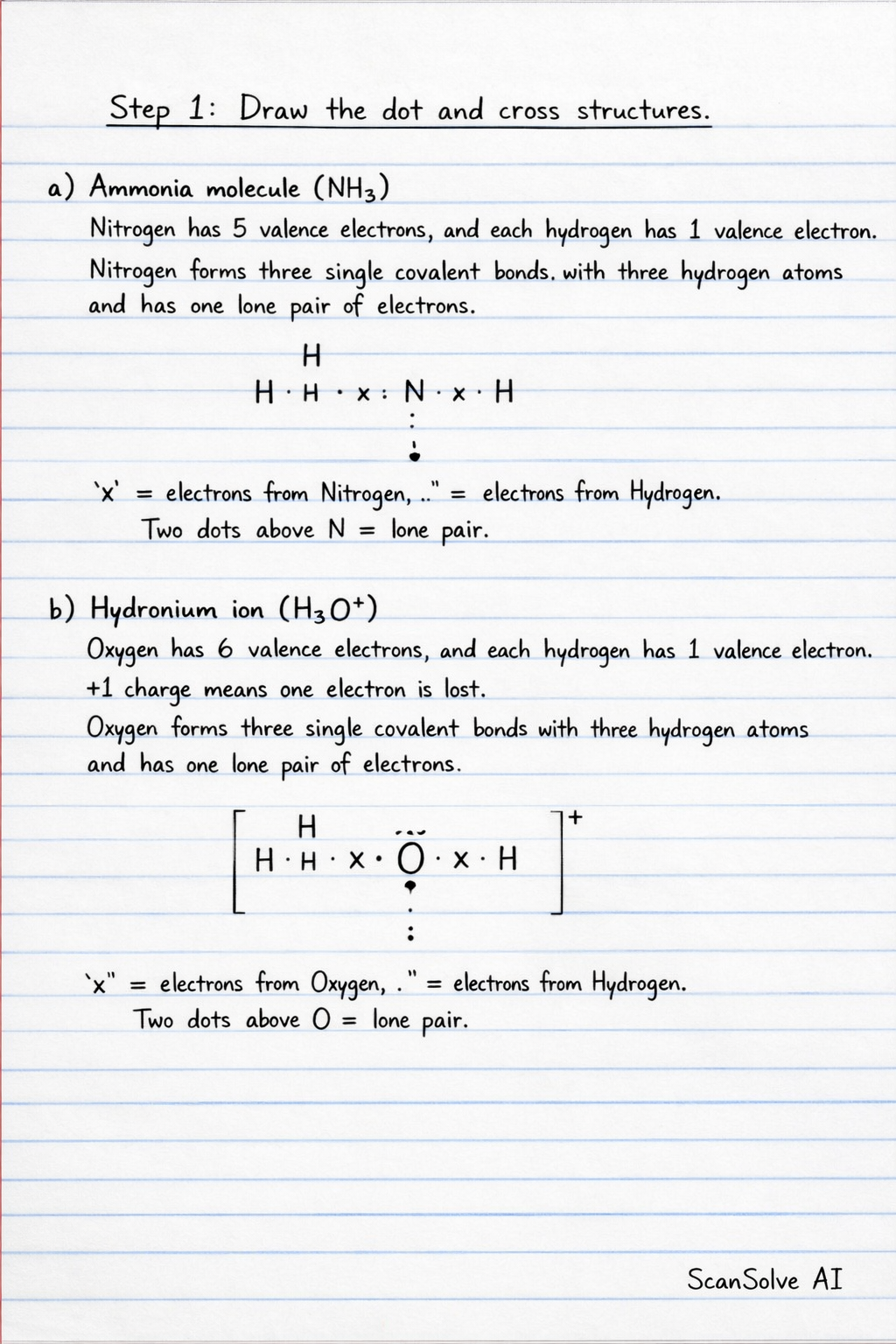
3 stepsDraw the dot and cross structures.
a) Ammonia molecule ()
Nitrogen has 5 valence electrons, and each hydrogen has 1 valence electron. Nitrogen forms three single covalent bonds with three hydrogen atoms and has one lone pair of electrons.(Where 'x' represents electrons from Nitrogen and '.' represents electrons from Hydrogen. The two dots above N represent the lone pair.)
b) Hydronium ion ()
Oxygen has 6 valence electrons, and each hydrogen has 1 valence electron. The +1 charge means one electron is lost. Oxygen forms three single covalent bonds with three hydrogen atoms and has one lone pair of electrons.(Where 'x' represents electrons from Oxygen and '.' represents electrons from Hydrogen. The two dots above O represent the lone pair.)
c) Ammonium hydroxide ()
This is an ionic compound consisting of the ammonium ion () and the hydroxide ion ().Ammonium ion ()
Nitrogen has 5 valence electrons, and each hydrogen has 1 valence electron. The +1 charge means one electron is lost. Nitrogen forms four single covalent bonds with four hydrogen atoms and has no lone pairs.(Where 'x' represents electrons from Nitrogen and '.' represents electrons from Hydrogen.)
Hydroxide ion ()
Oxygen has 6 valence electrons, and hydrogen has 1 valence electron. The -1 charge means one electron is gained. Oxygen forms one single covalent bond with hydrogen and has three lone pairs of electrons.(Where 'x' represents electrons from Oxygen and '.' represents electrons from Hydrogen. The six dots around O represent the three lone pairs.)
Calculate the R.A.M of X.
The reaction is between and hydrochloric acid ().
The balanced chemical equation is:Calculate the moles of :
Volume of
Concentration ofFrom the balanced equation, the mole ratio of to is .
Calculate the molar mass of :
Mass ofCalculate the R.A.M of X:
Molar mass of
Given C = 12.0, O = 16.0.The R.A.M of X is approximately 12.9.
Write ionic equations for the reactions.
a) Potassium iodide and lead nitrate
b) Magnesium sulphate and sodium carbonate
c) Calcium carbonate and dilute nitric (V) acid
Still stuck on this one?
Ask a follow-up, and the answer starts from this question.
More Chemistry Questions
Handwritten Step-by-Step Solution
Get this as a handwritten image on WhatsApp — like a tutor wrote it for you.
Try on WhatsApp