
We read your photo as:
Draw the structural formula of X, name reaction 1 and 2, name the type of elimination reaction 3 and give the condensed formula of product Z.
ScanSolve AI Answer
Here are the solutions to the questions:
3.1 Consider reaction 1:
3.1.1 X is the major product formed. Draw the structural formula of X.
Reaction 1 is a nucleophilic substitution reaction where the bromine atom in 2-bromobutane is replaced by a hydroxyl group from dilute NaOH, forming butan-2-ol.
3.1.2 Name the type of reaction.
- Nucleophilic substitution
3.2 Consider reaction 2:
3.2.1 Draw the structural formula of the major product, Y.
Reaction 2 is an elimination reaction (dehydrohalogenation) using concentrated NaOH in hot ethanol. The bromine atom and a hydrogen atom from an adjacent carbon are removed to form an alkene. According to Zaitsev's rule, the major product is the more substituted alkene, which is but-2-ene.
3.2.2 Name the type of reaction.
- Elimination
3.3 Consider reaction 3:
3.3.1 Name the type of elimination reaction.
- Cracking
3.3.2 Give the condensed formula of product Z.
The reactant is hexane (). The products are ethene () and ethane ().
To find Z, we subtract the atoms of ethene and ethane from hexane:
.
The condensed formula for is .
3.4 Compound Z is a monomer of a polymer used to make plastic bags:
3.4.1 Write down the NAME and CONDENSED STRUCTURAL FORMULA of this polymer.
Compound Z is ethene. The polymer formed from ethene is poly(ethene) or polyethylene.
- Name: Poly(ethene) (or Polyethylene)
- Condensed structural formula:
3.4.2 Describe the type of polymerisation that forms the polymer in QUESTION 3.4.1.
- Addition polymerisation
Still stuck on this one?
Ask a follow-up, and the answer starts from this question.
More Chemistry Questions
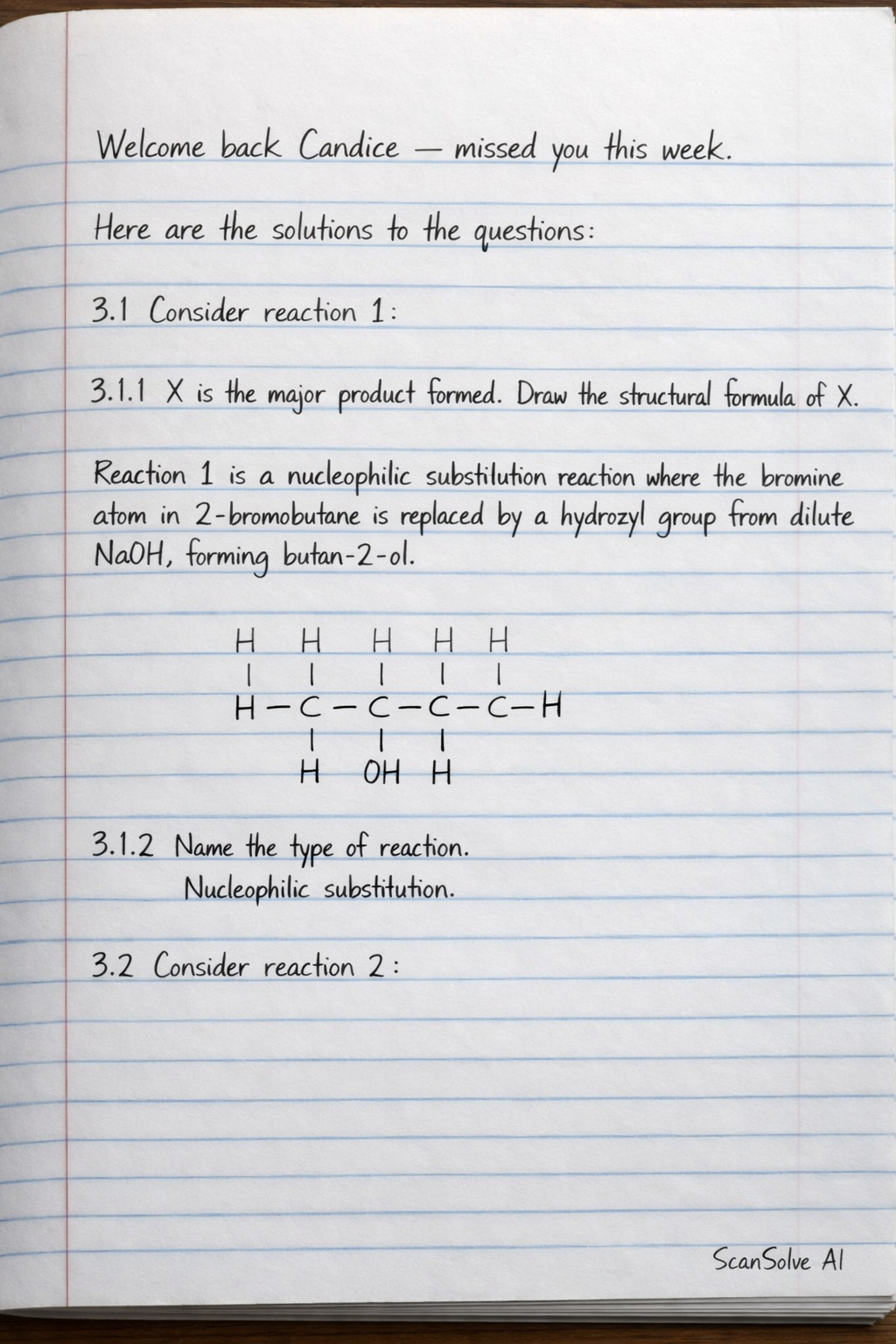
Handwritten Step-by-Step Solution
Get this as a handwritten image on WhatsApp — like a tutor wrote it for you.
Try on WhatsApp