
We read your photo as:
Complete the table by giving the values of X, Y, and Z. Elements A and B are involved in bonding. Give the formula of the compound formed.
ScanSolve AI Answer
Step-by-step solution
9 stepsHere's the solution to Question 1 (a), (b), (c), and (e) from your exam paper.
Part 1
Part a(i)
X
Complete the table above by giving the values of
Part a(ii)
Y
Part a(iii)· 3 steps
Z
Calculate X (Neutron number for Element A).
The mass number is the sum of protons and neutrons.
The value of X is .
Calculate Y (Electron number for Element A).
For a neutral atom, the number of electrons is equal to the number of protons.
The value of Y is .
Calculate Z (Mass number for Element C).
The mass number is the sum of protons and neutrons.
The value of Z is .
Part b(i)· 2 steps
Give the formula of the compound formed.
Elements A and B are involved in bonding.
Determine the valency of Element A and Element B.
Element A has 17 protons and 17 electrons (electronic configuration 2, 8, 7). It tends to gain 1 electron to form an ion with a charge of .
Element B has 12 protons and 12 electrons (electronic configuration 2, 8, 2). It tends to lose 2 electrons to form an ion with a charge of .Write the formula of the compound.
To balance the charges, two A ions ( each) are needed for every one B ion ().
The formula of the compound formed is .
Part b(ii)
Name the type of bond involved.
Element B (atomic number 12) is a metal, and Element A (atomic number 17) is a non-metal. The bond formed between a metal and a non-metal involves the transfer of electrons.
The type of bond involved is .
Part b(iii)· 2 steps
Give the electronic configuration of elements A and D.
Determine the electronic configuration for Element A.
Element A has an atomic number of 17.
The electronic configuration is .Determine the electronic configuration for Element D.
Element D has an atomic number of 8.
The electronic configuration is .
Part c· 2 steps
To which group of the Periodic Table does elements C and D fall?
Determine the group for Element C.
Element C has an atomic number of 3 (electronic configuration 2, 1). It has 1 valence electron.
Element C falls in .Determine the group for Element D.
Element D has an atomic number of 8 (electronic configuration 2, 6). It has 6 valence electrons.
Element D falls in .
Part e
How would element C be stored in the laboratory?
Element C (atomic number 3) is an alkali metal. Alkali metals are highly reactive with air and water.
Element C would be stored to prevent it from reacting with oxygen and moisture in the air.
Still stuck on this one?
Ask a follow-up, and the answer starts from this question.
More Chemistry Questions
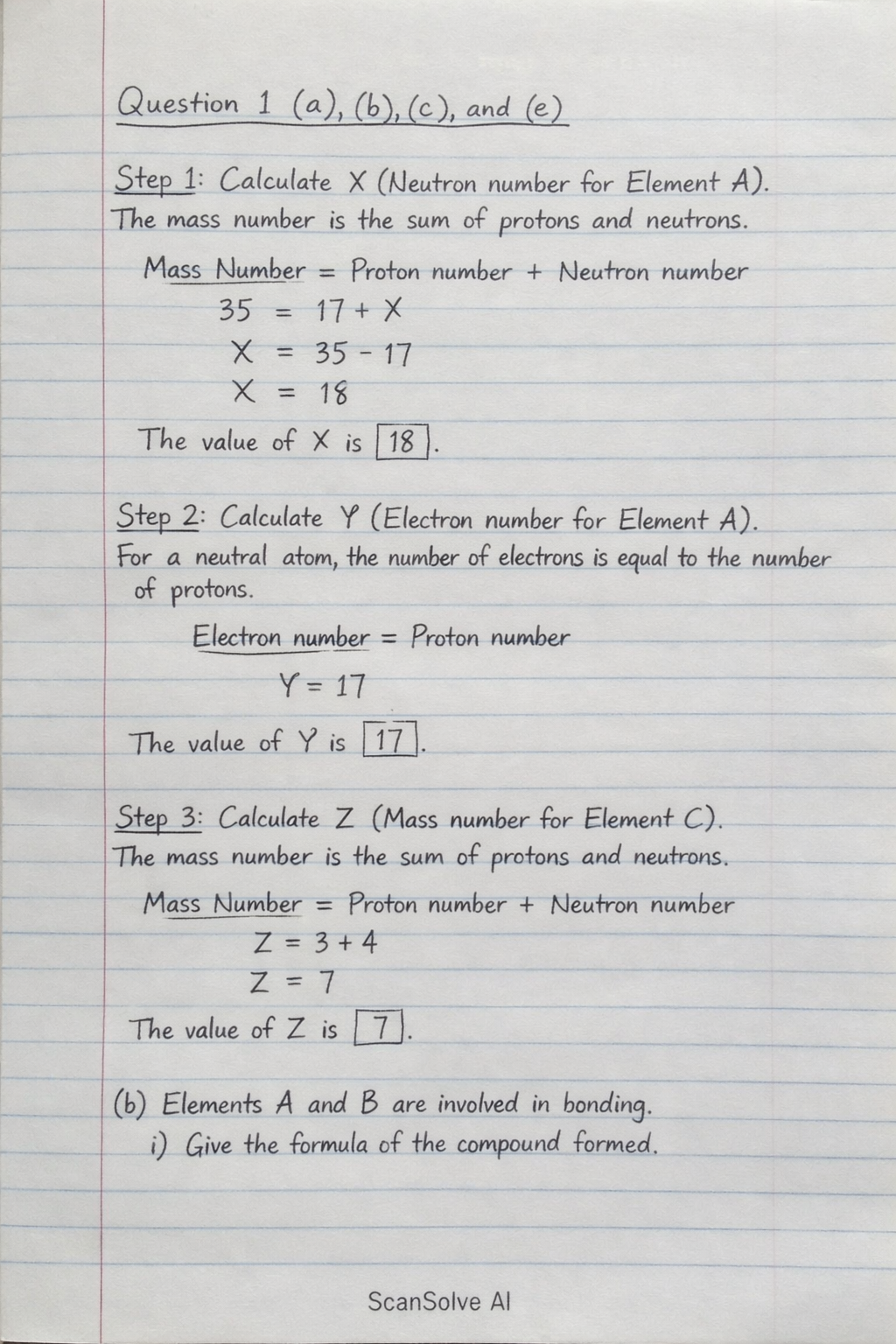
Handwritten Step-by-Step Solution
Get this as a handwritten image on WhatsApp — like a tutor wrote it for you.
Try on WhatsApp