
We read your photo as:
Elements W and Y have atomic numbers 11 and 9 respectively. a) Write the formula of the compound formed. b) State the type of bond present. c) Identify the type of structure formed.
ScanSolve AI Answer
Answers
3 partsStep-by-step solution
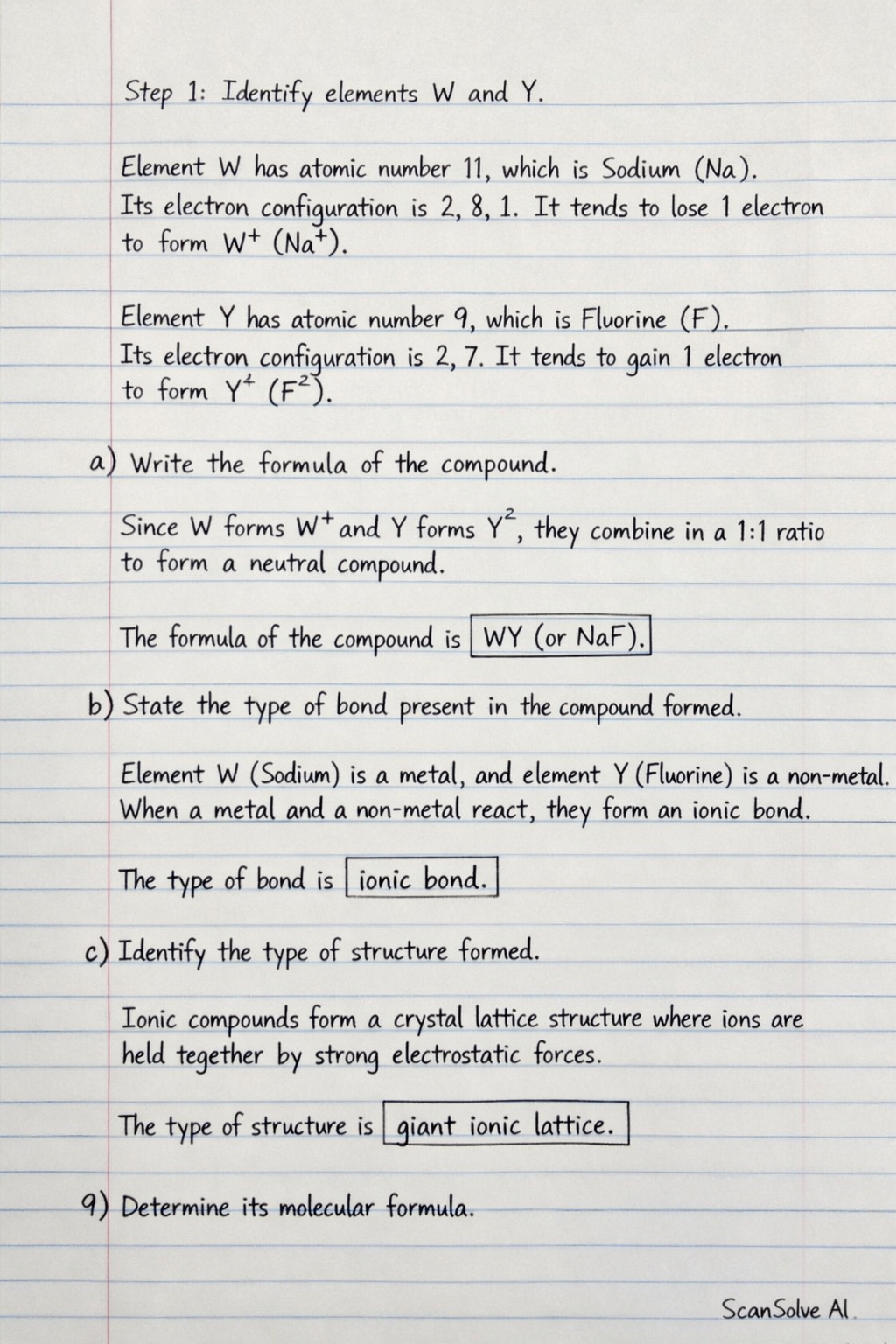
4 stepsStep 1: Identify elements W and Y.
Element W has atomic number 11, which is Sodium (Na). Its electron configuration is 2, 8, 1. It tends to lose 1 electron to form W (Na).
Element Y has atomic number 9, which is Fluorine (F). Its electron configuration is 2, 7. It tends to gain 1 electron to form Y (F).
Part a
Write the formula of the compound.
Since W forms W and Y forms Y, they combine in a 1:1 ratio to form a neutral compound.
The formula of the compound is (or NaF).
Part b
State the type of bond present in the compound formed.
Element W (Sodium) is a metal, and element Y (Fluorine) is a non-metal. When a metal and a non-metal react, they form an ionic bond.
The type of bond is .
Part c
Identify the type of structure formed.
Ionic compounds form a crystal lattice structure where ions are held together by strong electrostatic forces.
The type of structure is .
9) Determine its molecular formula.
Calculate the moles of each element in 100 g of the compound.
Assume a 100 g sample:
Mass of Carbon (C) = 40 g
Mass of Hydrogen (H) = 6.7 g
Mass of Oxygen (O) = 53.3 gMoles of C
Moles of H
Moles of ODetermine the simplest mole ratio (empirical formula).
Divide each mole value by the smallest number of moles (3.33 mol):
For C:
For H:
For O:
The empirical formula is .Calculate the empirical formula mass.
Empirical formula mass of .
Determine the molecular formula.
The relative molecular mass is given as 180.
Let be the number of empirical formula units in the molecular formula.Multiply the subscripts in the empirical formula by :
Molecular formula .
10) Explain the difference in their melting points.
Phosphorus trichloride () is a simple molecular substance. It consists of discrete molecules held together by weak intermolecular forces (van der Waals forces and dipole-dipole interactions). Only a small amount of energy is required to overcome these weak forces, leading to its low melting point of -91°C.
Sodium chloride () is an ionic compound with a giant ionic lattice structure. It consists of and ions held together by strong electrostatic forces of attraction throughout the lattice. A large amount of energy is required to overcome these strong forces to break down the lattice, resulting in its high melting point of 801°C.
Still stuck on this one?
Ask a follow-up, and the answer starts from this question.
More Chemistry Questions
Handwritten Step-by-Step Solution
Get this as a handwritten image on WhatsApp — like a tutor wrote it for you.
Try on WhatsApp