
We read your photo as:
e) (i) Select the species which is the strongest reducing agent? (ii) Write a cell diagram for the cell obtained by coupling A and B.
ScanSolve AI Answer
Step-by-step solution
5 stepsHere's the solution for question e):
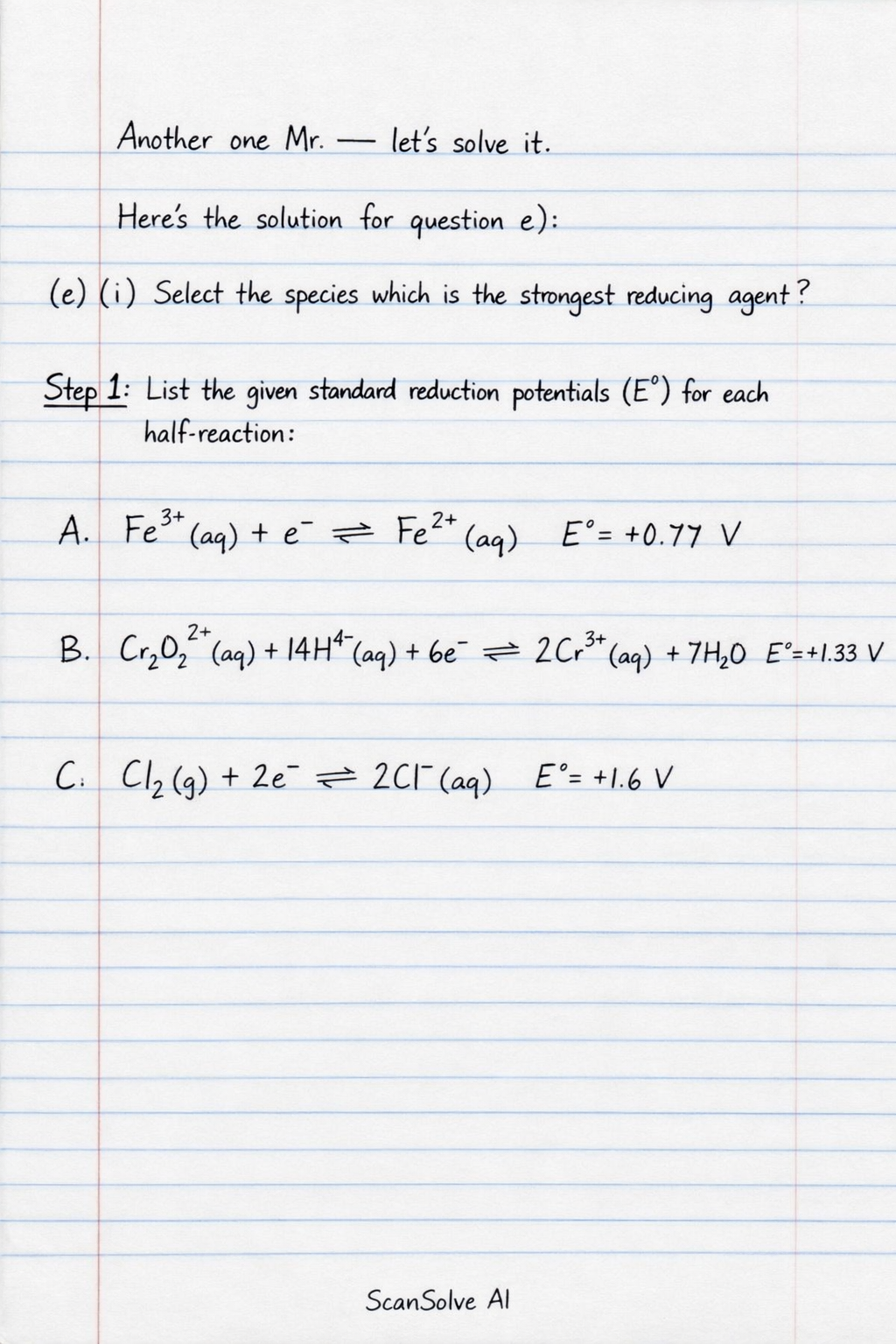
e) (i) Select the species which is the strongest reducing agent?
List the given standard reduction potentials () for each half-reaction.
- A:
- B:
- C:
Identify the strongest reducing agent.
A reducing agent is a species that gets oxidized (loses electrons). In a table of standard reduction potentials, the strongest reducing agents are the products of the half-reactions with the lowest (most negative) standard reduction potentials.
Comparing the values: (A), (B), and (C), the lowest potential is for half-reaction A.
The reducing agent in half-reaction A is .The strongest reducing agent is .
e) (ii) Write a cell diagram for the cell obtained by coupling A and B.
Determine the anode and cathode.
When coupling two half-cells, the one with the lower standard reduction potential will undergo oxidation (anode), and the one with the higher standard reduction potential will undergo reduction (cathode).
- Half-cell A:
- Half-cell B: Since , half-cell A will be the anode (oxidation) and half-cell B will be the cathode (reduction).
Write the half-reactions for the anode and cathode.
- Anode (oxidation):
- Cathode (reduction):
Construct the cell diagram.
The general convention for a cell diagram is: .
For half-cells involving only ions in solution, an inert electrode (like Platinum
Still stuck on this one?
Ask a follow-up, and the answer starts from this question.
More Chemistry Questions
Handwritten Step-by-Step Solution
Get this as a handwritten image on WhatsApp — like a tutor wrote it for you.
Try on WhatsApp