
We read your photo as:
What is electrolysis? Write the structural formula, balanced equation for complete combustion and molar mass of butane.
ScanSolve AI Answer
Answers
2 partsStep-by-step solution
8 stepsPart a· 4 steps
Butane (C₄H₁₀) is the main component of cooking gas.
-
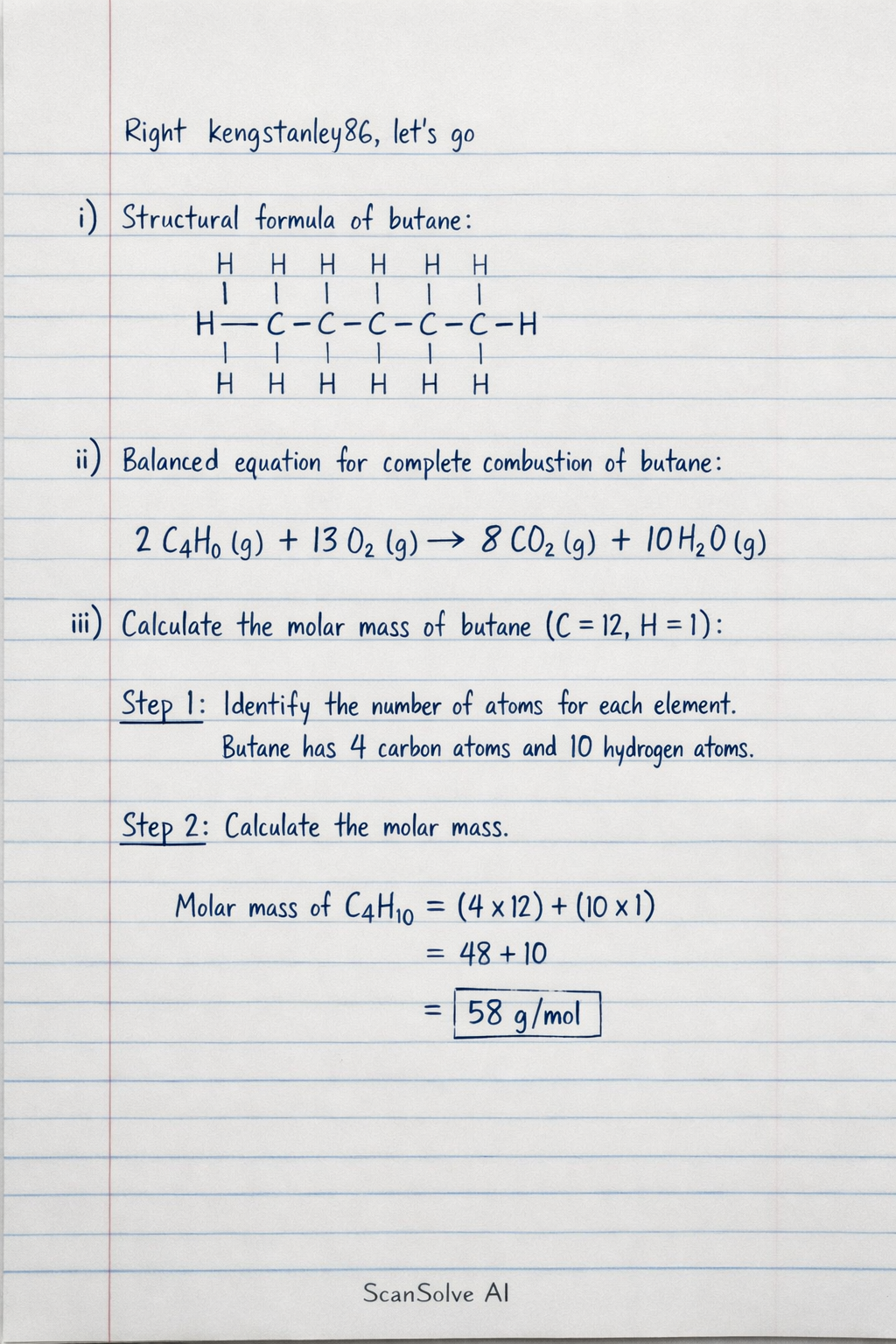
i) Structural formula of butane:
-
ii) Balanced equation for complete combustion of butane:
-
iii) Calculate the molar mass of butane (C=12, H=1):
Identify the number of atoms for each element.
Butane has 4 carbon atoms and 10 hydrogen atoms.Calculate the molar mass.
$$ \text{Molar mass of C}_4\text{H}_{10} = (4 \times 12) + (10 \times 1) $$ $$ = 48 + 10 $$ $$ = \boxed{\text{58 g/mol}} $$- iv) How many moles are present in 11.6 g of Butane?
Use the formula for moles.
$$ \text{Moles} = \frac{\text{Mass}}{\text{Molar mass}} $$Substitute the given values.
$$
\text{Moles} = \frac{11.6 \text{ g}}{58 \text{ g/mol}}
$$
$$
= \boxed{\text{0.2 mol}}
$$
Part b
**What is electrolysis?
Electrolysis is the process of using electrical energy to drive a non-spontaneous chemical reaction. It involves passing an electric current through an electrolyte (a molten or dissolved ionic compound) to decompose it into its constituent elements or other compounds.
Part c
A copper (II) sulphate solution was electrolyzed using inert electrodes.
-
i) State the different ions present in the solution: The ions present are from copper (II) sulphate and water.
-
ii) Given that a steady current of 2 A was passed through the solution for 1 hour 40 minutes, calculate the quantity of charge passed:
Convert time to seconds.
$$ \text{Time (t)} = 1 \text{ hour } 40 \text{ minutes} $$ $$ = (1 \times 60 \text{ minutes}) + 40 \text{ minutes} $$ $$ = 60 \text{ minutes} + 40 \text{ minutes} = 100 \text{ minutes} $$ $$ = 100 \times 60 \text{ seconds} = 6000 \text{ s} $$Calculate the quantity of charge (Q) using the formula .
$$ Q = 2 \text{ A} \times 6000 \text{ s} $$ $$ Q = \boxed{\text{12000 C}} $$- iii) The number of Faradays used:
Use Faraday's constant ().
$$ \text{Number of Faradays} = \frac{\text{Total charge (Q)}}{\text{Faraday's constant (F)}} $$Substitute the calculated charge.
$$
\text{Number of Faradays} = \frac{12000 \text{ C}}{96485 \text{ C/mol}}
$$
$$
\approx \boxed{\text{0.124 F}}
$$
Try one yourself
A new problem that tests the same skill.
Still stuck on this one?
Ask a follow-up, and the answer starts from this question.
More Chemistry Questions
Handwritten Step-by-Step Solution
Get this as a handwritten image on WhatsApp — like a tutor wrote it for you.
Try on WhatsApp