
We read your photo as:
Give a chemical test that distinguishes butane from but-1-ene and write the complete combustion equation for ethane.
ScanSolve AI Answer
Step-by-step solution
6 stepsPart ii· 1 step
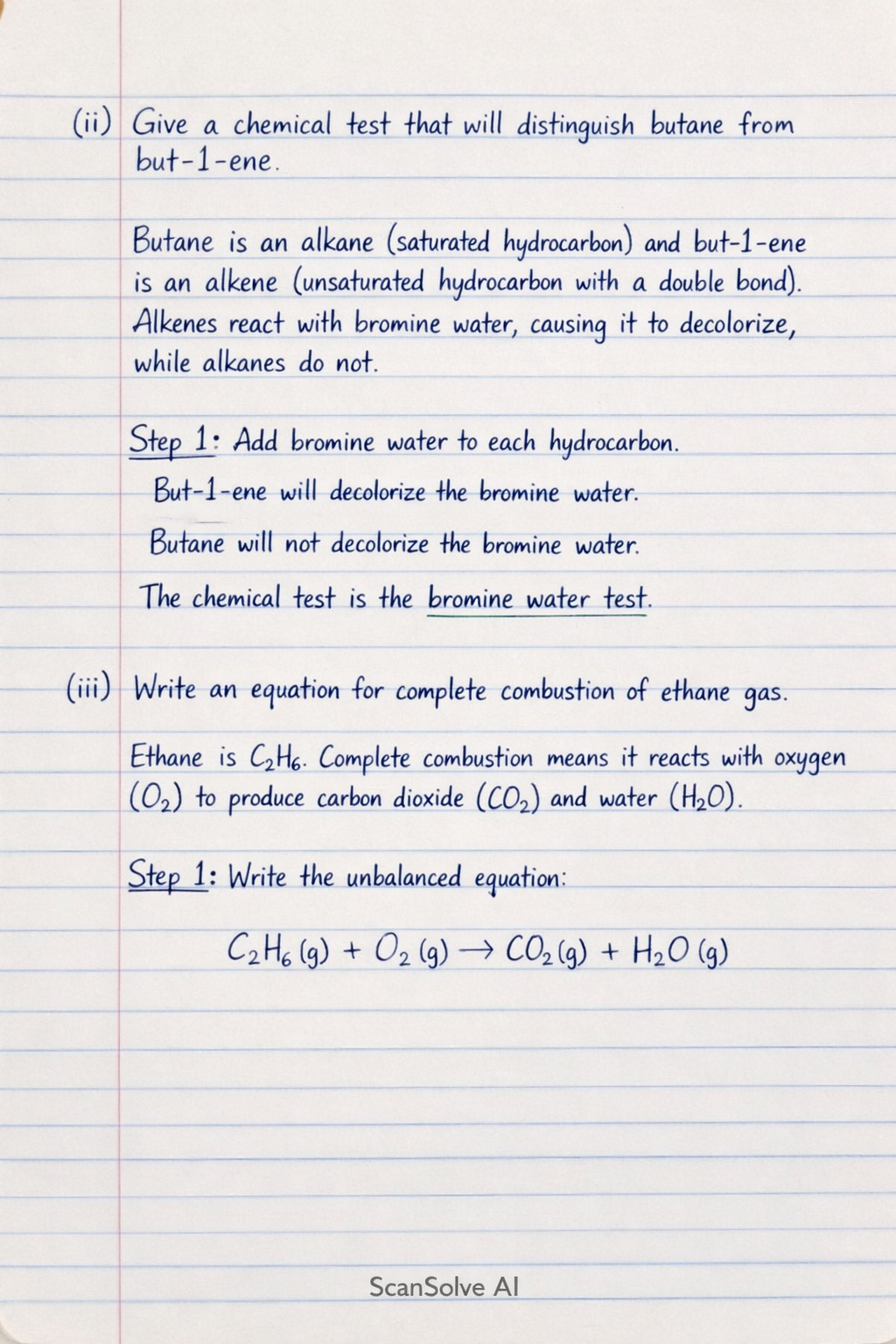
Give a chemical test that will distinguish butane from but-1-ene.
Butane is an alkane (saturated hydrocarbon), and but-1-ene is an alkene (unsaturated hydrocarbon with a double bond). Alkenes react with bromine water, causing it to decolorize, while alkanes do not.
Add bromine water to each hydrocarbon.
But-1-ene will decolorize the bromine water.
Butane will not decolorize the bromine water.
The chemical test is the bromine water test.
Part iii· 5 steps
Write an equation for complete combustion of ethane gas.
Ethane is . Complete combustion means it reacts with oxygen () to produce carbon dioxide () and water ().
Write the unbalanced equation.
Balance the carbon atoms.
There are 2 carbon atoms on the left, so put a 2 in front of .
Balance the hydrogen atoms.
There are 6 hydrogen atoms on the left, so put a 3 in front of .
Balance the oxygen atoms.
On the right, there are oxygen atoms.
To get 7 oxygen atoms on the left, we need in front of .Multiply the entire equation by 2 to remove the fraction.
The balanced equation for complete combustion of ethane gas is .
Part c(i)
Give the reagents and conditions for step II to occur.
Study the flow chart below and answer the questions that follow.
Step II shows the conversion of Ethene () to Ethane (). This is a hydrogenation reaction, where hydrogen is added across the double bond of ethene.
Reagents: Hydrogen gas ()
Conditions: Nickel catalyst and heat (or high temperature, e.g., ).
Part c(ii)
Give the industrial importance of step II.
Step II is the hydrogenation of ethene to ethane. This process is important in the manufacture of margarine (hardening of vegetable oils) and in the production of saturated hydrocarbons from unsaturated ones.
Part c(iii)
Name the compounds.
C: Ethene undergoes polymerization to form compound C. Polymerization of ethene produces polyethene (also known as polyethylene).
D: Ethene is formed from compound D through Step I, which involves . This suggests that D is a chloroalkane that undergoes dehydrohalogenation to form ethene, or D is an alkane that undergoes cracking or substitution followed by elimination. Given the context of ethene production, D is likely ethanol which undergoes dehydration to form ethene, or chloroethane which undergoes dehydrohalogenation. However, the arrow from D to Ethene with as a reactant for Step I is confusing. If is a reactant for Step I, and Ethene is the product, then D must be a compound that reacts with to form ethene. This is not a standard reaction.
Let's re-evaluate Step I. If D reacts to form Ethene, and is involved, it could be that D is an alkane (e.g., ethane) which undergoes halogenation to form chloroethane, and then chloroethane undergoes elimination to form ethene. Or, D could be ethanol, and Step I is dehydration to ethene, with being an unrelated reagent or a distractor.
Considering the common industrial production of ethene:
- Cracking of alkanes (e.g., ethane, propane, butane).
- Dehydration of ethanol.
If D is ethanol, then Step I would be dehydration. The would be extraneous or indicate a different reaction.
If D is ethane, then Step I could be cracking.
Let's assume the student's attempt "Ethanol" for D is correct and try to make sense of the diagram. If D is ethanol, then Step I is the dehydration of ethanol to ethene. The shown as a reactant for Step I is highly unusual for this conversion. However, if we ignore the for a moment and focus on the D Ethene conversion, ethanol is a common precursor.
Given the student's attempt for C as "polyethene" (which is correct) and D as "Ethanol", we will proceed with these.
Compound C: Polyethene
Compound D: Ethanol
Still stuck on this one?
Ask a follow-up, and the answer starts from this question.
More Chemistry Questions
Handwritten Step-by-Step Solution
Get this as a handwritten image on WhatsApp — like a tutor wrote it for you.
Try on WhatsApp