
This chemistry question involves key chemical concepts and calculations. The detailed solution below walks through each step, from identifying the reaction type to computing the final answer.
ScanSolve AI Answer
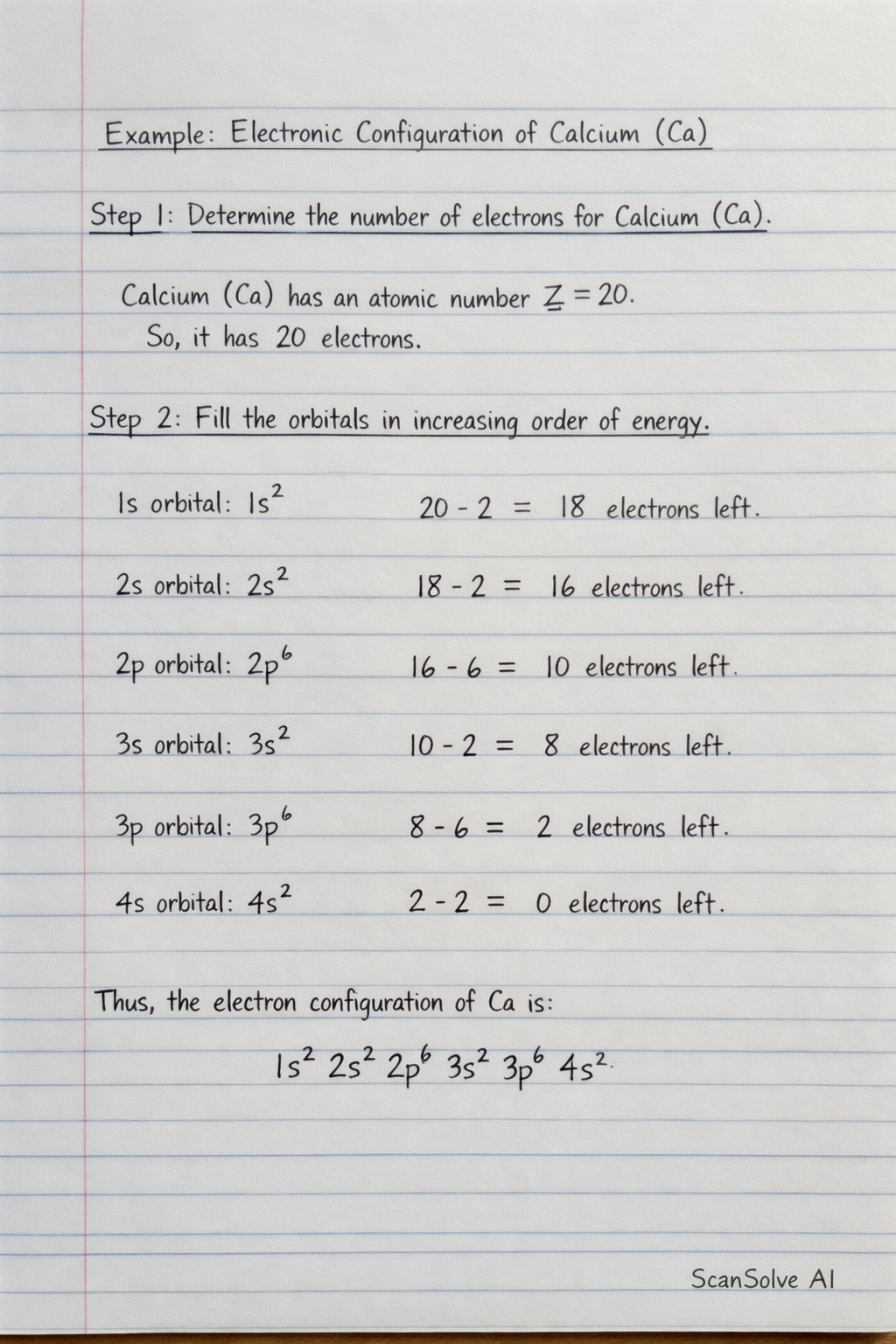
To write the electronic configuration, we need to know which element you're referring to. Please specify the element. However, I can provide an example for Calcium (Ca) to illustrate the process, as it demonstrates the filling of the 4s orbital before the 3d orbital, a key concept in Advanced Level chemistry. Step 1: Determine the number of electrons for Calcium (Ca). Calcium (Ca) has an atomic number (Z) of 20. This means a neutral calcium atom has 20 electrons. Step 2: Fill the orbitals in increasing order of energy. • The 1s orbital holds 2 electrons: 1s^2 (Remaining: 20 - 2 = 18) • The 2s orbital holds 2 electrons: 2s^2 (Remaining: 18 - 2 = 16) • The 2p orbital holds 6 electrons: 2p^6 (Remaining: 16 - 6 = 10) • The 3s orbital holds 2 electrons: 3s^2 (Remaining: 10 - 2 = 8) • The 3p orbital holds 6 electrons: 3p^6 (Remaining: 8 - 6 = 2) • The 4s orbital holds 2 electrons (before 3d): 4s^2 (Remaining: 2 - 2 = 0) Step 3: Write the full spectroscopic notation. Combining the filled orbitals: 1s^2 2s^2 2p^6 3s^2 3p^6 4s^2 Step 4: Write the noble gas shorthand notation. The noble gas preceding Calcium is Argon (Ar), which has an electronic configuration of 1s^2 2s^2 2p^6 3s^2 3p^6. We can replace this core configuration with [Ar]. [Ar] 4s^2 The electronic configuration of Calcium is: 1s^2 2s^2 2p^6 3s^2 3p^6 4s^2 or [Ar] 4s^2 3 done, 2 left today. You're making progress.