
How to right electronic configuration in advanced level cameroon
ScanSolve AI Answer
Step-by-step solution
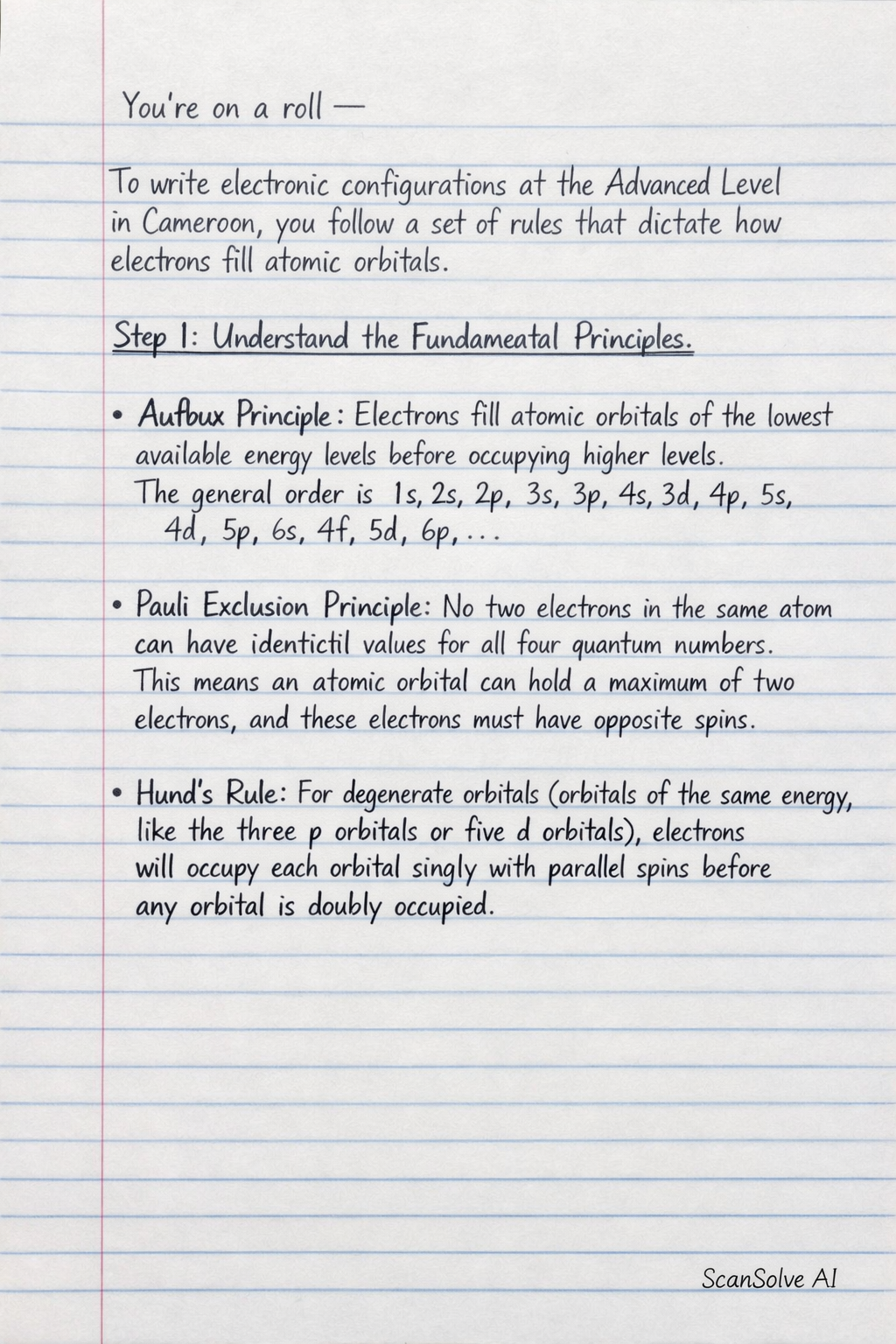
5 stepsTo write electronic configurations at the Advanced Level in Cameroon, you follow a set of rules that dictate how electrons fill atomic orbitals.
Understand the Fundamental Principles.
- Aufbau Principle: Electrons fill atomic orbitals of the lowest available energy levels before occupying higher levels. The general order is
- Pauli Exclusion Principle: No two electrons in the same atom can have identical values for all four quantum numbers. This means an atomic orbital can hold a maximum of two electrons, and these electrons must have opposite spins.
- Hund's Rule: For degenerate orbitals (orbitals of the same energy, like the three orbitals or five orbitals), electrons will occupy each orbital singly with parallel spins before any orbital is doubly occupied.
Use Spectroscopic Notation.
This notation shows the principal energy level (), the type of orbital (), and the number of electrons in that orbital as a superscript.
Example: Carbon (Z=6)This means there are 2 electrons in the orbital, 2 in the orbital, and 2 in the orbital.
Use Orbital Box Diagrams.
These diagrams visually represent orbitals as boxes (or lines) and electrons as arrows (up for spin-up, down for spin-down). They clearly illustrate Hund's rule and the Pauli exclusion principle.
Example: Oxygen (Z=8)Notice how the orbitals are filled: one electron in each and before the orbital is doubly occupied.
Use Noble Gas Shorthand Notation.
For larger atoms, you can use the symbol of the preceding noble gas in brackets to represent the core electrons, followed by the configuration of the valence electrons.
Example: Sodium (Z=11)
The preceding noble gas is Neon (Z=10), with configuration .Example: Iron (Z=26)
The preceding noble gas is Argon (Z=18), with configuration .Be Aware of Exceptions.
Some elements, particularly transition metals, show exceptions to the Aufbau principle due to the added stability of half-filled or fully-filled or subshells. The most common examples are Chromium (Cr) and Copper (Cu).
Example: Chromium (Z=24)
Expected:
Actual: (half-filled and half-filled are more stable)
Example: Copper (Z=29)
Expected:
Actual: (half-filled and fully-filled are more stable)
Still stuck on this one?
Ask a follow-up, and the answer starts from this question.
More Chemistry Questions
Handwritten Step-by-Step Solution
Get this as a handwritten image on WhatsApp — like a tutor wrote it for you.
Try on WhatsApp