
We read your photo as:
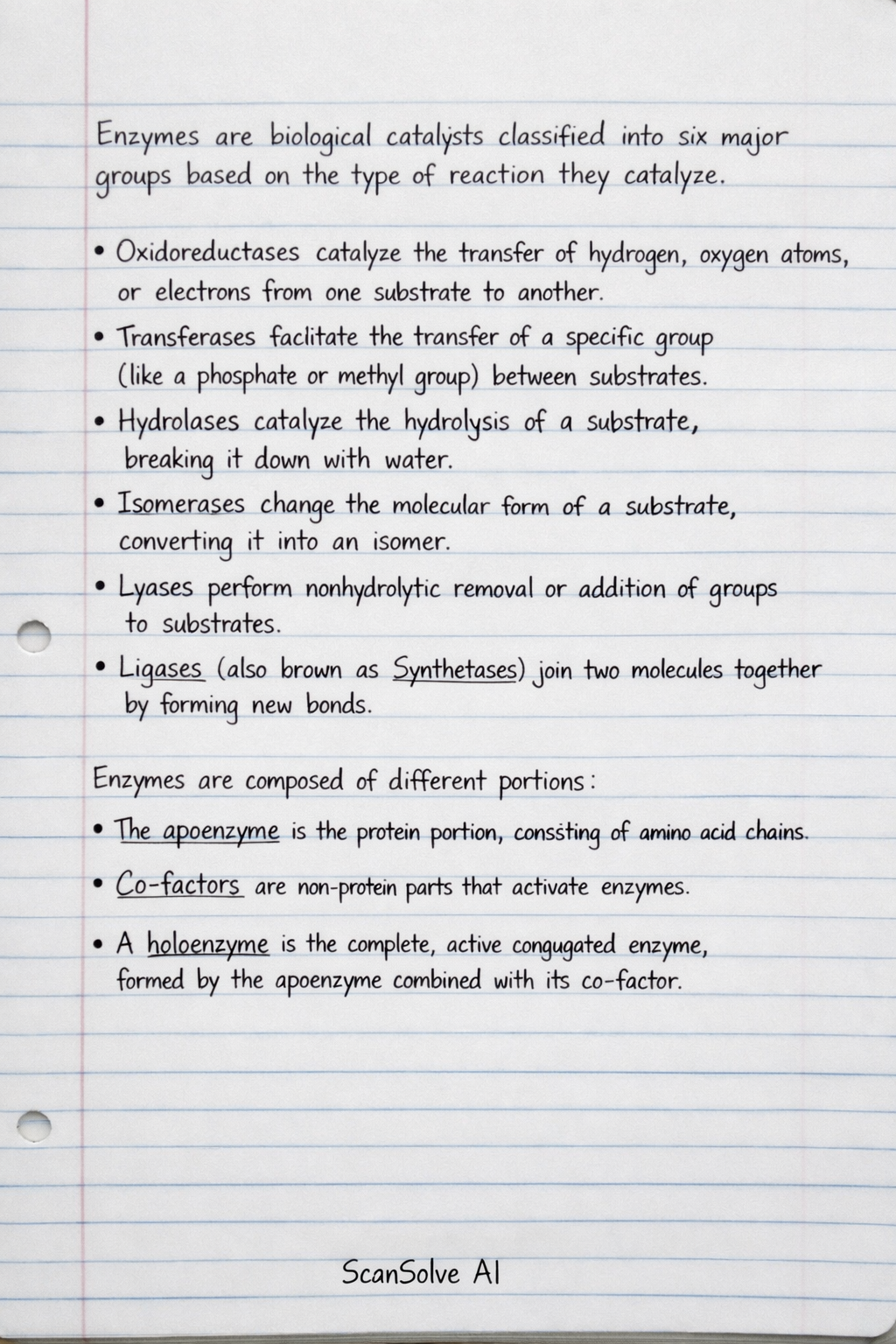
Enzymes are biological catalysts classified into six major groups based on the type of reaction they catalyze.
Chemistry
ScanSolve AI Answer
Enzymes are biological catalysts classified into six major groups based on the type of reaction they catalyze.
- Oxidoreductases catalyze the transfer of hydrogen, oxygen atoms, or electrons from one substrate to another.
- Transferases facilitate the transfer of a specific group (like a phosphate or methyl group) between substrates.
- Hydrolases catalyze the hydrolysis of a substrate, breaking it down with water.
- Isomerases change the molecular form of a substrate, converting it into an isomer.
- Lyases perform nonhydrolytic removal or addition of groups to substrates.
- Ligases (also known as Synthetases) join two molecules together by forming new bonds.
Enzymes are composed of different portions:
- The apoenzyme is the protein portion, consisting of amino acid chains.
- Co-factors are non-protein parts that activate enzymes.
- A holoenzyme is the complete, active conjugated enzyme, formed by the apoenzyme combined with its co-factor.
Was this helpful?
Still stuck on this one?
Ask a follow-up, and the answer starts from this question.
Got a different question?Ask your own question
More Chemistry Questions
QA) Enzymes are biological catalysts, which are proteins that speed up the rate of biochemical…QDefine enzymes as biocatalysts and explain their role in biochemical processes. Provide four…QDifference between enzymes and catalystQComplete the table below on enzymes.QWhat is a protein that acts as a catalyst to bring about a specific biochemical reaction, while its…
Browse by topic:Biochemistry
Handwritten Step-by-Step Solution
Get this as a handwritten image on WhatsApp — like a tutor wrote it for you.
Try on WhatsApp