Calculate the equilibrium concentration of the dianion A²⁻ in a 0.05M solution of a diprotic acid H₂A. Given data: Kₐ₁ = 2 x 10⁻⁶ and Kₐ₂ = 6 x 10⁻¹². Express the answer as Z where [A²⁻] = Z x 10⁻¹⁴ M.

Chemistry
Calculate the equilibrium concentration of the dianion A²⁻ in a 0.05M solution of a diprotic acid H₂A. Given data: Kₐ₁ = 2 x 10⁻⁶ and Kₐ₂ = 6 x 10⁻¹². Express the answer as Z where [A²⁻] = Z x 10⁻¹⁴ M.

ScanSolve AI Answer

2 steps

Answer

600

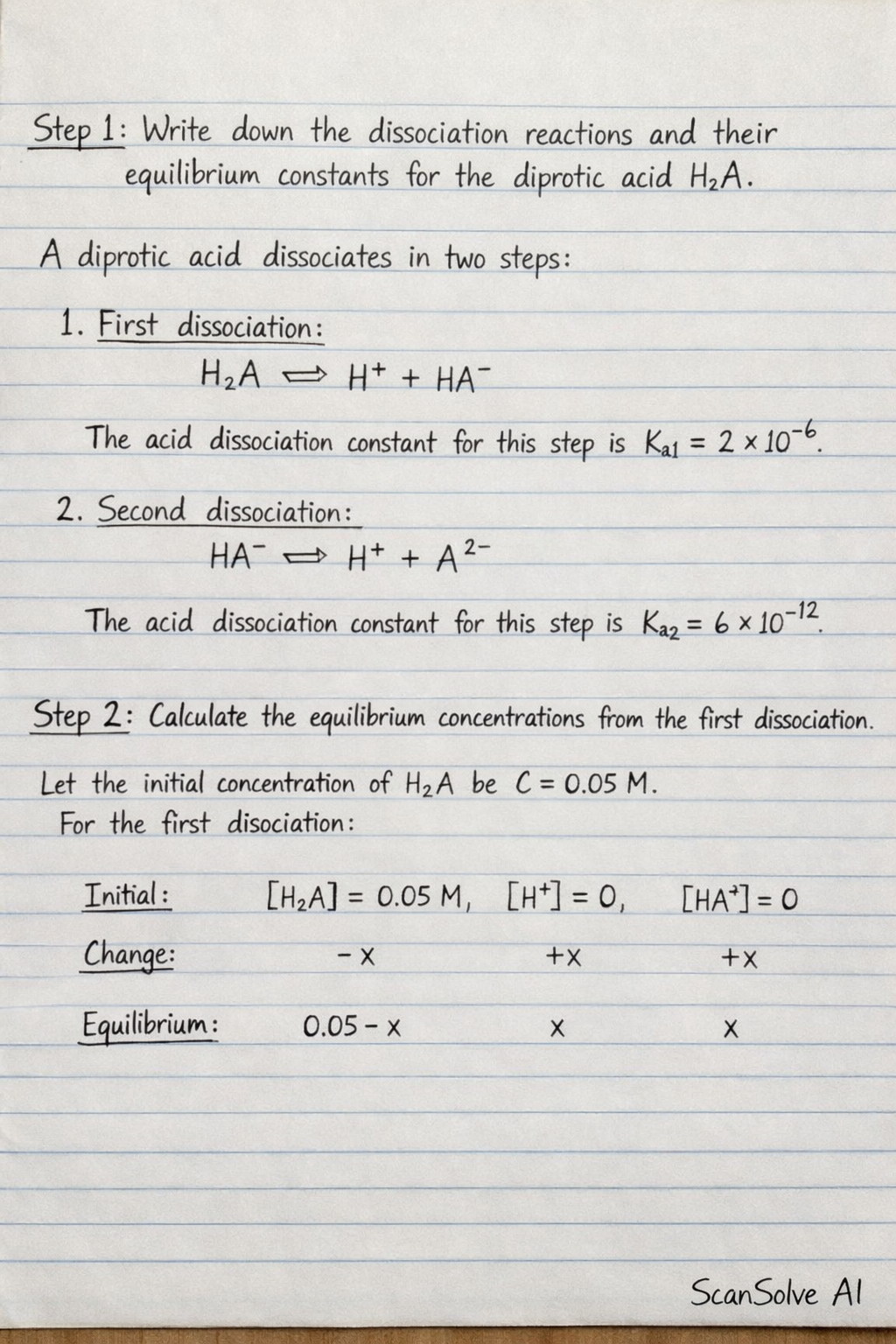
Step 1: Write down the dissociation reactions and their equilibrium constants for the diprotic acid H2_2A. A diprotic acid dissociates in two steps:

  1. First dissociation: H2AH++HAH_2A \rightleftharpoons H^+ + HA^- The acid dissociation constant for this step is Ka1=2×10⁶K_{a1} = 2 \times 10^{-6}.

  2. Second dissociation: HAH++A2HA^- \rightleftharpoons H^+ + A^{2-} The acid dissociation constant for this step is Ka2=6×10¹²K_{a2} = 6 \times 10^{-12}.

Step 2: Calculate the equilibrium concentrations from the first dissociation. Let the initial concentration of H2_2A be C=0.05C = 0.05 M. For the first dissociation: Initial: [H2A]=0.05[H_2A] = 0.05 M, [H+]=0[H^+] = 0, [HA]=0[HA^-] = 0 Change: x-x, +x+x, +x+x Equilibrium: 0.05x0.05 - x, xx, xx

The expression for Ka1K_{a1} is: Ka1=[H+][HA][H2A]=xx0.05xK_{a1} = \frac{[H^+][HA^-]}{[H_2A]} = \frac{x \cdot x}{0.05 - x} Given Ka1=2×10⁶K_{a1} = 2 \times 10^{-6}: 2×106=x20.05x2 \times 10^{-6} = \frac{x^2}{0.05 - x} Since Ka1K_{a1} is small, we can assume x0.05x \ll 0.05, so 0.05x0.050.05 - x \approx 0.05. 2×106x20.052 \times 10^{-6} \approx \frac{x^2}{0.05} x2=2×106×0.05=1×10⁷x^2 = 2 \times 10^{-6} \times 0.05 = 1 \times 10^{-7} x=1×107=10×108=10×1043.16×104Mx = \sqrt{1 \times 10^{-7}} = \sqrt{10 \times 10^{-8}} = \sqrt{10} \times 10^{-4} \approx 3.16 \times 10^{-4} M This value of xx is indeed much smaller than 0.05, so the approximation is valid. Thus, at equilibrium from the first dissociation: [H+]3.16×10⁴M[H^+] \approx 3.16 \times 10^{-4} M [HA]3.16×10⁴M[HA^-] \approx 3.16 \times 10^{-4} M

Step 3: Calculate the concentration of A2^{2-} from the second dissociation. Now consider the second dissociation, using the concentrations from the first step: HAH++A2HA^- \rightleftharpoons H^+ + A^{2-} Initial: [HA]3.16×10⁴[HA^-] \approx 3.16 \times 10^{-4}, [H+]3.16×10⁴[H^+] \approx 3.16 \times 10^{-4}, [A2]=0[A^{2-}] = 0 Change: y-y, +y+y, +y+y Equilibrium: 3.16×10⁴y3.16 \times 10^{-4} - y, 3.16×10⁴+y3.16 \times 10^{-4} + y, yy

The expression for Ka2K_{a2} is: Ka2=[H+][A2][HA]=(3.16×10⁴+y)y(3.16×10⁴y)K_{a2} = \frac{[H^+][A^{2-}]}{[HA^-]} = \frac{(3.16 \times 10^{-4} + y) \cdot y}{(3.16 \times 10^{-4} - y)} Given Ka2=6×10¹²K_{a2} = 6 \times 10^{-12}. Since Ka2K_{a2} is very small compared to Ka1K_{a1} and the concentrations, we can assume y3.16×104y \ll 3.16 \times 10^{-4}. Therefore, 3.16×10⁴+y3.16×1043.16 \times 10^{-4} + y \approx 3.16 \times 10^{-4} and 3.16×10⁴y3.16×1043.16 \times 10^{-4} - y \approx 3.16 \times 10^{-4}. Substituting these approximations: 6×10¹²(3.16×10⁴)y(3.16×10⁴)6 \times 10^{-12} \approx \frac{(3.16 \times 10^{-4}) \cdot y}{(3.16 \times 10^{-4})} 6×10¹²y6 \times 10^{-12} \approx y So, the equilibrium concentration of the dianion A2^{2-} is: [A2]=6×10¹²M[A^{2-}] = 6 \times 10^{-12} M

Step 4: Express the answer in the required format. The question asks to express the answer as Z where [A2]=Z×1014[A^{2-}] = Z \times 10^{-14} M. We have [A2]=6×10¹²[A^{2-}] = 6 \times 10^{-12} M. To convert this to the desired format: 6×10¹²M=6×102×1014M=600×1014M6 \times 10^{-12} M = 6 \times 10^2 \times 10^{-14} M = 600 \times 10^{-14} M Comparing this with Z×1014Z \times 10^{-14} M, we find Z=600Z = 600.

The final answer is 600\boxed{600}.

That's 3 down. 2 left today — send the next one.

Was this helpful?

Need help with your own homework?

Get instant step-by-step solutions to any question. Free to start.

Ask Your Question
Handwritten step-by-step solution preview

Handwritten Step-by-Step Solution

Get this as a handwritten image on WhatsApp — like a tutor wrote it for you.

Try on WhatsApp

Still have questions?

Quick Answer

Write down the dissociation reactions and their equilibrium constants for the diprotic acid H_2A.

Calculate the equilibrium concentration of the dianion A²⁻ in a 0.05M solution of a diprotic acid H₂A. Given data: Kₐ₁ = 2 x 10⁻⁶ and Kₐ₂ = 6 x 10⁻¹². Express the answer as Z where [A²⁻] = Z x 10⁻¹⁴ M.
Chemistry

This chemistry question involves key chemical concepts and calculations. The detailed solution below walks through each step, from identifying the reaction type to computing the final answer.

ScanSolve AI Answer
Step 1: Write down the dissociation reactions and their equilibrium constants for the diprotic acid H_2A. A diprotic acid dissociates in two steps: 1. First dissociation: H_2A H^+ + HA^- The acid dissociation constant for this step is K_a1 = 2 × 10^-6. 2. Second dissociation: HA^- H^+ + A^2- The acid dissociation constant for this step is K_a2 = 6 × 10^-12. Step 2: Calculate the equilibrium concentrations from the first dissociation. Let the initial concentration of H_2A be C = 0.05 M. For the first dissociation: Initial: [H_2A] = 0.05 M, [H^+] = 0, [HA^-] = 0 Change: -x, +x, +x Equilibrium: 0.05 - x, x, x The expression for K_a1 is: K_a1 = [H^+][HA^-][H_2A] = (x · x)/(0.05 - x) Given K_a1 = 2 × 10^-6: 2 × 10^-6 = (x^2)/(0.05 - x) Since K_a1 is small, we can assume x 0.05, so 0.05 - x ≈ 0.05. 2 × 10^-6 ≈ (x^2)/(0.05) x^2 = 2 × 10^-6 × 0.05 = 1 × 10^-7 x = sqrt(1 × 10^-7) = sqrt(10 × 10^-8) = sqrt(10) × 10^-4 ≈ 3.16 × 10^-4 M This value of x is indeed much smaller than 0.05, so the approximation is valid. Thus, at equilibrium from the first dissociation: [H^+] ≈ 3.16 × 10^-4 M [HA^-] ≈ 3.16 × 10^-4 M Step 3: Calculate the concentration of A^2- from the second dissociation. Now consider the second dissociation, using the concentrations from the first step: HA^- H^+ + A^2- Initial: [HA^-] ≈ 3.16 × 10^-4, [H^+] ≈ 3.16 × 10^-4, [A^2-] = 0 Change: -y, +y, +y Equilibrium: 3.16 × 10^-4 - y, 3.16 × 10^-4 + y, y The expression for K_a2 is: K_a2 = [H^+][A^2-][HA^-] = (3.16 × 10^-4 + y) · y(3.16 × 10^-4 - y) Given K_a2 = 6 × 10^-12. Since K_a2 is very small compared to K_a1 and the concentrations, we can assume y 3.16 × 10^-4. Therefore, 3.16 × 10^-4 + y ≈ 3.16 × 10^-4 and 3.16 × 10^-4 - y ≈ 3.16 × 10^-4. Substituting these approximations: 6 × 10^-12 ≈ (3.16 × 10^-4) · y(3.16 × 10^-4) 6 × 10^-12 ≈ y So, the equilibrium concentration of the dianion A^2- is: [A^2-] = 6 × 10^-12 M Step 4: Express the answer in the required format. The question asks to express the answer as Z where [A^2-] = Z × 10^-14 M. We have [A^2-] = 6 × 10^-12 M. To convert this to the desired format: 6 × 10^-12 M = 6 × 10^2 × 10^-14 M = 600 × 10^-14 M Comparing this with Z × 10^-14 M, we find Z = 600. The final answer is 600. That's 3 down. 2 left today — send the next one.