What is equilibrium? What would be observed when hydrochloric acid is added drop-wise to a solution of Bismuth chloride?
|Chemistry
What is equilibrium? What would be observed when hydrochloric acid is added drop-wise to a solution of Bismuth chloride?
ScanSolve AI Answer
Answer
FeS(s)+2HCl(aq)⟶FeCl2(aq)+H2S(g)
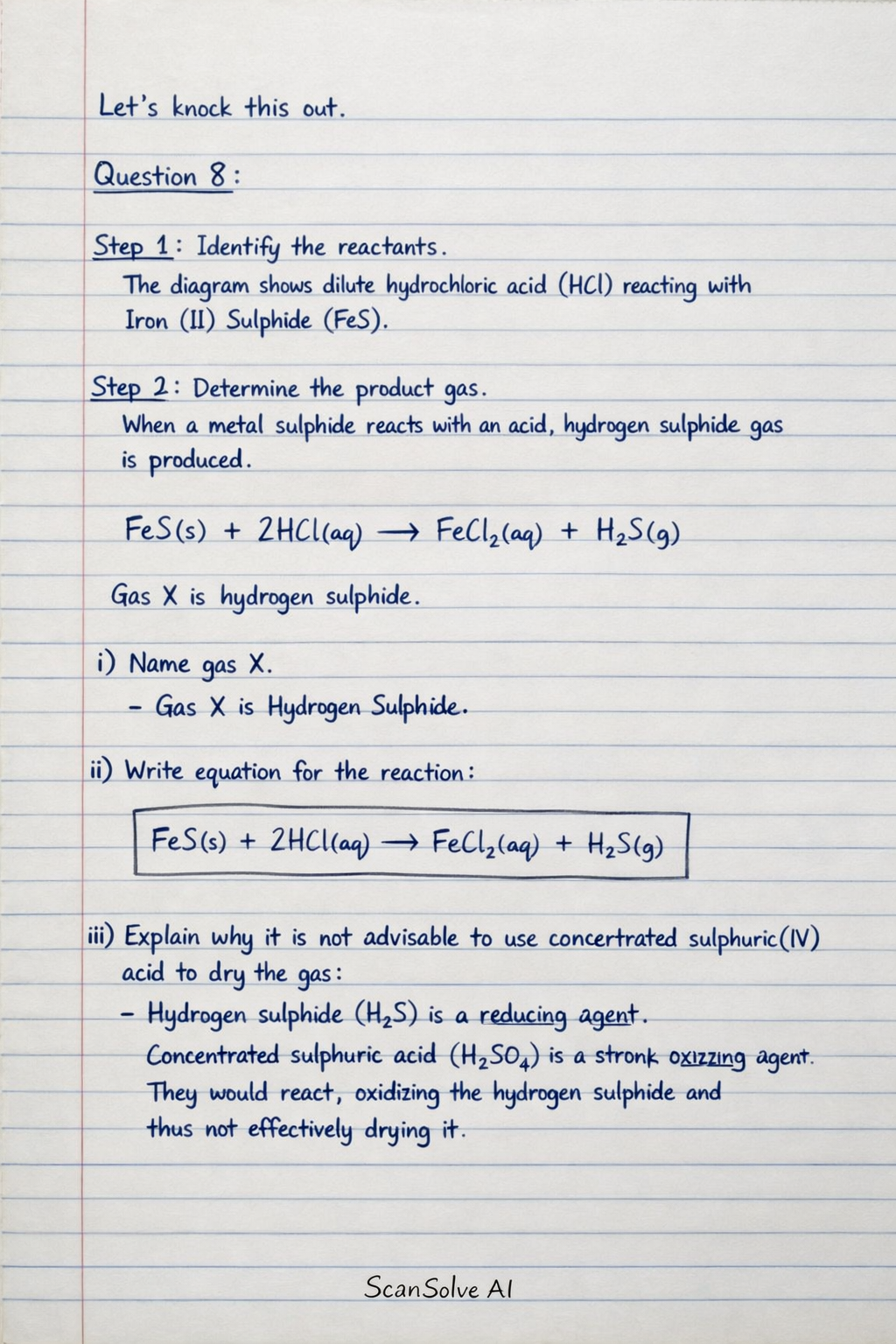
Let's knock this out.
Question 8:a)
Step 1: Identify the reactants.
The diagram shows dilute hydrochloric acid (HCl) reacting with Iron (II) Sulphide (FeS).
Step 2: Determine the product gas.
When a metal sulphide reacts with an acid, hydrogen sulphide gas is produced.
FeS(s)+2HCl(aq)⟶FeCl2(aq)+H2S(g)
Gas X is hydrogen sulphide.
i) Name gas X.
Gas X is Hydrogen Sulphide.
ii) Write equation for the reaction.
\text{FeS(s) + 2HCl(aq) \longrightarrow FeCl_2(aq) + H_2S(g)}
iii) Explain why it is not advisable to use concentrated sulphuric(IV) acid to dry the gas.
Hydrogen sulphide (H2S) is a reducing agent. Concentrated sulphuric acid (H2SO4) is a strong oxidizing agent. They would react, oxidizing the hydrogen sulphide and thus not effectively drying it.
Question 9:a) What is equilibrium?
Equilibrium is a state in a reversible reaction where the rate of the forward reaction is equal to the rate of the reverse reaction, and the concentrations of reactants and products remain constant.
b)i) What would be observed when hydrochloric acid is added drop-wise to a solution of Bismuth chloride?
The white suspension of bismuth oxychloride (BiOCl(s)) would dissolve or disappear.
ii) Give a reason for the observation in b (i).
Adding hydrochloric acid (HCl) increases the concentration of a product. According to Le Chatelier's principle, the equilibrium BiCl3(aq)+H2O(l)⇌BiOCl(s)+2HCl(aq) shifts to the left (reverse reaction) to consume the added HCl, causing the solid BiOCl to react and dissolve.
Question 10:
State the colour of the indicators in the solutions given in the table.
| Indicator | Colour in Acid | Colour in Base |
| :-------------- | :------------- | :------------- |
| Litmus | Red | (i) Blue |
| Methylorange | (ii) Red | Yellow |
| Phenolphthalein | (iii) Colourless | (iv) Pink |
(i) Blue
(ii) Red
(iii) Colourless
(iv) Pink
Question 11:a) Name the:
i) Colourless gas.
From Step I: Copper (II) oxide + Carbon powder ⟶ Colourless gas + Brown solid.
CuO(s)+C(s)⟶Cu(s)+CO(g)
The colourless gas is carbon monoxide.
Carbon monoxide
ii) Brown solid.
From Step I: The brown solid is copper.
Copper
iii) Brown gas.
From Step II: Brown solid (Copper) + Brown gas ⟶ Blue solution. Copper reacts with nitric acid to form a blue solution (copper(II) nitrate) and nitrogen dioxide (a brown gas).
Nitrogen dioxide
b) Write the equation for the reaction in step I.
CuO(s) + C(s) \longrightarrowCu(s) + CO(g)
Question 12:a) Name process A.
Process A is the conversion of Petroleum to Ethene (CH2=CH2). This process is called cracking.
Cracking
b) Identify substances Q, R and S.
Q: Ethene (CH2=CH2) reacts with concentrated sulphuric acid and water to form Q. This is the hydration of ethene to ethanol.
CH2=CH2+H2OConc.H2SO4CH3CH2OH
Q is Ethanol.
R: Q (Ethanol) reacts with sodium (Na) to produce hydrogen gas (H2) and R.
2CH3CH2OH+2Na⟶2CH3CH2ONa+H2
R is Sodium ethoxide.
S: Q (Ethanol) undergoes a reaction with excess concentrated sulphuric acid at 170∘C to form S. This is the dehydration of ethanol to ethene.
CH3CH2OHExcessH2SO4,170\circCCH2=CH2+H2O
S is Ethene.
Question 13:
State one use of each of the acids given to complete the table:
The table for question 13 is not provided in the image. Assuming the question refers to common acids or acids mentioned in the paper (e.g., Hydrochloric acid, Sulphuric acid, Nitric acid):
Hydrochloric acid (HCl): Used for cleaning metal surfaces (pickling).
Sulphuric acid (H₂SO₄): Used in car batteries or for the production of fertilizers.
Nitric acid (HNO₃): Used in the production of fertilizers or explosives.
Send me the next one 📸
Was this helpful?
Need help with your own homework?
Get instant step-by-step solutions to any question. Free to start.
This chemistry question involves key chemical concepts and calculations. The detailed solution below walks through each step, from identifying the reaction type to computing the final answer.
ScanSolve AI Answer
Let's knock this out. Question 8: a) Step 1: Identify the reactants. The diagram shows dilute hydrochloric acid (HCl) reacting with Iron (II) Sulphide (FeS). Step 2: Determine the product gas. When a metal sulphide reacts with an acid, hydrogen sulphide gas is produced. FeS(s) + 2HCl(aq) FeCl_2(aq) + H_2S(g) Gas X is hydrogen sulphide. i) Name gas X. Gas X is Hydrogen Sulphide*. ii) Write equation for the reaction. FeS(s) + 2HCl(aq) FeCl_2(aq) + H_2S(g) iii) Explain why it is not advisable to use concentrated sulphuric(IV) acid to dry the gas. Hydrogen sulphide (H_2S) is a reducing agent. Concentrated sulphuric acid (H_2SO_4) is a strong oxidizing agent*. They would react, oxidizing the hydrogen sulphide and thus not effectively drying it. Question 9: a) What is equilibrium? Equilibrium is a state in a reversible reaction where the rate of the forward reaction is equal to the rate of the reverse reaction, and the concentrations of reactants and products remain constant*. b) i) What would be observed when hydrochloric acid is added drop-wise to a solution of Bismuth chloride? The white suspension of bismuth oxychloride (BiOCl(s)) would dissolve or disappear*. ii) Give a reason for the observation in b (i). Adding hydrochloric acid (HCl) increases the concentration of a product. According to Le Chatelier's principle, the equilibrium BiCl_3(aq) + H_2O(l) BiOCl(s) + 2HCl(aq) shifts to the left* (reverse reaction) to consume the added HCl, causing the solid BiOCl to react and dissolve. Question 10: State the colour of the indicators in the solutions given in the table. | Indicator | Colour in Acid | Colour in Base | | :-------------- | :------------- | :------------- | | Litmus | Red | (i) Blue | | Methylorange | (ii) Red | Yellow | | Phenolphthalein | (iii) Colourless | (iv) Pink | (i) Blue* (ii) Red* (iii) Colourless* (iv) Pink* Question 11: a) Name the: i) Colourless gas. From Step I: Copper (II) oxide + Carbon powder Colourless gas + Brown solid. CuO(s) + C(s) Cu(s) + CO(g) The colourless gas is carbon monoxide. Carbon monoxide* ii) Brown solid. From Step I: The brown solid is copper. Copper* iii) Brown gas. From Step II: Brown solid (Copper) + Brown gas Blue solution. Copper reacts with nitric acid to form a blue solution (copper(II) nitrate) and nitrogen dioxide (a brown gas). Nitrogen dioxide* b) Write the equation for the reaction in step I. CuO(s) + C(s) Cu(s) + CO(g) Question 12: a) Name process A. Process A is the conversion of Petroleum to Ethene (CH_2=CH_2). This process is called cracking*. Cracking* b) Identify substances Q, R and S. Q: Ethene (CH_2=CH_2) reacts with concentrated sulphuric acid and water to form Q. This is the hydration of ethene to ethanol. CH_2=CH_2 + H_2O Conc. H_2SO_4 CH_3CH_2OH Q is Ethanol. R: Q (Ethanol) reacts with sodium (Na) to produce hydrogen gas (H_2) and R. 2CH_3CH_2OH + 2Na 2CH_3CH_2ONa + H_2 R is Sodium ethoxide. S: Q (Ethanol) undergoes a reaction with excess concentrated sulphuric acid at 170^ to form S. This is the dehydration of ethanol to ethene. CH_3CH_2OH Excess H_2SO_4, 170^ CH_2=CH_2 + H_2O S is Ethene. Question 13: State one use of each of the acids given to complete the table: The table for question 13 is not provided in the image. Assuming the question refers to common acids or acids mentioned in the paper (e.g., Hydrochloric acid, Sulphuric acid, Nitric acid): Hydrochloric acid (HCl): Used for cleaning metal surfaces (pickling)*. Sulphuric acid (H₂SO₄): Used in car batteries or for the production of fertilizers*. Nitric acid (HNO₃): Used in the production of fertilizers or explosives*. Send me the next one 📸