
We read your photo as:
Which experiment listed in the table is most similar to Experiment 4 and what is the effect of the difference in conditions?
ScanSolve AI Answer
Answer
Step-by-step solution
4 stepsIdentify the conditions for Experiment 4 from the table.
- Concentration of HCl: 1.5 mol/dm³
- Volume of HCl: 400 cm³
- State of Division of HCl (referring to the zinc): Granules
- Temperature: 25 °C
- Reaction Time: x min
Compare Experiment 4 with another experiment where most conditions are similar.
Let's compare Experiment 4 with Experiment 2:
- Experiment 2:
- Concentration of HCl: 1.5 mol/dm³
- Volume of HCl: 200 cm³
- State of Division of HCl (zinc): Granules
- Temperature: 25 °C
- Reaction Time: 14 min
- Experiment 2:
Analyze the differences and similarities between Experiment 2 and Experiment 4.
- Similarities: Both experiments use the same concentration of HCl (1.5 mol/dm³), the same state of division for the zinc (Granules), and the same temperature (25 °C). The problem also states that the same mass of zinc is used in all experiments, and zinc is the limiting reactant.
- Difference: The only difference is the volume of HCl, which is 200 cm³ in Experiment 2 and 400 cm³ in Experiment 4.
Determine the effect of the difference on the reaction time.
Since the concentration of HCl, the surface area of the zinc (due to the "Granules" state and same mass), and the temperature are all identical, the rate of reaction will be the same in both experiments. The volume of the excess reactant (HCl) does not affect the rate of reaction as long as its concentration is constant and it remains in excess, which it does. Since the same mass of zinc is used in both experiments, and the rate at which it reacts is the same, the total time taken for all the zinc to react will also be the same.
Therefore, the reaction time for Experiment 4 will be the same as for Experiment 2.
The value of x in experiment 4 is .
Try one yourself
A new problem that tests the same skill.
Still stuck on this one?
Ask a follow-up, and the answer starts from this question.
More Chemistry Questions
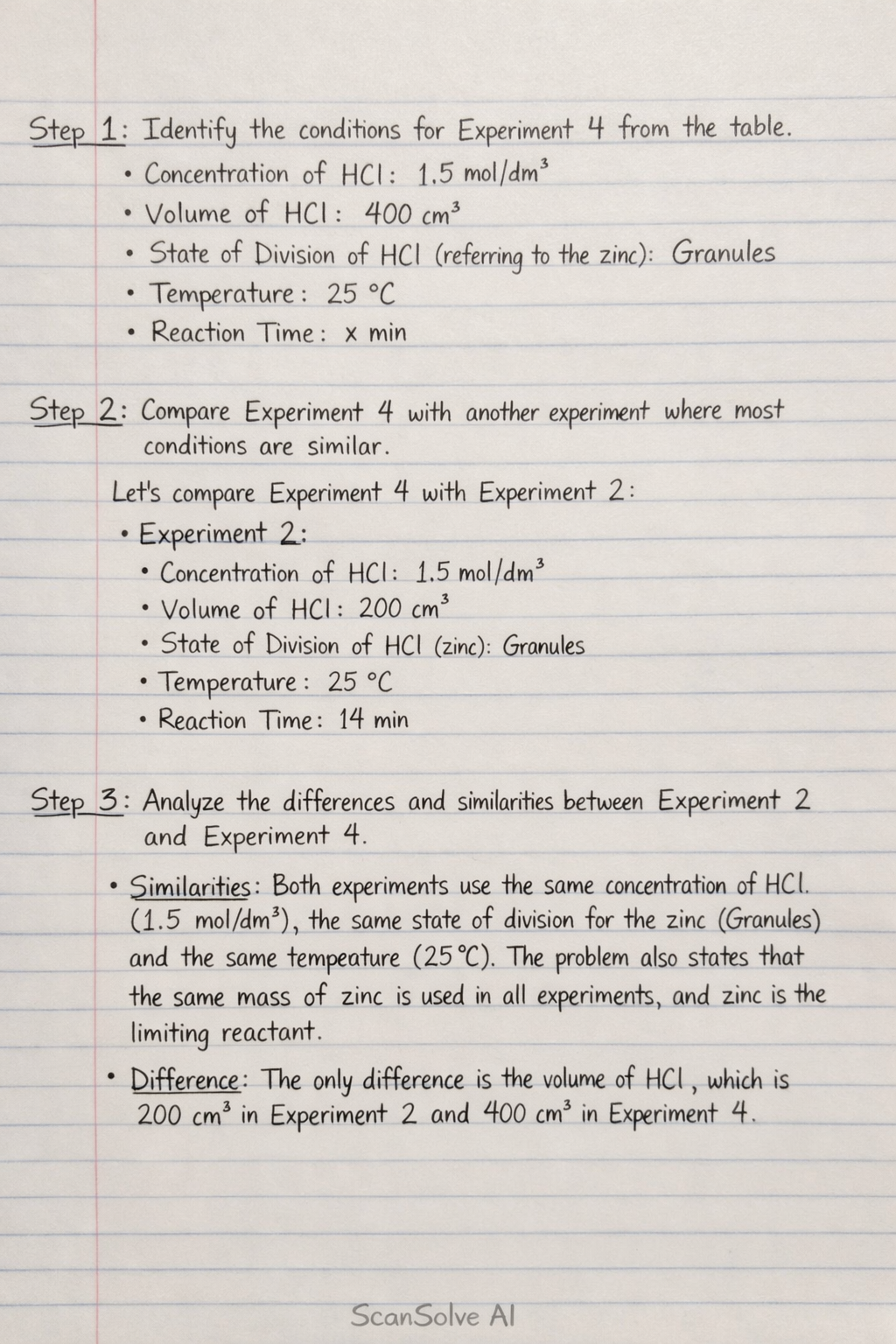
Handwritten Step-by-Step Solution
Get this as a handwritten image on WhatsApp — like a tutor wrote it for you.
Try on WhatsApp