
We read your photo as:
Describe the results of Experiment 4, focusing on the role of catalase concentration and substrate amount in the reaction rate.
ScanSolve AI Answer
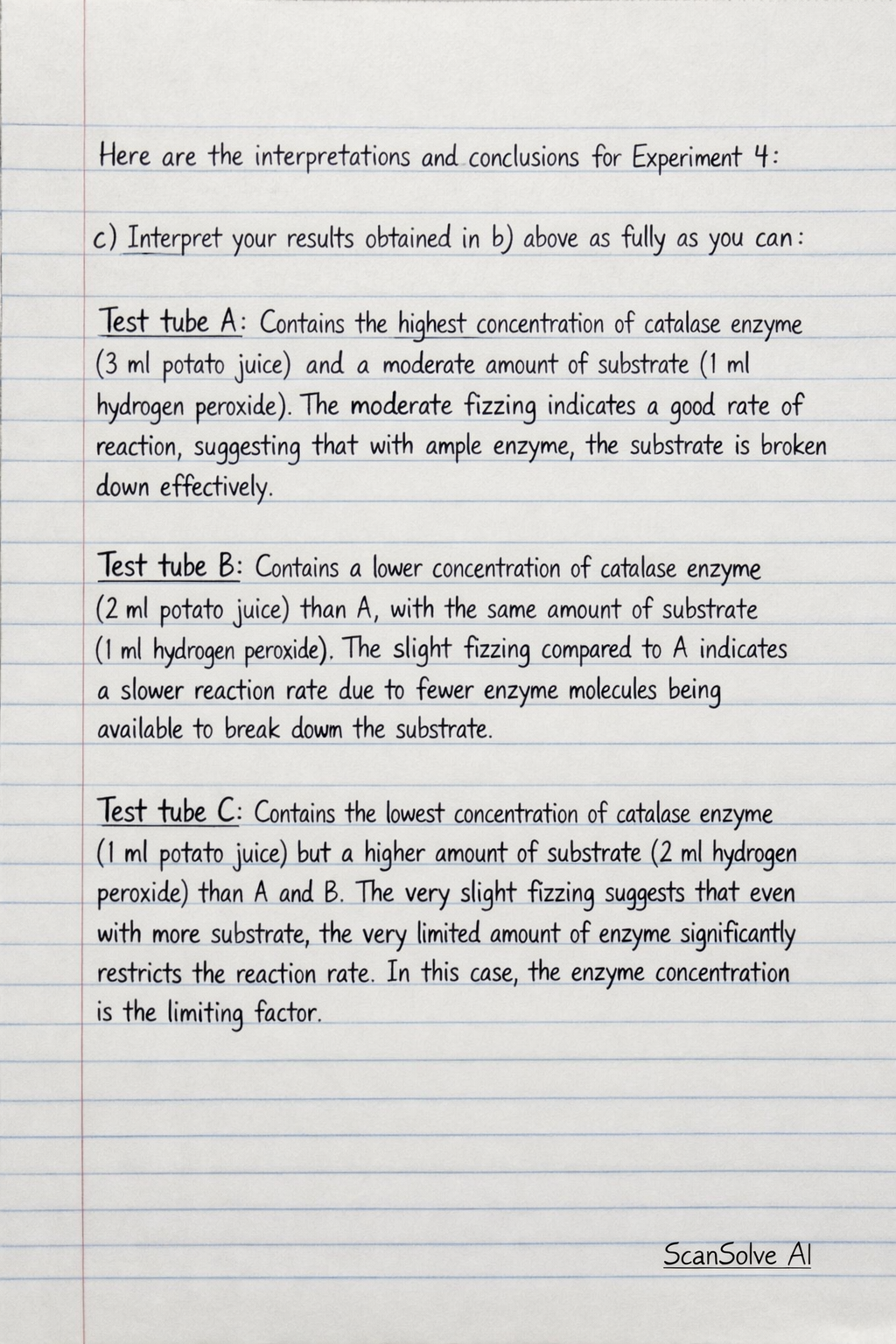
Here are the interpretations and conclusions for Experiment 4:
c) Interpret your results obtained in b) above as fully as you can
- Test tube A: Contains the highest concentration of catalase enzyme (3 ml potato juice) and a moderate amount of substrate (1 ml hydrogen peroxide). The moderate fizzing indicates a good rate of reaction, suggesting that with ample enzyme, the substrate is broken down effectively.
- Test tube B: Contains a lower concentration of catalase enzyme (2 ml potato juice) than A, with the same amount of substrate (1 ml hydrogen peroxide). The slight fizzing compared to A indicates a slower reaction rate due to fewer enzyme molecules being available to break down the substrate.
- Test tube C: Contains the lowest concentration of catalase enzyme (1 ml potato juice) but a higher amount of substrate (2 ml hydrogen peroxide) than A and B. The very slight fizzing suggests that even with more substrate, the very limited amount of enzyme significantly restricts the reaction rate. In this case, the enzyme concentration is the limiting factor.
- Test tube D: Contains no catalase enzyme (0 ml potato juice) but the highest amount of substrate (3 ml hydrogen peroxide). The no fizzing result confirms that the catalase enzyme is absolutely necessary for the decomposition of hydrogen peroxide into water and oxygen. Without the enzyme, the reaction does not occur at a noticeable rate.
d) What can you conclude on effect of substrate concentration on the rate of catalase activities?
When the enzyme concentration is sufficient, increasing the substrate concentration (hydrogen peroxide) generally increases the rate of catalase activity (degree of fizzing). This is because more substrate molecules are available to bind with the enzyme's active sites, leading to a faster rate of product formation. However, if the enzyme concentration is very low, increasing the substrate concentration may not significantly increase the reaction rate, as the enzyme becomes the limiting factor.
e) What can you conclude on effect of enzyme concentration on the rate of catalase activities?
Increasing the enzyme concentration (potato juice/catalase) directly increases the rate of catalase activity (degree of fizzing), provided there is sufficient substrate available. This is evident by comparing Test tube A (3 ml enzyme, moderate fizzing) and Test tube B (2 ml enzyme, slight fizzing) with the same substrate amount. More enzyme molecules mean more active sites are available to bind with and break down the hydrogen peroxide, leading to a faster reaction. The absence of enzyme (Test tube D) results in no reaction.
Still stuck on this one?
Ask a follow-up, and the answer starts from this question.
More Biology Questions
Handwritten Step-by-Step Solution
Get this as a handwritten image on WhatsApp — like a tutor wrote it for you.
Try on WhatsApp