This chemistry question involves key chemical concepts and calculations. The detailed solution below walks through each step, from identifying the reaction type to computing the final answer.
ScanSolve AI Answer
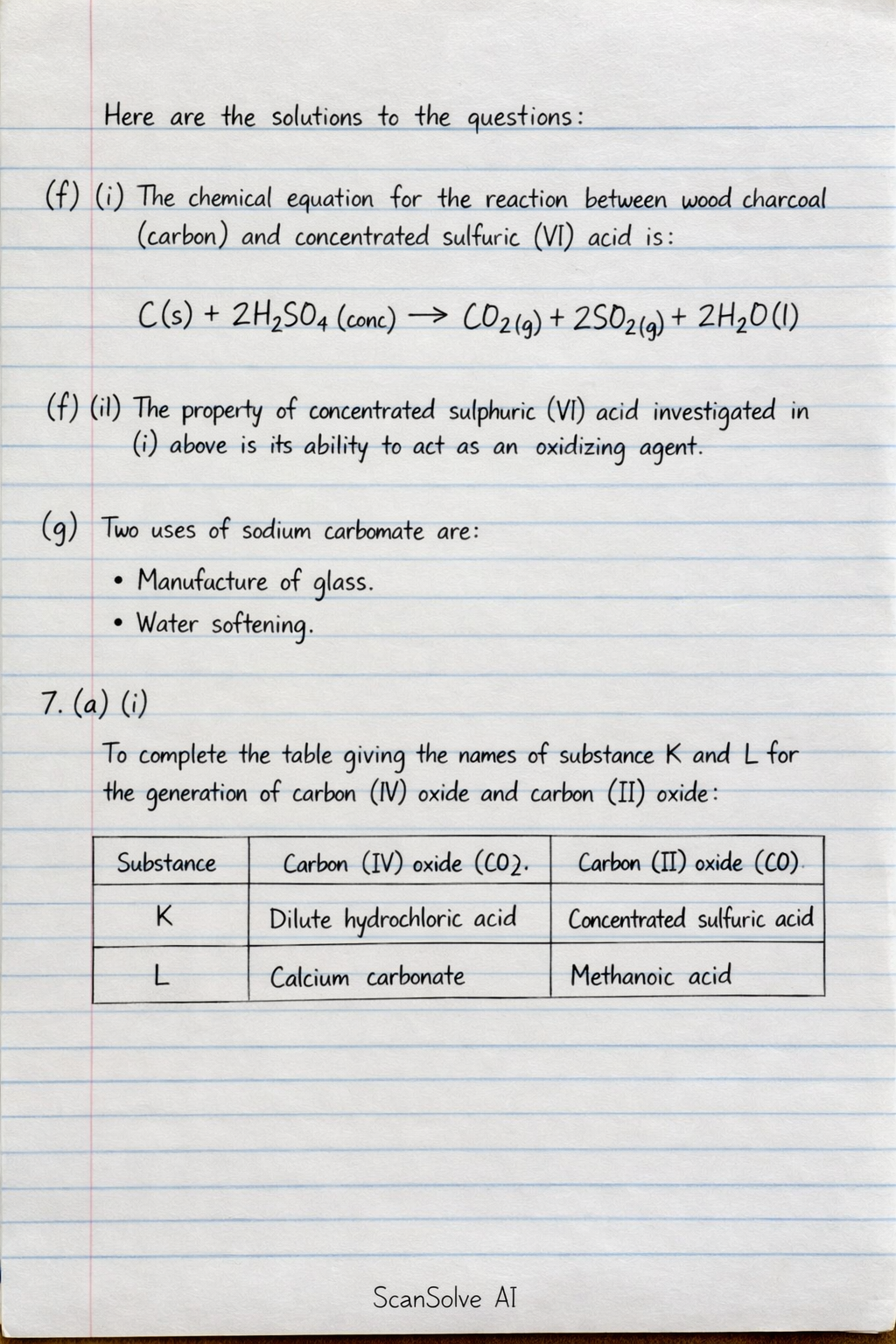
Here are the solutions to the questions:
(f) (i) The chemical equation for the reaction between wood charcoal (carbon) and concentrated sulfuric (VI) acid is:
$$ \text{C(s)} + 2\text{H}_2\text{SO}_4\text{(conc)} \xrightarrow{\text{heat}} \text{CO}_2\text{(g)} + 2\text{SO}_2\text{(g)} + 2\text{H}_2\text{O(l)} $$
(f) (ii) The property of concentrated sulphuric (VI) acid investigated in (i) above is its ability to act as an oxidizing agent.
(g) Two uses of sodium carbonate are:
• Manufacture of glass.
• Water softening.
7. (a) (i)
To complete the table giving the names of substance K and L for the generation of carbon (IV) oxide and carbon (II) oxide:
| Substance | Carbon (IV) oxide ($\text{CO}_2$) | Carbon (II) oxide ($\text{CO}$) |
| :-------- | :--------------------------------- | :------------------------------- |
| K | Dilute hydrochloric acid | Concentrated sulfuric acid |
| L | Calcium carbonate | Methanoic acid |
(ii) To complete the diagram to show how a sample of carbon (II) oxide can be collected:
The delivery tube from the gas generating flask should be extended into a trough of water. An inverted gas jar or test tube, initially filled with water, is then placed over the end of the delivery tube. As carbon (II) oxide is generated, it will bubble into the inverted container, displacing the water. This method is called downward displacement of water.
(iii) Two ways that can be used to distinguish carbon (IV) oxide from carbon (II) oxide are:
1. Limewater test: Bubble each gas through limewater (calcium hydroxide solution, $\text{Ca(OH)}_2\text{(aq)}$). Carbon (IV) oxide ($\text{CO}_2$) will turn the limewater milky due to the formation of insoluble calcium carbonate ($\text{CaCO}_3$), while carbon (II) oxide ($\text{CO}$) will have no effect.
$$ \text{CO}_2\text{(g)} + \text{Ca(OH)}_2\text{(aq)} \rightarrow \text{CaCO}_3\text{(s)} + \text{H}_2\text{O(l)} $$
2. Combustion test: Ignite a sample of each gas. Carbon (II) oxide ($\text{CO}$) is flammable and will burn with a pale blue flame to form carbon (IV) oxide ($\text{CO}_2$), whereas carbon (IV) oxide ($\text{CO}_2$) is non-flammable and will not burn.
$$ 2\text{CO(g)} + \text{O}_2\text{(g)} \xrightarrow{\text{ignition}} 2\text{CO}_2\text{(g)} $$
(f) (i) The chemical equation for the reaction between wood charcoal (carbon) and concentrated sulfuric (VI) acid is:
|Chemistry
(f) (i) The chemical equation for the reaction between wood charcoal (carbon) and concentrated sulfuric (VI) acid is:
ScanSolve AI Answer
Here are the solutions to the questions:
(f) (i) The chemical equation for the reaction between wood charcoal (carbon) and concentrated sulfuric (VI) acid is:
C(s)+2H2SO4(conc)heatCO2(g)+2SO2(g)+2H2O(l)
(f) (ii) The property of concentrated sulphuric (VI) acid investigated in (i) above is its ability to act as an oxidizing agent.
(g) Two uses of sodium carbonate are:
• Manufacture of glass.
• Water softening.
7. (a) (i)
To complete the table giving the names of substance K and L for the generation of carbon (IV) oxide and carbon (II) oxide:
(ii) To complete the diagram to show how a sample of carbon (II) oxide can be collected:
The delivery tube from the gas generating flask should be extended into a trough of water. An inverted gas jar or test tube, initially filled with water, is then placed over the end of the delivery tube. As carbon (II) oxide is generated, it will bubble into the inverted container, displacing the water. This method is called downward displacement of water.
(iii) Two ways that can be used to distinguish carbon (IV) oxide from carbon (II) oxide are:
Limewater test: Bubble each gas through limewater (calcium hydroxide solution, Ca(OH)2(aq)). Carbon (IV) oxide (CO2) will turn the limewater milky due to the formation of insoluble calcium carbonate (CaCO3), while carbon (II) oxide (CO) will have no effect.
CO2(g)+Ca(OH)2(aq)→CaCO3(s)+H2O(l)
Combustion test: Ignite a sample of each gas. Carbon (II) oxide (CO) is flammable and will burn with a pale blue flame to form carbon (IV) oxide (CO2), whereas carbon (IV) oxide (CO2) is non-flammable and will not burn.
2CO(g)+O2(g)ignition2CO2(g)
Need help with your own homework?
Get instant step-by-step solutions to any question. Free to start.