

This chemistry question involves key chemical concepts and calculations. The detailed solution below walks through each step, from identifying the reaction type to computing the final answer.
ScanSolve AI Answer
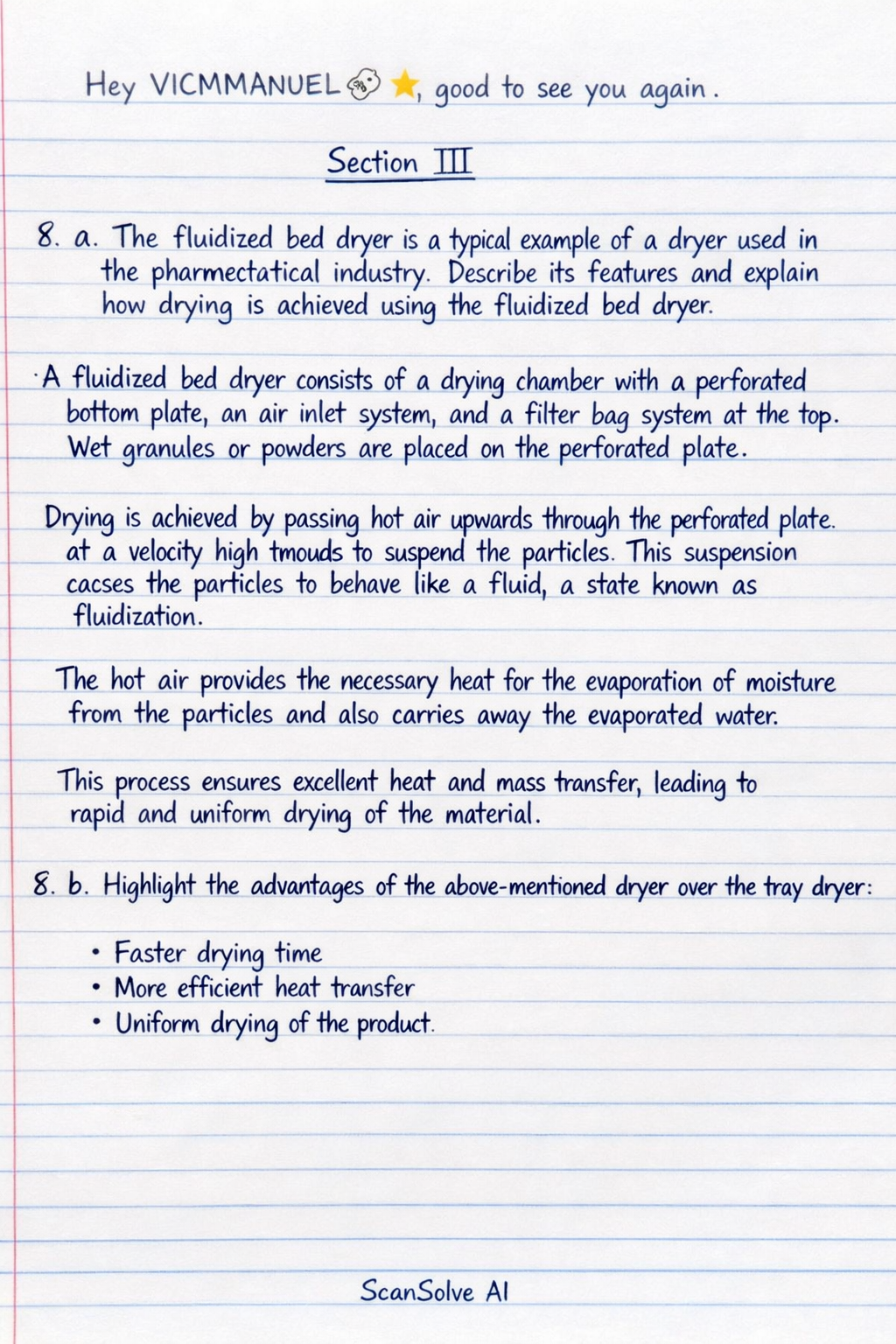
Hey VICMMANUEL👻⭐, good to see you again. Section III 8. a. The fluidized bed dryer is a typical example of a dryer used in the pharmaceutical industry. Describe its features and explain how drying is achieved using the fluidized bed dryer. A fluidized bed dryer consists of a drying chamber with a perforated bottom plate, an air inlet system, and a filter bag system at the top. Wet granules or powders are placed on the perforated plate. Drying is achieved by passing hot air upwards through the perforated plate at a velocity high enough to suspend the particles. This suspension causes the particles to behave like a fluid, a state known as fluidization. The hot air provides the necessary heat for the evaporation of moisture from the particles and also carries away the evaporated water. This process ensures excellent heat and mass transfer, leading to rapid and uniform drying of the material. 8. b. Highlight the advantages of the above-mentioned dryer over the tray dryer. Advantages of a fluidized bed dryer over a tray dryer include: • Faster drying time: Due to efficient heat and mass transfer, drying is significantly quicker. • Better drying uniformity: All particles are uniformly exposed to the drying air, leading to consistent moisture content. • Higher thermal efficiency: More effective utilization of heat energy. • Reduced labor costs: Less manual handling is required compared to tray dryers. • Compact design: Requires less floor space for the same processing capacity. 9. Define the concept of "solute migration" and suggest measures to minimize migration during drying. Solute migration is the phenomenon where dissolved substances (solutes) within a wet material move towards the surface of the material as water evaporates during drying. As water moves to the surface to be removed, it carries the dissolved solutes with it, leading to an uneven distribution of the solute, often resulting in a higher concentration at the surface of the dried product. Measures to minimize solute migration during drying: • Rapid drying: Drying the material quickly can reduce the time available for solutes to migrate to the surface. • Pre-treatment: Granulation or coating of particles can encapsulate solutes, preventing their movement. • Use of binders: Incorporating suitable binders can help fix solutes within the material matrix. • Controlled drying conditions: Using lower drying temperatures or controlled humidity can slow down the migration process. • Microwave or radiofrequency drying: These methods heat the material internally, reducing surface evaporation and thus minimizing migration. 10. Describe the fractional distillation process and how can this be carried out under reduced pressure? Fractional distillation is a separation technique used to separate components of a liquid mixture that have different, but often close, boiling points. The process involves repeatedly vaporizing and condensing the mixture within a fractionating column. As the vapor rises through the column, it undergoes multiple cycles of condensation and re-vaporization. Each cycle enriches the vapor in the more volatile component (lower boiling point) and the liquid in the less volatile component (higher boiling point), allowing for a more complete separation than simple distillation. Fractional distillation can be carried out under reduced pressure (also known as vacuum distillation) to separate compounds that are heat-sensitive or have very high boiling points. By lowering the pressure inside the distillation apparatus using a vacuum pump, the boiling points of the liquids are significantly reduced. This allows the separation to occur at much lower temperatures, preventing thermal degradation of the compounds and making the process safer and more efficient for substances that would otherwise decompose at their normal boiling points. Send me the next one 📸