
We read your photo as:
Discuss two advantages of using a powdered dosage form and outline two methods for determining powder flowability, including a calculation.
ScanSolve AI Answer
This answer stops before the end.
It was cut off when it was first written. Ask ScanSolve this question again for the full working.
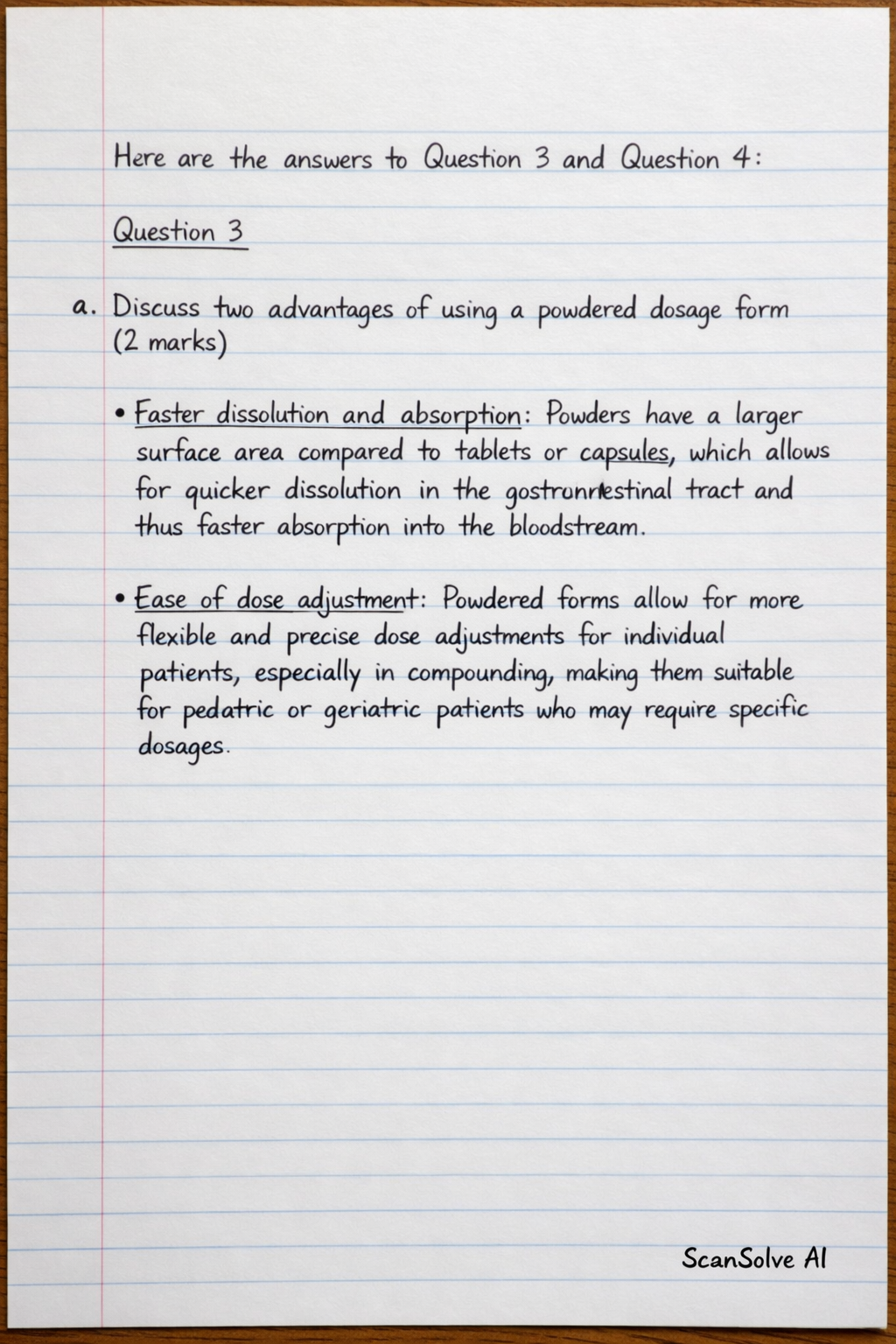
Here are the answers to Question 3 and Question 4:
Question 3
a. Discuss two advantages of using a powdered dosage form (2 marks)
- Faster dissolution and absorption: Powders have a larger surface area compared to tablets or capsules, which allows for quicker dissolution in the gastrointestinal tract and thus faster absorption into the bloodstream.
- Ease of dose adjustment: Powdered forms allow for more flexible and precise dose adjustments for individual patients, especially in compounding, making them suitable for pediatric or geriatric patients who may require specific dosages.
b. i. Outline two methods that can be used to determine the flowability of the powder? (2 marks)
- Angle of Repose: This method measures the maximum angle at which a pile of powder can stand without slumping. A smaller angle of repose indicates better flowability.
- Carr's Index (Compressibility Index) or Hausner Ratio: These are calculated from the bulk density and tapped density of the powder. They provide an indication of the powder's compressibility and, indirectly, its flow characteristics.
b. ii. Determine the flowability of the powder.
Given: Bulk density = , Tapped density = .
Step 1: Calculate Carr's Index.
Step 2: Calculate Hausner Ratio.
Step 3: Interpret the flowability based on the calculated values.
A Carr's Index of and a Hausner Ratio of 1.22 both indicate that the powder has Fair flowability.
b. iii. How does poor flowability of a powder affects the formulation of tablets? (2 marks)
Poor flowability significantly impacts tablet formulation by causing inconsistent filling of tablet dies. This leads to weight variation among tablets, which in turn results in content uniformity issues, meaning each tablet may contain a different amount of the active pharmaceutical ingredient. It can also cause manufacturing problems such as bridging in hoppers or sticking to punch faces.
b. iv. What can be done to improve powder flowability? (2 marks)
- Granulation: This process converts fine powders into larger, denser granules, which generally flow better and reduce dustiness.
- Addition of Glidants: Incorporating small amounts of flow-enhancing agents, such as colloidal silicon dioxide or talc, can reduce inter-particulate friction and improve powder flow.
Question 4
a. If the adult dose of Allopurinol is 100mg, calculate a dose for a child with a body surface area of 0.45m² (2 marks)
Step 1: Use the Body Surface Area (BSA) formula for pediatric dosing, assuming a standard adult BSA of .
The dose for the child is approximately .
b. The initial maintenance dose of vancomycin for infants less than 1 week old is 17mg/kg every 18hours.
i. What would be the dose, in milligram, for an infant weighing 2500g? (2 marks)
Step 1: Convert the infant's weight from grams to kilograms.
Step 2: Calculate the dose in milligrams.
The dose for the infant would be .
ii. How many milliliters of an injection containing 500mg per 25ml should be administered to obtain this dose? (2 marks)
Step 1: Determine the concentration of the injection.
Step 2: Calculate the volume needed for the dose.
of the injection should be administered.
c. A physician orders 2g of an antibiotic to be placed in 1000ml of D5W. Using an injection that contains 200mg of the antibiotic per 2ml, how many milliliters should be added to the medication order? (2 marks)
Step 1: Convert the ordered dose from grams to milligrams.
Step 2: Determine the concentration of the antibiotic injection.
Still stuck on this one?
Ask a follow-up, and the answer starts from this question.
More Chemistry Questions
Handwritten Step-by-Step Solution
Get this as a handwritten image on WhatsApp — like a tutor wrote it for you.
Try on WhatsApp