
We read your photo as:
A formulation scientist is developing a tablet with specific challenges: the active ingredient is unstable below pH 5.0 and is heat sensitive. Additionally, the powder exhibits poor flow, and the init
ScanSolve AI Answer
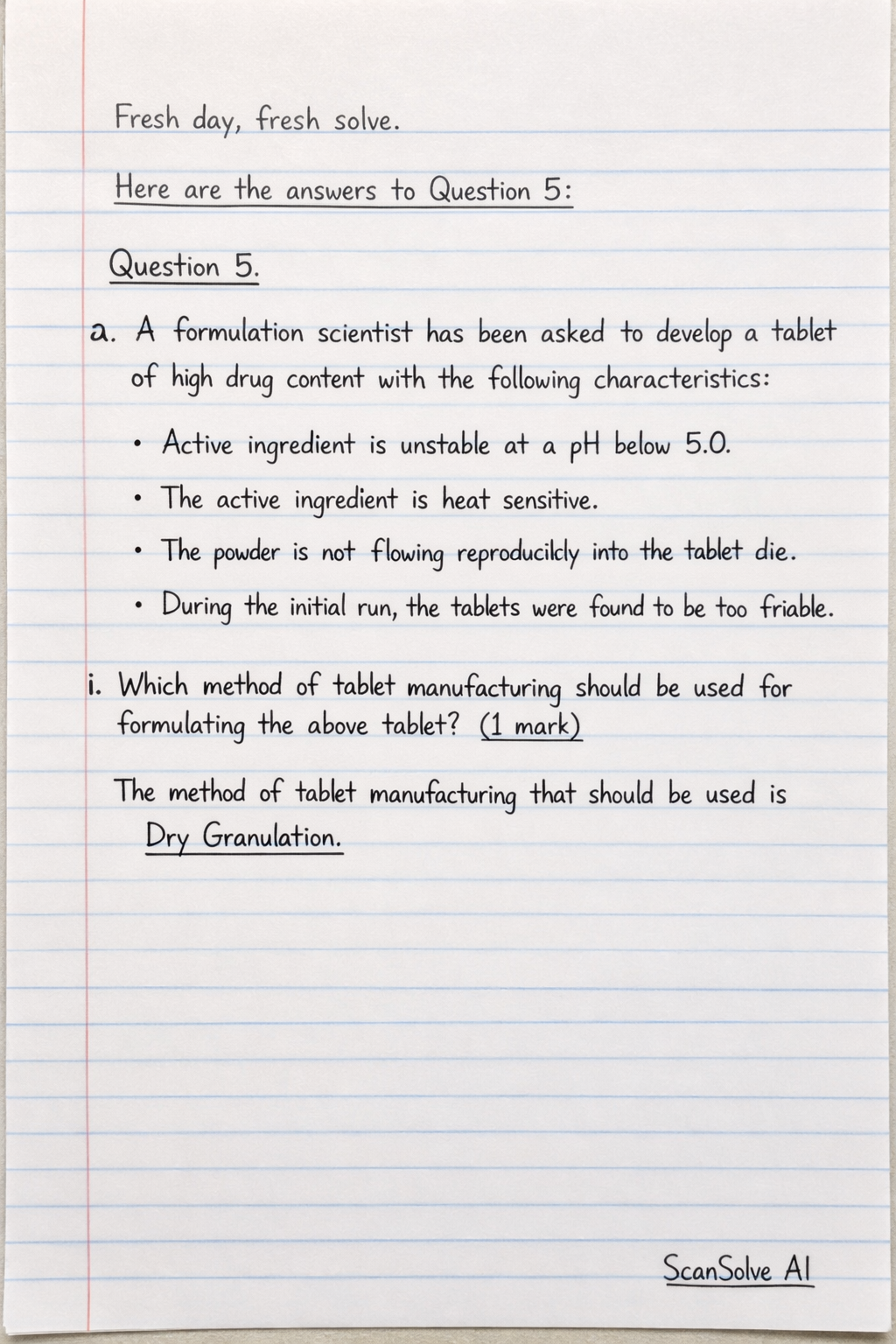
Here are the answers to Question 5:
Question 5
a. A formulation scientist has been asked to develop a tablet of high drug content with the following characteristics:
- Active ingredient is unstable at a pH below 5.0.
- The active ingredient is heat sensitive.
- The powder is not flowing reproducibly into the tablet die.
- During the initial run, the tablets were found to be too friable.
i. Which method of tablet manufacturing should be used for formulating the above tablet? (1 mark)
The method of tablet manufacturing that should be used is Dry Granulation.
ii. Discuss the rationale for choosing the above method (3 marks)
Dry granulation is chosen for several reasons based on the drug characteristics:
- Heat Sensitivity: This method avoids the use of heat, which is critical for heat-sensitive active ingredients, as it eliminates the drying step required in wet granulation.
- pH Instability: Dry granulation does not involve aqueous solvents, thereby preventing potential degradation of the active ingredient that is unstable at pH below 5.0 by avoiding exposure to moisture and pH changes.
- Poor Flowability: Granulation, whether wet or dry, improves the flow properties of powders by converting fine, poorly flowing particles into larger, denser granules that flow more uniformly into the tablet die.
- Friability: Granulation also enhances the compressibility of the powder mixture, leading to stronger tablets with reduced friability.
iii. The active ingredient is unstable at pH below 5.0, what can be done to solve this problem? (1 mark)
To solve the problem of the active ingredient being unstable at pH below 5.0, a buffering agent should be incorporated into the tablet formulation to maintain the pH above 5.0.
iv. Discuss the method used in part (i) above, including the unit operations and excipients. (6 marks)
The method used is Dry Granulation, specifically Roller Compaction. This method involves compacting the powder mixture into a dense sheet or ribbon, which is then milled into granules.
Unit Operations:
- Milling/Sieving: The active pharmaceutical ingredient (API) and excipients are initially milled or sieved to achieve a uniform particle size, which aids in homogeneous mixing.
- Blending: The API is thoroughly mixed with selected excipients (diluents, dry binders, disintegrants) in a blender to ensure a uniform distribution.
- Compaction (Roller Compaction): The blended powder mixture is fed into a roller compactor, where it is compressed between two counter-rotating rollers to form a dense ribbon or sheet. This step increases the particle density and creates larger aggregates.
- Milling/Sizing (Granulation): The compacted ribbon is then passed through a mill or granulator, which breaks it down into granules of a desired size range. This improves flow and compressibility.
- Final Blending: The formed granules are then blended with an extragranular lubricant (e.g., magnesium stearate) and often an extragranular disintegrant to ensure proper tablet ejection and disintegration.
- Tablet Compression: The final blend of granules and extragranular excipients is fed into a tablet press and compressed into tablets.
Excipients:
- Diluents/Fillers: (e.g., Microcrystalline cellulose, Lactose, Dicalcium phosphate) – Added to increase the bulk of the tablet, especially for high drug content formulations, and to aid in compaction.
- Dry Binders: (e.g., Microcrystalline cellulose, Pregelatinized starch) – Provide cohesiveness to the powder mixture, allowing it to form granules and strong tablets without the need for liquid.
- Disintegrants: (e.g., Croscarmellose sodium, Sodium starch glycolate) – Help the tablet break apart into smaller particles when it comes into contact with bodily fluids, facilitating drug release. They can be added both intragranularly (before compaction) and extragranularly (after granulation).
- Lubricants: (e.g., Magnesium stearate, Stearic acid) – Added extragranularly to reduce friction between the tablet and the die wall during compression and ejection, preventing sticking.
- Glidants: (e.g., Colloidal silicon dioxide, Talc) – Improve the flow properties of the powder mixture before compaction and of the granules before final compression.
Still stuck on this one?
Ask a follow-up, and the answer starts from this question.
More Chemistry Questions
Handwritten Step-by-Step Solution
Get this as a handwritten image on WhatsApp — like a tutor wrote it for you.
Try on WhatsApp