
We read your photo as:
Describe the objective of particle size analysis in pharmaceuticals and list the limitations of the sieving method.
Chemistry
ScanSolve AI Answer
Step-by-step solution
2 stepsAnswer 1.a.
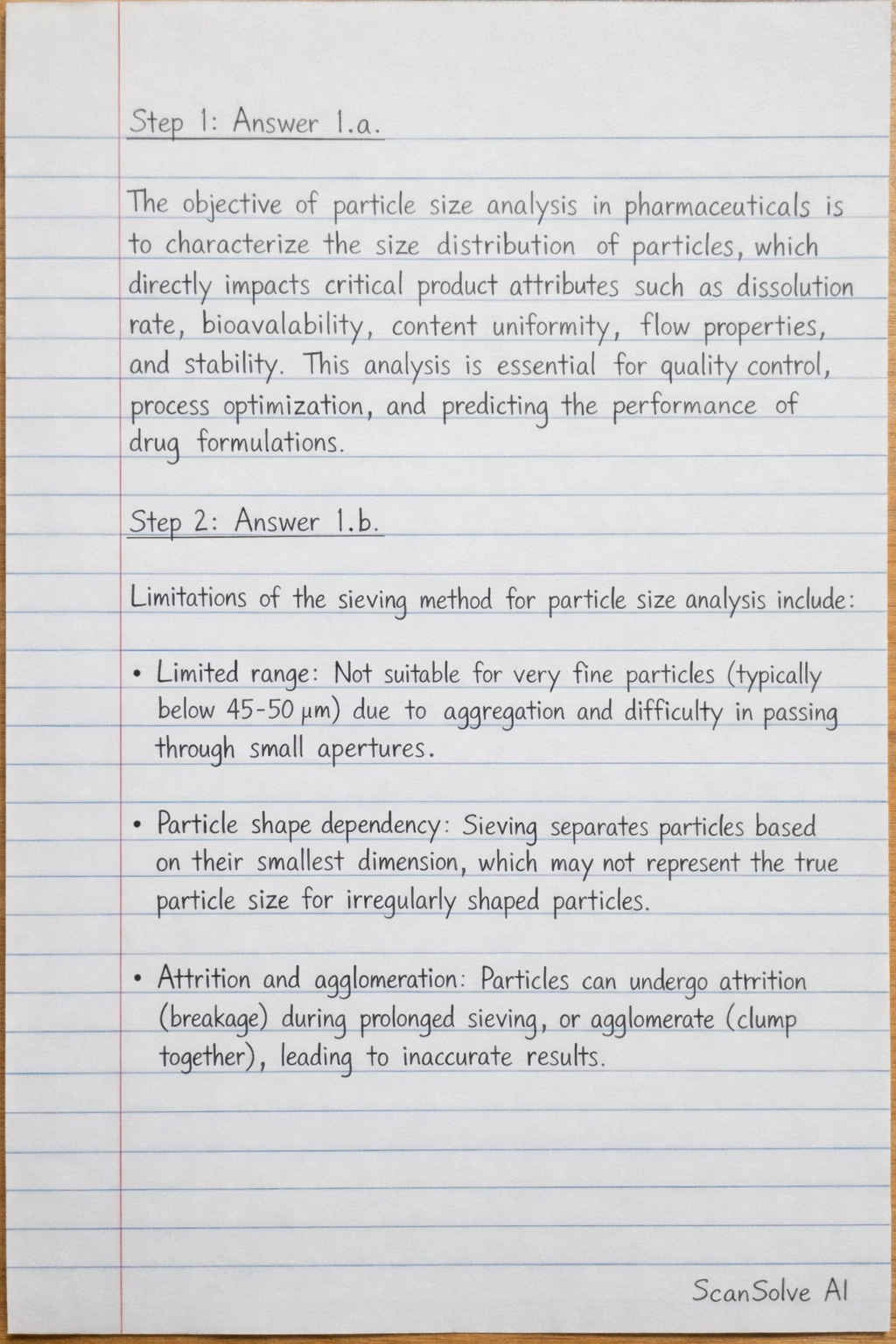
The objective of particle size analysis in pharmaceuticals is to characterize the size distribution of particles, which directly impacts critical product attributes such as dissolution rate, bioavailability, content uniformity, flow properties, and stability. This analysis is essential for quality control, process optimization, and predicting the performance of drug formulations.
Answer 1.b.
Limitations of the sieving method for particle size analysis include:
- Limited range: Not suitable for very fine particles (typically below 45-50 m) due to aggregation and difficulty in passing through small apertures.
- Particle shape dependency: Sieving separates particles based on their smallest dimension, which may not represent the true particle size for irregularly shaped particles.
- Attrition and agglomeration: Particles can undergo attrition (breakage) during prolonged sieving, or agglomerate (clump together), leading to inaccurate results.
- Time-consuming: The process can be lengthy, especially for fine powders requiring extended sieving times to ensure complete separation.
Was this helpful?
Still stuck on this one?
Ask a follow-up, and the answer starts from this question.
Got a different question?Ask your own question
More Chemistry Questions
QWhat is the objective of particle size analysis and what are the limitations of the sieving method?QExplain how particle size is defined and why it is important, especially for powders.QList the objectives of particle size reductionQDiscuss two advantages of using a powdered dosage form and outline two methods for determining…QProvide answers to the following questions about particle technology and pharmaceutical sciences.
Handwritten Step-by-Step Solution
Get this as a handwritten image on WhatsApp — like a tutor wrote it for you.
Try on WhatsApp