
We read your photo as:
What is the objective of particle size analysis and what are the limitations of the sieving method?
ScanSolve AI Answer
Section I
1. a) What is the objective of particle size analysis?
The objective of particle size analysis in pharmaceutics is to characterize the size distribution of particles in a powder or suspension. This is crucial because particle size significantly influences various properties of pharmaceutical products, including:
- Dissolution rate and bioavailability of drugs.
- Flowability and compressibility of powders, affecting manufacturing processes like tableting.
- Content uniformity in solid dosage forms.
- Stability and sedimentation rate of suspensions and emulsions.
- Texture, appearance, and efficacy of topical preparations.
1. b) Itemize the limitations of the sieving method for particle size analysis.
Limitations of the sieving method include:
- Lower limit: It is generally not suitable for particles smaller than due to electrostatic forces and agglomeration.
- Agglomeration: Fine particles tend to stick together, leading to inaccurate results.
- Time-consuming: The process can be lengthy, especially for fine powders.
- Wear and tear: Sieves can wear out over time, changing their aperture size.
- Irregular particles: The method assumes spherical particles, which can lead to inaccuracies for irregularly shaped particles.
- Moisture sensitivity: High moisture content can cause particles to clump, blocking sieve apertures.
- Dusting: Fine particles can become airborne, leading to material loss and potential health hazards.
2. a) Enumerate some factors affecting particle size reduction.
Factors affecting particle size reduction include:
- Hardness: Harder materials require more energy and time for reduction.
- Toughness/Brittleness: Tough materials resist fracture, while brittle materials break easily.
- Stickiness/Adhesiveness: Sticky materials can clog mills and screens, hindering reduction.
- Moisture content: Optimal moisture content can aid reduction, but excessive moisture can cause clumping.
- Feed rate: The rate at which material is fed into the mill affects efficiency and product fineness.
- Temperature: Heat generated during milling can affect heat-sensitive materials.
- Material structure: Crystalline, amorphous, or fibrous structures respond differently to milling.
- Equipment design: Type of mill, speed, screen size, and grinding media all influence the outcome.
2. b) Contrast between Hammer mill and Ball mill under the following headings:
| Feature | Hammer Mill | Ball Mill
3. What is mixing, write short note on the distinguishing features of positive and negative mixtures.
Mixing is a unit operation that involves combining two or more distinct components (solids, liquids, or gases) to achieve a uniform distribution of these components throughout the mixture. The goal is to reduce non-uniformity and achieve a desired level of homogeneity.
Distinguishing features of positive and negative mixtures:
- Positive Mixtures: These are formed from materials that are miscible and spontaneously mix completely and irreversibly by diffusion. Once mixed, they tend to stay mixed and do not separate on standing. Examples include gases or two mutually soluble liquids like alcohol and water.
- Negative Mixtures: These are formed from materials that are immiscible or have a tendency to separate. They require continuous or intermittent energy input to maintain homogeneity. If left undisturbed, the components will separate due to differences in density, particle size, or other physical properties. Examples include suspensions (solid in liquid) or emulsions (liquid in liquid), such as oil and water.
4. What do you understand by the term, "Percolation Segregation" and mention four approaches to minimise segregation.
Percolation segregation is a type of particle segregation that occurs when smaller particles sift down through a bed of larger particles. This happens when a mixture of different sized particles is disturbed, allowing smaller particles to "percolate" through the voids created by the larger particles, leading to an accumulation of smaller particles at the bottom and larger particles at the top. This phenomenon is common in pharmaceutical powders and can lead to non-uniformity in dosage forms.
Four approaches to minimise segregation:
- Particle Size and Density Control: Use particles with a narrow size distribution and similar densities. Minimizing differences in these properties reduces the tendency for smaller/denser particles to percolate.
- Granulation: Convert fine powders into larger, more uniform granules. This reduces the surface area available for percolation and creates a more homogeneous mixture that is less prone to segregation.
- Controlled Mixing Techniques: Use gentle mixing methods and avoid excessive agitation or prolonged mixing times that can induce segregation. Techniques like ordered mixing (adhering fine particles to larger carrier particles) can also be effective.
- Addition of Binders or Adhesives: Incorporating small amounts of liquid binders or adhesive excipients can cause particles to stick together, forming aggregates that resist segregation. This can be done during mixing or granulation.
Section II
5. a) Write and name the equation that describes all the factors that affect the rate of filtration (2 marks)
The equation that describes the factors affecting the rate of filtration is Darcy's Law:
Where:
- $\frac{dV}{
Still stuck on this one?
Ask a follow-up, and the answer starts from this question.
More Chemistry Questions
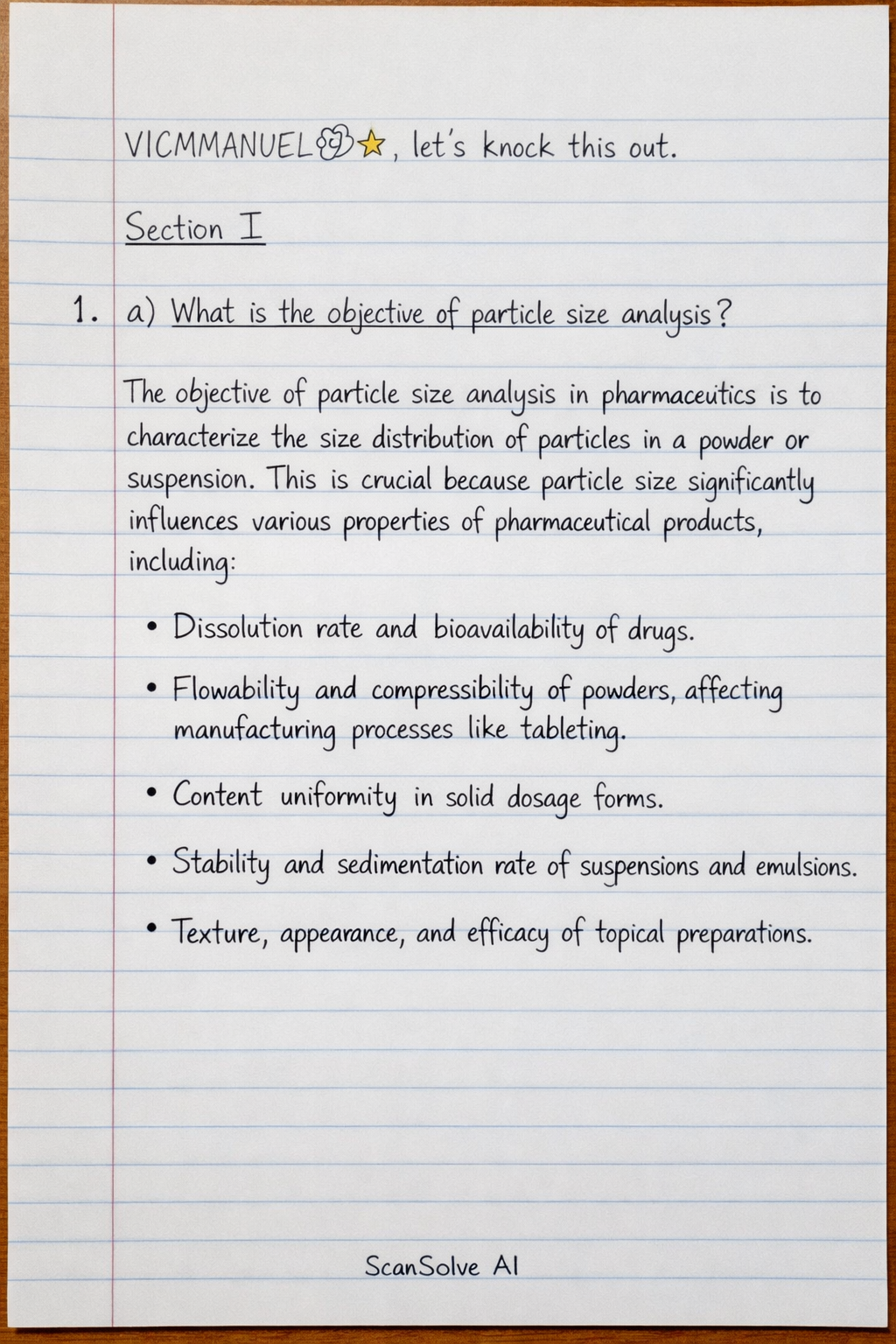
Handwritten Step-by-Step Solution
Get this as a handwritten image on WhatsApp — like a tutor wrote it for you.
Try on WhatsApp