
We read your photo as:
Provide answers to the following questions about particle technology and pharmaceutical sciences.
ScanSolve AI Answer
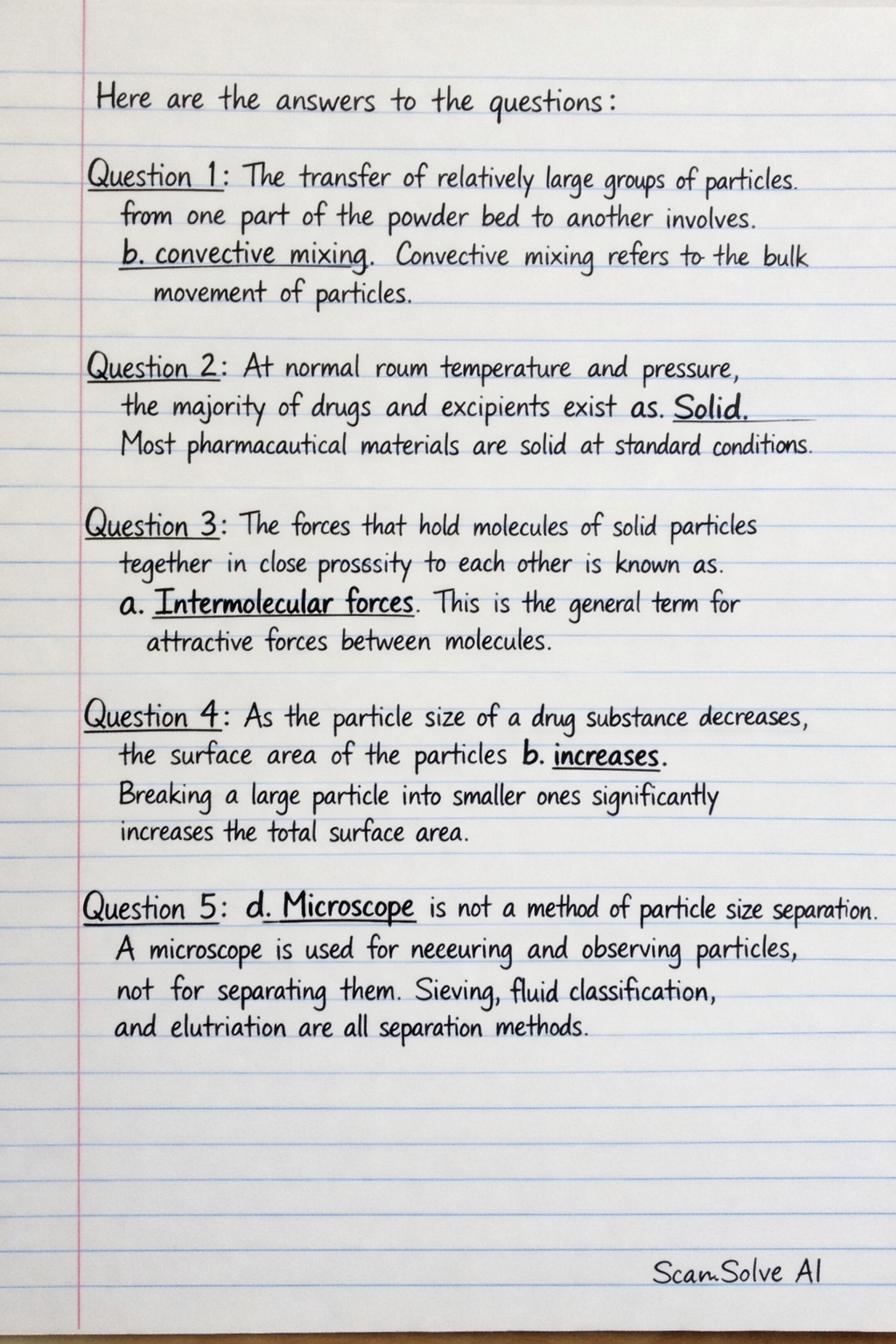
Here are the answers to the questions:
Question 1: The transfer of relatively large groups of particles from one part of the powder bed to another involves b. convective mixing. Convective mixing refers to the bulk movement of particles.
Question 2: At normal room temperature and pressure, the majority of drugs and excipients exist as a. Solid. Most pharmaceutical materials are solid at standard conditions.
Question 3: The forces that hold molecules of solid particles together in close proximity to each other is known as a. Intermolecular forces. This is the general term for attractive forces between molecules.
Question 4: As the particle size of a drug substance decreases, the surface area of the particles b. increases. Breaking a large particle into smaller ones significantly increases the total surface area.
Question 5: d. Microscope is not a method of particle size separation. A microscope is used for measuring and observing particles, not for separating them. Sieving, fluid classification, and elutriation are all separation methods.
Question 6: A Coulter counter is the only method that measures a property having a direct relationship to the c. volume of the particle. It measures the change in electrical resistance as a particle displaces an electrolyte, which is proportional to the particle's volume.
Question 7: The results of a particle size analysis can be presented as the following except d. Pie chart. Pie charts are used for showing proportions of a whole, not for continuous data distributions like particle size.
Question 8: An advantage of the use of an optical microscope is d. direct measurement of the particle. Optical microscopes allow for visual inspection and direct measurement of individual particle dimensions and characteristics.
Question 9: Particle size analysis is usually carried out on a. Representative sample. To ensure the results accurately reflect the entire batch, the sample analyzed must be representative.
Question 10: A powder with Carr's compressibility index greater than 20% would be found to exhibit b. Poor flow. A Carr's index above 20% indicates poor or very poor flowability.
Question 11: In the Coulter counter method, d. Liquid samples are dispersed in an electrically conductive fluid. The method requires particles to be suspended in an electrolyte solution (an electrically conductive fluid) to measure changes in electrical resistance.
Still stuck on this one?
Ask a follow-up, and the answer starts from this question.
More Chemistry Questions
Handwritten Step-by-Step Solution
Get this as a handwritten image on WhatsApp — like a tutor wrote it for you.
Try on WhatsApp