
We read your photo as:
Define polymer, explain its role in pharmaceuticals, and give an example. Classify polymers by origin with examples. Discuss one physical property and its pharmaceutical relevance.
Chemistry
ScanSolve AI Answer
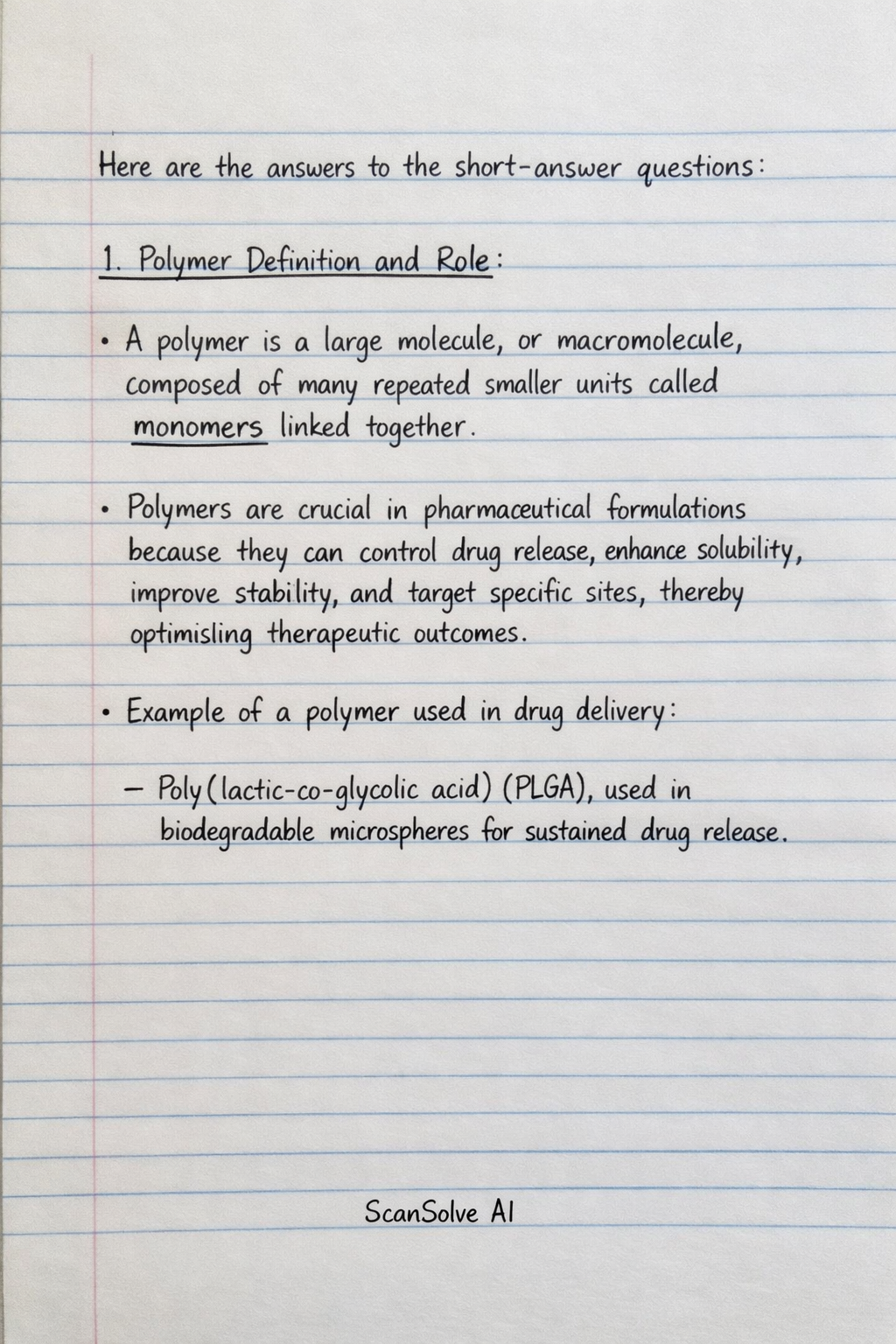
Here are the answers to the short-answer questions:
1. Polymer Definition and Role:
- A polymer is a large molecule, or macromolecule, composed of many repeated smaller units called monomers linked together.
- Polymers are crucial in pharmaceutical formulations because they can control drug release, enhance solubility, improve stability, and target specific sites, thereby optimizing therapeutic outcomes.
- Example of a polymer used in drug delivery: Poly(lactic-co-glycolic acid) (PLGA), used in biodegradable microspheres for sustained drug release.
2. Classification by Origin:
- The three main categories of polymers based on their origin are:
- Natural Polymers: Derived from biological sources. Example: Alginate, used in oral formulations as a disintegrant or sustained-release agent.
- Semi-synthetic Polymers: Chemically modified natural polymers. Example: Hydroxypropyl methylcellulose (HPMC), widely used as a binder, film-former, and controlled-release matrix in tablets.
- Synthetic Polymers: Entirely man-made through chemical synthesis. Example: Polyethylene glycol (PEG), used as a solubilizer, excipient, and drug carrier in various dosage forms.
3. Physical Properties:
- One important physical property of polymers is viscosity.
- Viscosity influences pharmaceutical applications by affecting flow properties, which is critical in gel preparation. For instance, polymers with higher viscosity can form stable gels at lower concentrations, providing desired consistency for topical drug delivery or ophthalmic solutions.
4. Chemical Properties:
- The chemical stability of a polymer is vital for pharmaceutical packaging as it ensures the integrity and safety of the packaged drug product over its shelf life. If a polymer degrades, it can leach harmful substances into the drug or compromise the barrier properties of the packaging, leading to drug degradation or contamination.
- Example of a polymer used in packaging: Polyethylene terephthalate (PET). PET is widely used for packaging oral liquids and solid dosage forms due to its excellent barrier properties against gases and moisture, and its chemical inertness, which prevents interaction with the drug.
5. Polymer Synthesis:
- Addition polymerisation involves the direct joining of monomers without the loss of any atoms, typically initiated by free radicals, ions, or coordination catalysts. The polymer's molecular weight increases rapidly.
- Condensation polymerisation involves the reaction of monomers with the elimination of a small molecule, such as water or methanol, as a byproduct. The polymer's molecular weight increases gradually.
- Example of a polymer synthesised by addition polymerisation: Poly(methyl methacrylate) (PMMA), used in bone cements and dental prosthetics.
- Example of a polymer synthesised by condensation polymerisation: Polyester (e.g., PLGA), used in biodegradable sutures and controlled-release drug delivery systems.
Was this helpful?
Still stuck on this one?
Ask a follow-up, and the answer starts from this question.
Got a different question?Ask your own question
More Chemistry Questions
QDefine polymer and explain its role in pharmaceutical formulations, providing an example. Classify…QA pharmaceutical company is developing an oral tablet for a drug with poor water solubility…QProvide answers to the following questions about particle technology and pharmaceutical sciences.QPoly(lactic-co-glycolic acid) (PLGA) is a prominent polymer used in pharmaceutical products, notably…QWhat are the medical and pharmaceutical uses of specific chemical compounds and elements, and what…
Browse by topic:Organic Chemistry
Handwritten Step-by-Step Solution
Get this as a handwritten image on WhatsApp — like a tutor wrote it for you.
Try on WhatsApp