

This chemistry question involves key chemical concepts and calculations. The detailed solution below walks through each step, from identifying the reaction type to computing the final answer.
ScanSolve AI Answer
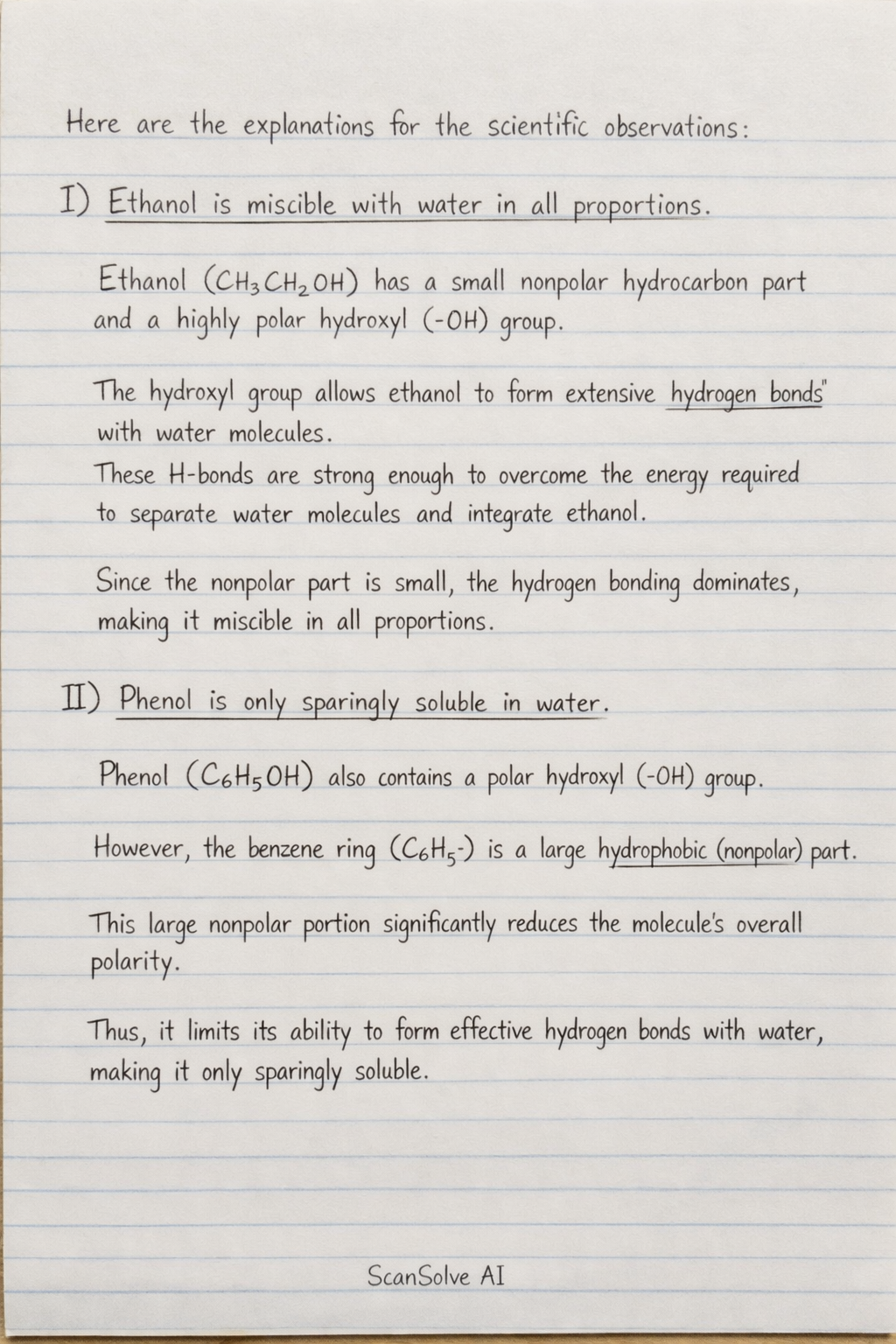
Here are the explanations for the scientific observations: I)* Ethanol is miscible with water in all proportions. Ethanol (CH_3CH_2OH) has a small nonpolar hydrocarbon part and a highly polar hydroxyl (-OH) group. The hydroxyl group allows ethanol to form extensive hydrogen bonds with water molecules, which are strong enough to overcome the energy required to separate water molecules and integrate ethanol. Since the nonpolar part is small, the hydrogen bonding capability dominates, making it miscible in all proportions. II)* Phenol is only sparingly soluble in water. Phenol (C_6H_5OH) also contains a polar hydroxyl (-OH) group that can form hydrogen bonds with water. However, the benzene ring (C_6H_5-) is a large hydrophobic (nonpolar) part. This large nonpolar portion significantly reduces the molecule's overall polarity, limiting its ability to form effective hydrogen bonds with water and making it only sparingly soluble. III)* Propan-2-one in the presence of trace acid gives a positive test for both carbonyl and hydroxyl groups. Propan-2-one (acetone, CH_3COCH_3) is a ketone and inherently contains a carbonyl group (C=O). In the presence of trace acid, propan-2-one undergoes keto-enol tautomerism, forming an equilibrium mixture with its enol form (CH_3C(OH)=CH_2). The enol form contains a hydroxyl group (-OH). Consequently, the solution will contain both the keto form (carbonyl) and the enol form (hydroxyl), leading to positive tests for both functional groups. 3 done, 2 left today. You're making progress.