
We read your photo as:
From the information given above, calculate the: (i). Concentration of A in m/dm (ii). Concentration of B in moldm
ScanSolve AI Answer
Step-by-step solution
5 stepshere are the solutions to and .
****
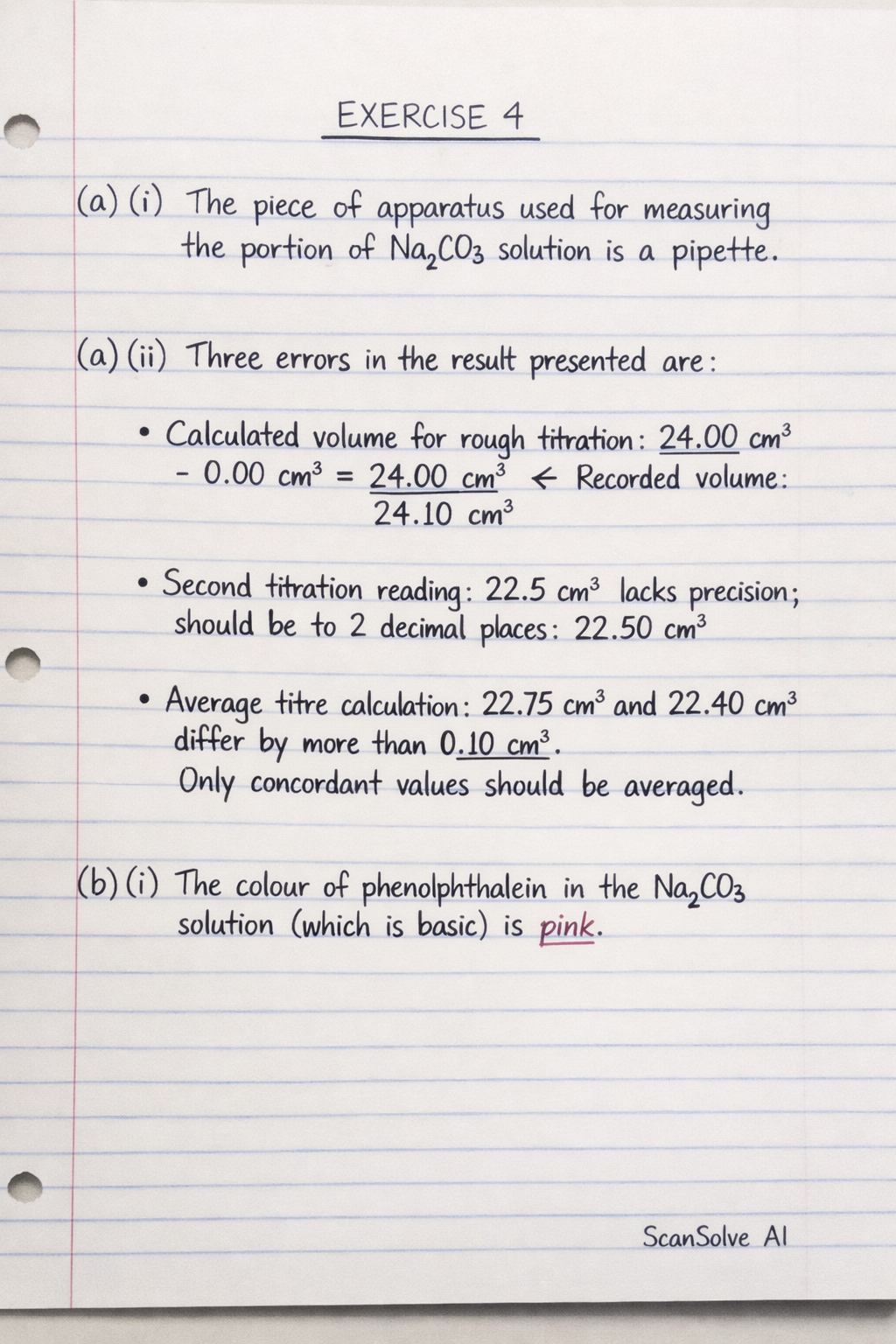
a) (i) The piece of apparatus used for measuring the portion of solution is a pipette.
a) (ii) Three errors in the result presented are:
- The calculated volume for the rough titration () does not match the recorded volume ().
- The second titration reading () lacks precision; burette readings should be recorded to two decimal places (e.g., ).
- The average titre value calculation includes values that are not concordant (e.g., and differ by more than ). Only concordant values should be averaged.
b) (i) The colour of phenolphthalein in the solution (which is basic) is pink.
b) (ii) Yes, phenolphthalein is a suitable indicator for the first equivalence point of this titration.
- Reason: is a weak base, and is a strong acid. Phenolphthalein changes colour in the range of , which corresponds to the at the first equivalence point where is converted to .
c) (i) The acid would turn blue litmus paper red.
c) (ii) After the burette had been washed and rinsed with water, the final cleaning step should be to rinse it with the acid () to be used before filling it.
c) (iii) The type of reaction demonstrated by the experiment is an acid-base neutralization reaction.
c) (iv) The apparatus used to measure the volume of:
- solution is a burette.
- solution is a pipette.
****
a) (i) Concentration of A in
Calculate the molar mass of .
Convert the mass concentration to molar concentration.
The concentration of A is .
a) (ii) Concentration of B in
Write down the balanced chemical equation and identify the mole ratio.
From the equation, the mole ratio of to is .
So, and .List the given values.
- Concentration of A () = (from part a(i))
- Volume of A () =
- Volume of B () =
- Concentration of B () = ?
Use the titration formula to calculate .
The concentration of B is .
Still stuck on this one?
Ask a follow-up, and the answer starts from this question.
More Chemistry Questions
Handwritten Step-by-Step Solution
Get this as a handwritten image on WhatsApp — like a tutor wrote it for you.
Try on WhatsApp