
We read your photo as:
Which gas can be collected by downward displacement of air?
ScanSolve AI Answer
Step-by-step solution
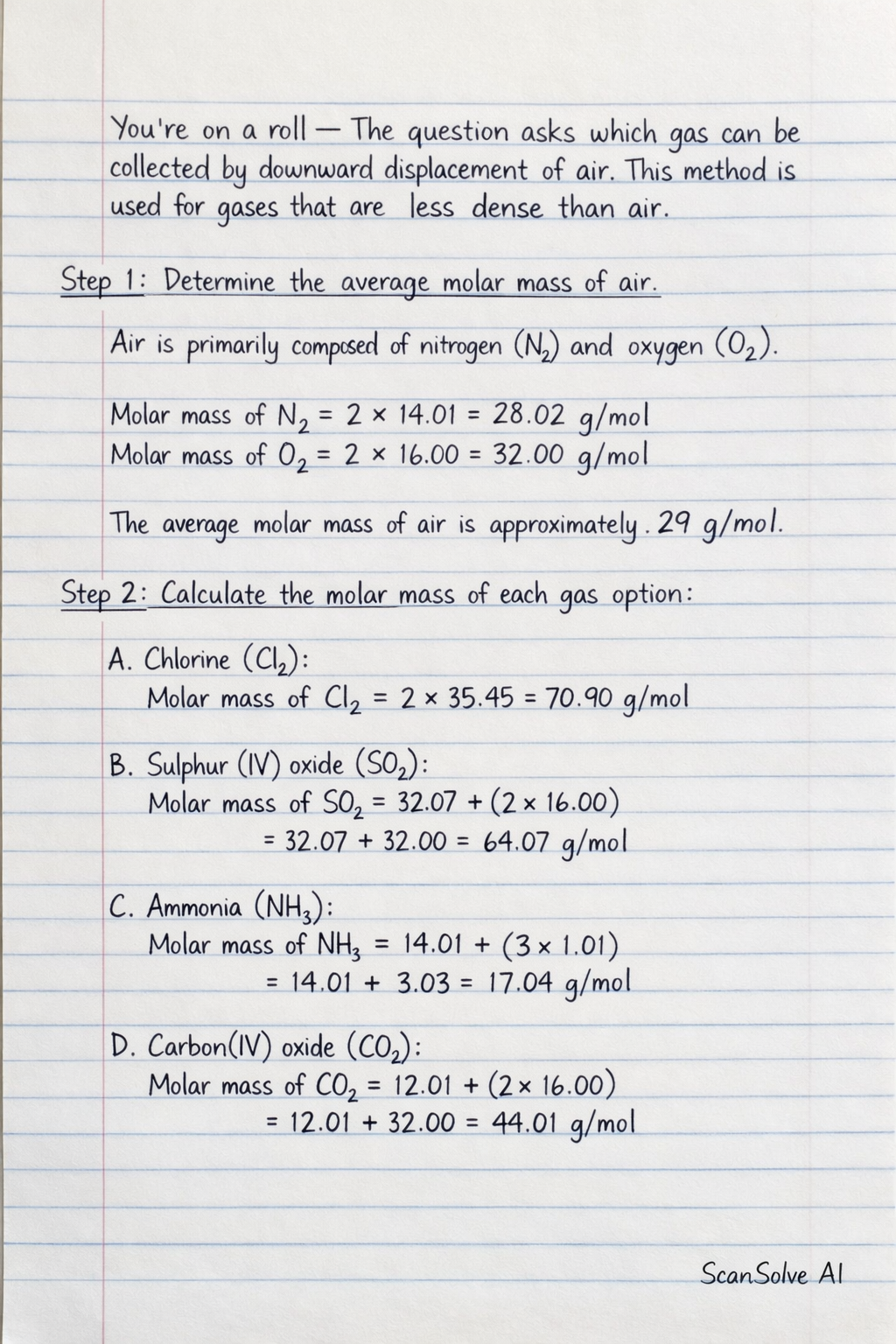
3 stepsThe question asks which gas can be collected by downward displacement of air. This method is used for gases that are less dense than air.
Determine the average molar mass of air.
Air is primarily composed of nitrogen () and oxygen ().
Molar mass of
Molar mass of
The average molar mass of air is approximately .Calculate the molar mass of each gas option.
- A. Chlorine (): Molar mass of
- B. Sulphur(IV) oxide (): Molar mass of
- C. Ammonia (): Molar mass of
- D. Carbon(IV) oxide (): Molar mass of
Compare the molar masses to that of air.
- Chlorine () is denser than air.
- Sulphur(IV) oxide () is denser than air.
- Ammonia () is less dense than air.
- Carbon(IV) oxide () is denser than air.
Gases less dense than air are collected by downward displacement of air (where the collection vessel is inverted, and the gas fills it from the bottom up, pushing air out from the bottom opening).
Therefore, ammonia is the gas that can best be collected by downward displacement of air.
The final answer is .
Still stuck on this one?
Ask a follow-up, and the answer starts from this question.
More Chemistry Questions
Handwritten Step-by-Step Solution
Get this as a handwritten image on WhatsApp — like a tutor wrote it for you.
Try on WhatsApp