
We read your photo as:
Given the cation radius is 148 pm and the anion radius is 195 pm, determine the coordination number and crystal structure.
ScanSolve AI Answer
Answer
Step-by-step solution
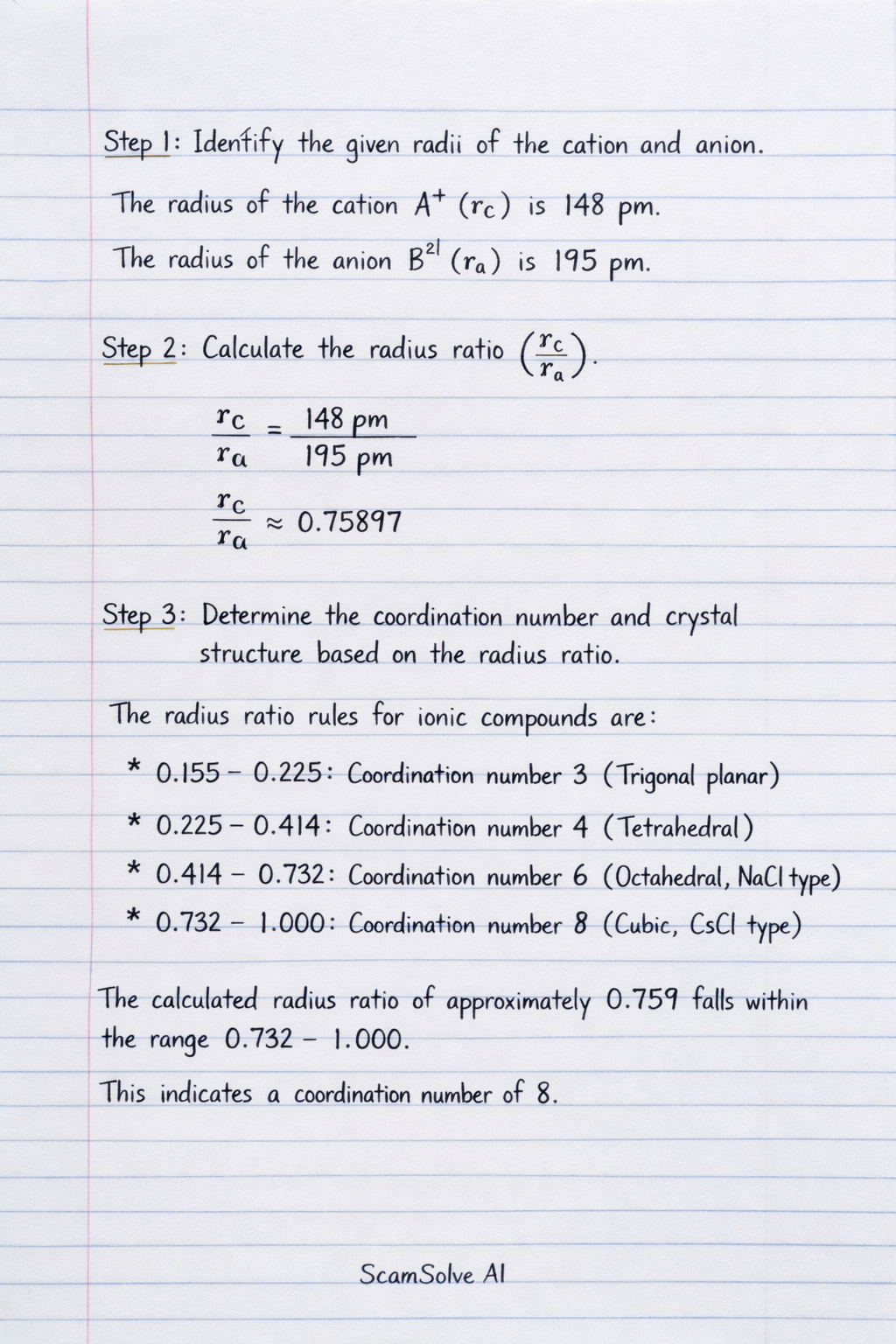
4 stepsIdentify the given radii of the cation and anion.
The radius of the cation A () is .
The radius of the anion B () is .Calculate the radius ratio ().
Determine the coordination number and crystal structure based on the radius ratio.
The radius ratio rules for ionic compounds are:
- : Coordination number 3 (Trigonal planar)
- : Coordination number 4 (Tetrahedral)
- : Coordination number 6 (Octahedral, NaCl type)
- : Coordination number 8 (Cubic, CsCl type)
The calculated radius ratio of approximately 0.759 falls within the range . This indicates a coordination number of 8.
Relate the coordination number to the given options.
A coordination number of 8 for an ionic compound typically corresponds to a cubic arrangement, such as the CsCl structure. In the CsCl structure, one type of ion (e.g., cation) is located at the body center of a cube formed by eight ions of the other type (e.g., anions). This arrangement is often referred to as a Body-Centered Cubic (BCC) structure in the context of ionic compounds.
Comparing this with the options:
- (a) Body centred cubic: This matches the expected structure for a coordination number of 8.
- (b) Face centred cubic: This corresponds to a coordination number of 6 (e.g., NaCl type).
- (c) Tetrahedral: This corresponds to a coordination number of 4.
- (d) Octahedral: This corresponds to a coordination number of 6.
Therefore, the ionic compound AB will have a Body-Centered Cubic structure.
The final answer is .
Try one yourself
A new problem that tests the same skill.
Still stuck on this one?
Ask a follow-up, and the answer starts from this question.
More Chemistry Questions
Handwritten Step-by-Step Solution
Get this as a handwritten image on WhatsApp — like a tutor wrote it for you.
Try on WhatsApp