This chemistry question involves key chemical concepts and calculations. The detailed solution below walks through each step, from identifying the reaction type to computing the final answer.
Hie l need full information or explanation on titration notes not brief but explain further
Chemistry
ScanSolve AI Answer
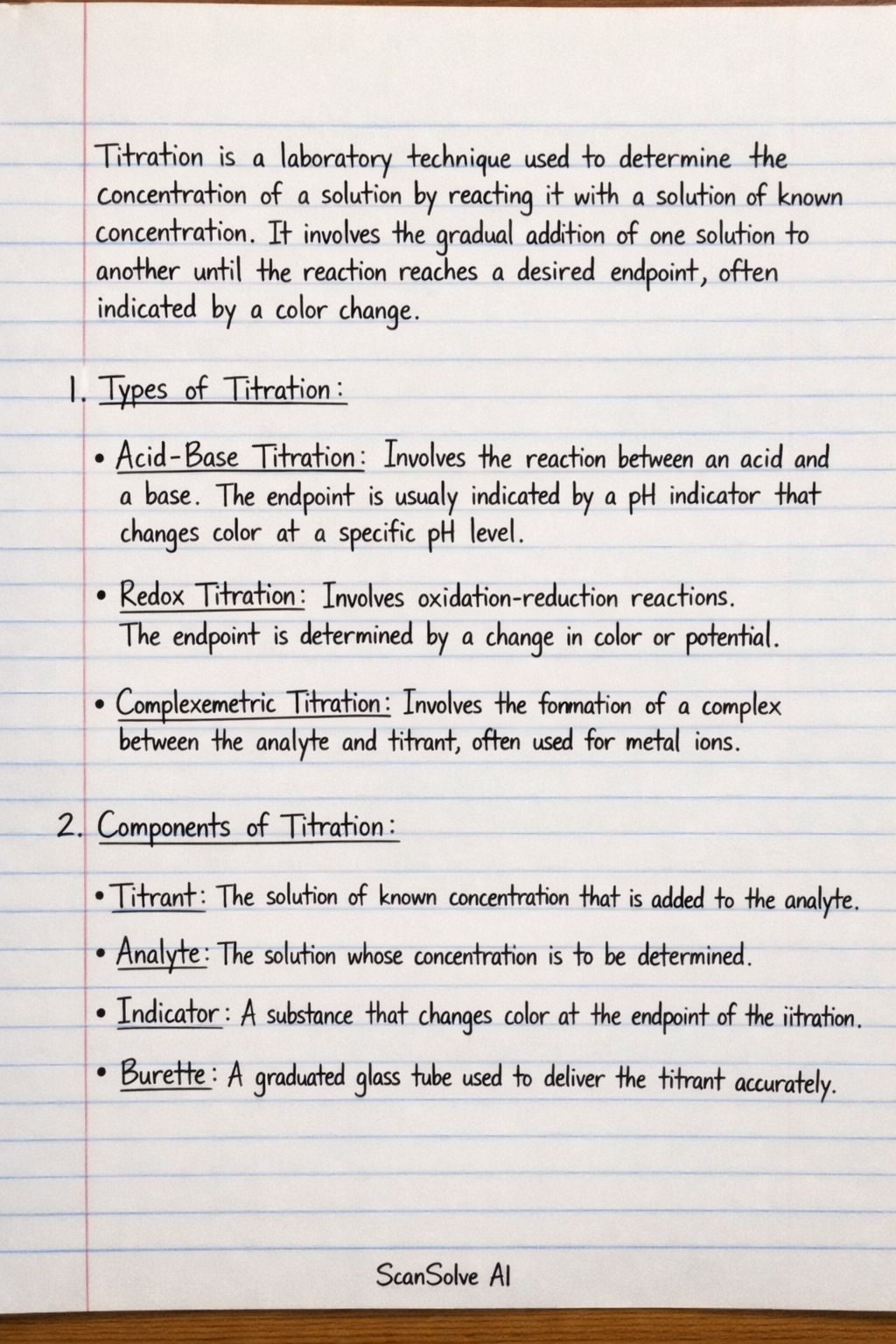
5 stepsTitration is a laboratory technique used to determine the concentration of a solution by reacting it with a solution of known concentration. It involves the gradual addition of one solution to another until the reaction reaches a desired endpoint, often indicated by a color change.
-
Types of Titration:
- Acid-Base Titration: Involves the reaction between an acid and a base. The endpoint is usually indicated by a pH indicator that changes color at a specific pH level.
- Redox Titration: Involves oxidation-reduction reactions. The endpoint is determined by a change in color or potential.
- Complexometric Titration: Involves the formation of a complex between the analyte and titrant, often used for metal ions.
-
Components of Titration:
- Titrant: The solution of known concentration that is added to the analyte.
- Analyte: The solution whose concentration is to be determined.
- Indicator: A substance that changes color at the endpoint of the titration.
- Burette: A graduated glass tube used to deliver the titrant accurately.
-
Procedure:
- Prepare the analyte in a flask and add a few drops of the indicator.
- Fill the burette with the titrant and record the initial volume.
- Slowly add the titrant to the analyte while continuously swirling the flask.
- Stop adding the titrant when the endpoint is reached (color change).
- Record the final volume of the titrant in the burette.
-
Calculations: The concentration of the analyte can be calculated using the formula:
where:
- = concentration of the titrant
- = volume of the titrant used
- = concentration of the analyte
- = volume of the analyte
-
Applications:
- Determining the concentration of acids, bases, and salts in various solutions.
- Quality control in industries such as pharmaceuticals and food.
Titration is a precise method that requires careful technique and attention to detail to ensure accurate results.
Was this helpful?
Still stuck on this one?
Ask a follow-up, and the answer starts from this question.
Got a different question?Ask your own question
More Chemistry Questions

Handwritten Step-by-Step Solution
Get this as a handwritten image on WhatsApp — like a tutor wrote it for you.
Try on WhatsAppScanSolve AI Answer
Titration is a laboratory technique used to determine the concentration of a solution by reacting it with a solution of known concentration. It involves the gradual addition of one solution to another until the reaction reaches a desired endpoint, often indicated by a color change. 1. Types of Titration: Acid-Base Titration: Involves the reaction between an acid and a base. The endpoint is usually indicated by a pH indicator that changes color at a specific pH level. Redox Titration: Involves oxidation-reduction reactions. The endpoint is determined by a change in color or potential. Complexometric Titration: Involves the formation of a complex between the analyte and titrant, often used for metal ions. 2. Components of Titration: Titrant: The solution of known concentration that is added to the analyte. Analyte: The solution whose concentration is to be determined. Indicator: A substance that changes color at the endpoint of the titration. Burette: A graduated glass tube used to deliver the titrant accurately. 3. Procedure: Prepare the analyte in a flask and add a few drops of the indicator. Fill the burette with the titrant and record the initial volume. Slowly add the titrant to the analyte while continuously swirling the flask. Stop adding the titrant when the endpoint is reached (color change). Record the final volume of the titrant in the burette. 4. Calculations: The concentration of the analyte can be calculated using the formula: C_1V_1 = C_2V_2 where: \( C_1 \) = concentration of the titrant \( V_1 \) = volume of the titrant used \( C_2 \) = concentration of the analyte \( V_2 \) = volume of the analyte 5. Applications: Determining the concentration of acids, bases, and salts in various solutions. Quality control in industries such as pharmaceuticals and food. Titration is a precise method that requires careful technique and attention to detail to ensure accurate results.