We read your photo as:

Provide calculation steps and general answers for titration and experimental data analysis, assuming reasonable values for missing data.

Chemistry

ScanSolve AI Answer

I will provide the steps and general answers for the questions. Since the tables are blank, I will outline the calculation methods and make reasonable assumptions for observations in Question 2 to demonstrate the process. You will need to substitute your actual experimental data into the formulas for numerical answers.


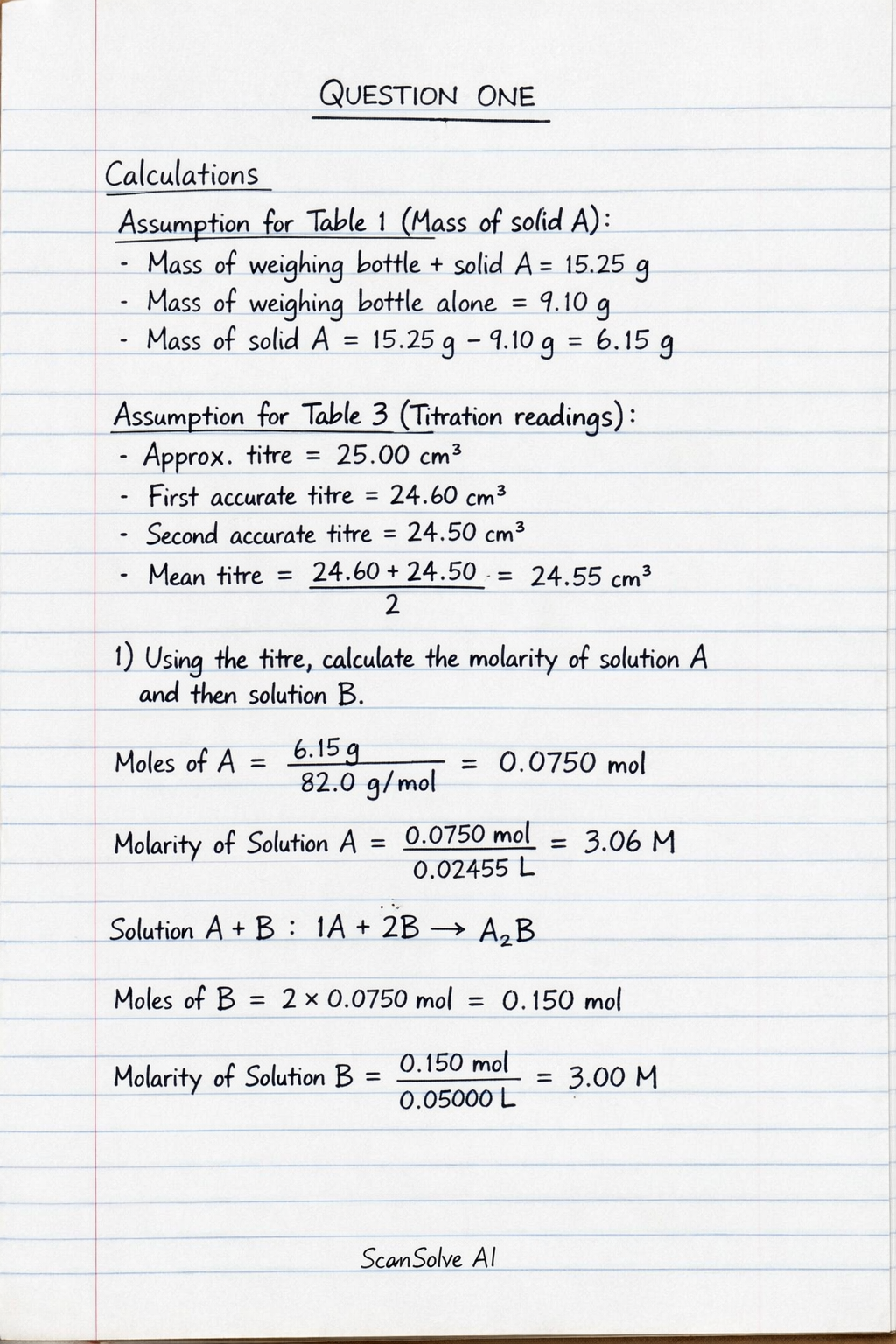
QUESTION ONE

Calculations

  • Assumption for Table 1 (Mass of solid A):

    • Mass of weighing bottle + solid A = 15.25 g15.25 \text{ g}
    • Mass of weighing bottle alone = 9.10 g9.10 \text{ g}
    • Mass of solid A = 15.25 g−9.10 g=6.15 g15.25 \text{ g} - 9.10 \text{ g} = 6.15 \text{ g} (This value is within the specified range of 6.0 to 6.25 g)
  • Assumption for Table 3 (Titration readings):

    • Approximate titre = 25.00 cm325.00 \text{ cm}^3
    • First accurate titre = 24.60 cm324.60 \text{ cm}^3
    • Second accurate titre = 24.50 cm324.50 \text{ cm}^3
    • Mean titre = 24.60+24.502=24.55 cm3\frac{24.60 + 24.50}{2} = 24.55 \text{ cm}^3

1) Using the titre, calculate the molarity of solution A and then solution B.

  • Step 1: Calculate the molar mass of Na2S2O3⋅5H2O\text{Na}_2\text{S}_2\text{O}_3 \cdot 5\text{H}_2\text{O} (solid A).

    Mr(Na2S2O3⋅5H2O)=(2×22.99)+(2×32.07)+(3×16.00)+(5×(2×1.008+16.00))M_r(\text{Na}_2\text{S}_2\text{O}_3 \cdot 5\text{H}_2\text{O}) = (2 \times 22.99) + (2 \times 32.07) + (3 \times 16.00) + (5 \times (2 \times 1.008 + 16.00)) Mr(Na2S2O3⋅5H2O)=45.98+64.14+48.00+(5×18.016)M_r(\text{Na}_2\text{S}_2\text{O}_3 \cdot 5\text{H}_2\text{O}) = 45.98 + 64.14 + 48.00 + (5 \times 18.016) Mr(Na2S2O3⋅5H2O)=45.98+64.14+48.00+90.08=248.20 g/molM_r(\text{Na}_2\text{S}_2\text{O}_3 \cdot 5\text{H}_2\text{O}) = 45.98 + 64.14 + 48.00 + 90.08 = 248.20 \text{ g/mol}
  • Step 2: Calculate the moles of Na2S2O3⋅5H2O\text{Na}_2\text{S}_2\text{O}_3 \cdot 5\text{H}_2\text{O} in 250 cm3250 \text{ cm}^3 of solution A.

    Moles of A=Mass of AMr(Na2S2O3⋅5H2O)\text{Moles of A} = \frac{\text{Mass of A}}{M_r(\text{Na}_2\text{S}_2\text{O}_3 \cdot 5\text{H}_2\text{O})} Moles of A=6.15 g248.20 g/mol=0.02478 mol\text{Moles of A} = \frac{6.15 \text{ g}}{248.20 \text{ g/mol}} = 0.02478 \text{ mol}
  • Step 3: Calculate the molarity of solution A.

    Molarity of A=Moles of AVolume of solution A (in L)\text{Molarity of A} = \frac{\text{Moles of A}}{\text{Volume of solution A (in L)}} Molarity of A=0.02478 mol0.250 L=0.09912 mol/L\text{Molarity of A} = \frac{0.02478 \text{ mol}}{0.250 \text{ L}} = 0.09912 \text{ mol/L}
  • Step 4: Calculate the moles of S2O32−\text{S}_2\text{O}_3^{2-} used in the titration.

    Moles of S2O32−=Molarity of A×Mean titre (in L)\text{Moles of S}_2\text{O}_3^{2-} = \text{Molarity of A} \times \text{Mean titre (in L)} Moles of S2O32−=0.09912 mol/L×24.551000 L=0.002433 mol\text{Moles of S}_2\text{O}_3^{2-} = 0.09912 \text{ mol/L} \times \frac{24.55}{1000} \text{ L} = 0.002433 \text{ mol}
  • Step 5: Calculate the moles of I2\text{I}_2 reacted. From the equation: 2S2O32−+I2⟶S4O62−+2I−2\text{S}_2\text{O}_3^{2-} + \text{I}_2 \longrightarrow \text{S}_4\text{O}_6^{2-} + 2\text{I}^- The mole ratio S2O32−:I2\text{S}_2\text{O}_3^{2-} : \text{I}_2 is 2:12:1.

    Moles of I2=Moles of S2O32−2\text{Moles of I}_2 = \frac{\text{Moles of S}_2\text{O}_3^{2-}}{2} Moles of I2=0.002433 mol2=0.0012165 mol\text{Moles of I}_2 = \frac{0.002433 \text{ mol}}{2} = 0.0012165 \text{ mol}
  • **Step

Was this helpful?

Still stuck on this one?

Ask a follow-up, and the answer starts from this question.

Got a different question?Ask your own question
Handwritten step-by-step solution preview

Handwritten Step-by-Step Solution

Get this as a handwritten image on WhatsApp — like a tutor wrote it for you.

Try on WhatsApp