
We read your photo as:
How do you calculate the average titre value from titration results?
Chemistry
ScanSolve AI Answer
Step-by-step solution
2 stepsTabulate your results.
A titration table is used to record the burette readings and calculate the volume of titrant used.
Calculate the average volume of A used.
To calculate the average volume of A used, select the concordant titre values (those that are within a close range, typically or of each other). Sum these concordant values and divide by the number of values.
For example, if Titration 1, 2, and 3 yielded volumes respectively, and and were concordant:
Since no experimental data (burette readings) is provided, a numerical average volume cannot be calculated.
Was this helpful?
Still stuck on this one?
Ask a follow-up, and the answer starts from this question.
Got a different question?Ask your own question
More Chemistry Questions
QWhat is the average accurate titre volume in a titration experiment, and how is it calculated?QHow do you calculate the concentration of an acid from titration data, assuming you have the average…QCalculate the mean titre from the given accurate titre readings and the mass of oxalic acid.QThe table for burette readings is empty. To complete the calculations, I will assume an average…QCalculate the average titre, ensuring to exclude the rough titre and only include concordant…
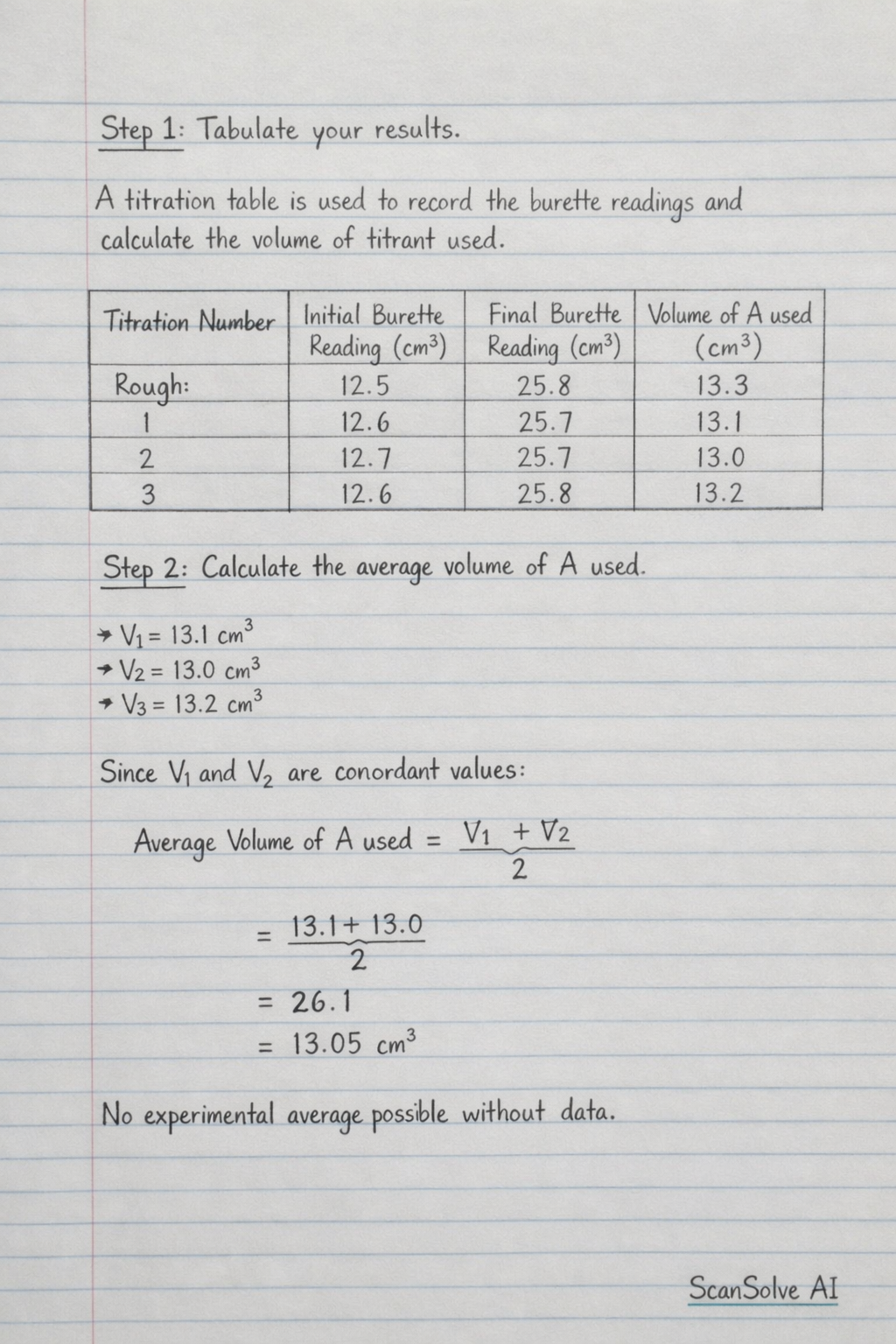
Handwritten Step-by-Step Solution
Get this as a handwritten image on WhatsApp — like a tutor wrote it for you.
Try on WhatsApp