
We read your photo as:
How do you calculate the concentration of an acid from titration data, assuming you have the average titre value and the balanced chemical equation?
ScanSolve AI Answer
Step-by-step solution
12 stepsTo complete the calculations, the burette readings from the experiment are required. Since the table is empty, I will explain how to perform each calculation, assuming the necessary data would be available from a completed experiment.
Part i· 3 steps
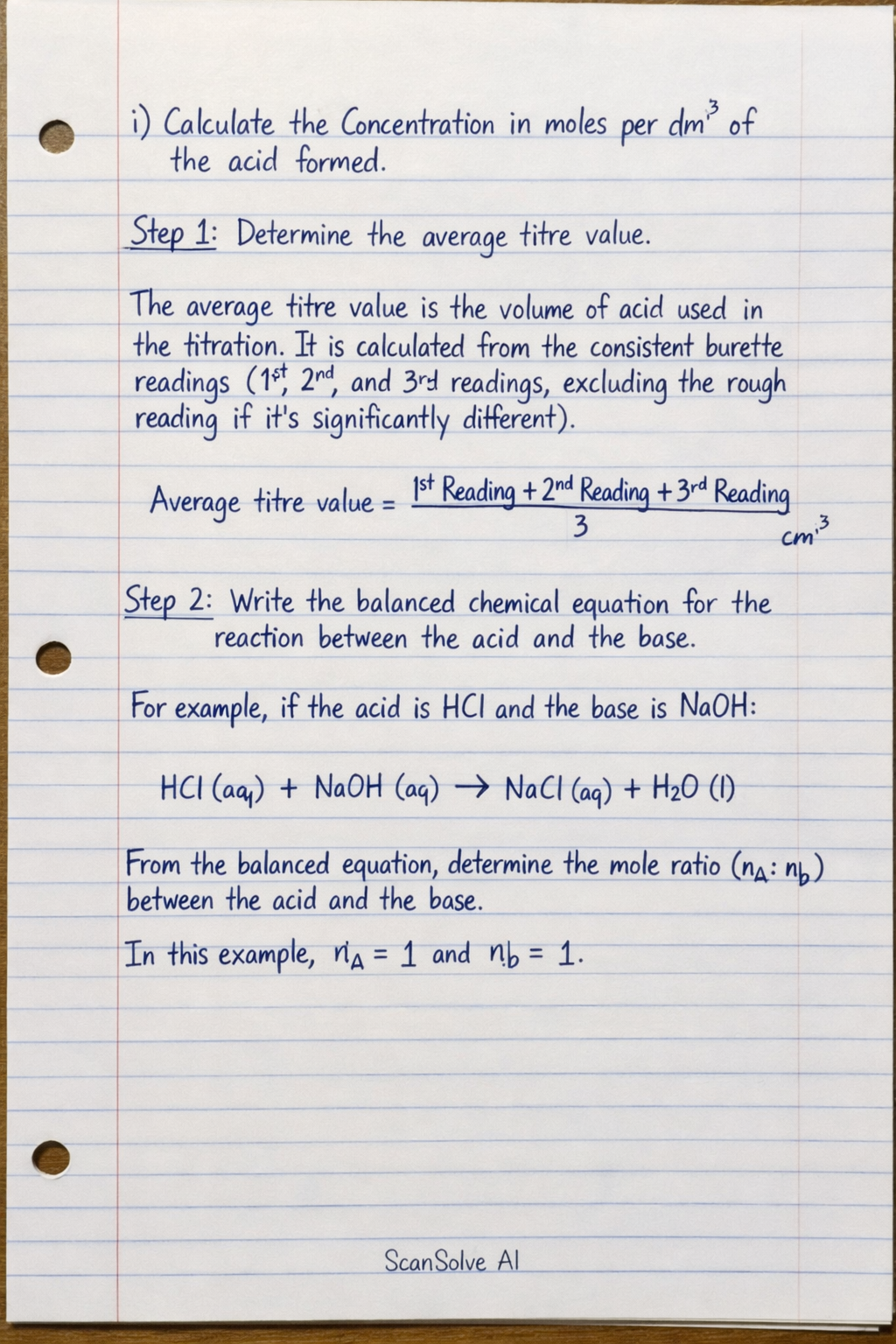
**Calculate the Concentration in moles per dm³ of the acid formed.
Determine the average titre value.
The average titre value is the volume of acid used in the titration. It is calculated from the consistent burette readings (usually the 1st, 2nd, and 3rd readings, excluding the rough reading if it's significantly different).
Write the balanced chemical equation for the reaction between the acid and the base.
For example, if the acid is HCl and the base is NaOH:
From the balanced equation, determine the mole ratio () between the acid and the base. In this example, and .
Use the titration formula to calculate the concentration of the acid.
The formula for titration is:
Where:
- = Molar concentration of the acid (mol/dm³)
- = Volume of the acid (average titre value in dm³)
- = Stoichiometric coefficient of the acid from the balanced equation
- = Molar concentration of the base (mol/dm³) (This value must be known or given)
- = Volume of the base (pipetted volume in dm³) (This value must be known or given, typically 25 cm³ or 20 cm³)
- = Stoichiometric coefficient of the base from the balanced equation
Rearrange the formula to solve for :
Substitute the known values and calculate . Remember to convert volumes from cm³ to dm³ by dividing by 1000.
Part ii· 3 steps
**Determine the Mass Concentration of the base.
Determine the molar concentration of the base ().
This value would either be given in the problem or calculated from a titration where the acid's concentration is known.
Calculate the molar mass of the base ().
The molar mass is calculated by summing the atomic masses of all atoms in the chemical formula of the base. For example, if the base is NaOH:
Calculate the mass concentration of the base.
The mass concentration (in g/dm³) is given by the formula:
Substitute the molar concentration of the base and its molar mass to find the mass concentration.
Part iii· 3 steps
**Determine the acidity or basicity of the solution formed using a pH indicator paper.
Identify the nature of the acid and base used in the titration.
The "solution formed" typically refers to the solution at the equivalence point of the titration. The pH of this solution depends on the strength of the acid and base involved:
- Strong acid + Strong base: The solution at the equivalence point will be neutral (pH 7).
- Strong acid + Weak base: The solution at the equivalence point will be acidic (pH < 7).
- Weak acid + Strong base: The solution at the equivalence point will be basic (pH > 7).
- Weak acid + Weak base: The pH at the equivalence point depends on the relative strengths of the acid and base, but it is generally difficult to determine precisely with a simple indicator.
Explain how pH indicator paper works.
A pH indicator paper contains a mixture of indicators that change color over a wide range of pH values. By dipping the paper into the solution formed at the equivalence point and comparing its color to a standard color chart, the approximate pH of the solution can be determined.
Conclude the acidity or basicity.
Based on the determined pH:
- If pH 7, the solution is neutral.
- If pH < 7, the solution is acidic.
- If pH > 7, the solution is basic. Without knowing the specific acid and base used, a definitive answer for the acidity or basicity cannot be provided.
Part iv· 3 steps
**Determine the equivalent and the end-point from the titration curve of the analysis.
Understand the terms.
- The equivalence point (or stoichiometric point) is the point in a titration where the amount of titrant added is exactly enough to react completely with the analyte solution. For an acid-base titration, this means the moles of acid equal the moles of base according to the stoichiometry of the reaction.
- The end-point is the point in a titration where the indicator changes color, signaling the completion of the reaction. Ideally, the end-point should be very close to the equivalence point.
Locate the equivalence point on a titration curve.
A titration curve is a plot of pH versus the volume of titrant added. The equivalence point is characterized by the steepest part of the curve, where the pH changes most rapidly with a small addition of titrant. It is the midpoint of the vertical region of the curve.
Relate the end-point to the titration curve.
The end-point is the volume of titrant at which the chosen indicator changes color. On a titration curve, this corresponds to the pH value at which the indicator's color transition occurs. A suitable indicator is one whose color change range (its p value) falls within the steep vertical region of the titration curve, ensuring that the end-point is a good approximation of the equivalence point.
Without the actual titration curve, these points cannot be numerically determined.
Still stuck on this one?
Ask a follow-up, and the answer starts from this question.
More Chemistry Questions
Handwritten Step-by-Step Solution
Get this as a handwritten image on WhatsApp — like a tutor wrote it for you.
Try on WhatsApp