
We read your photo as:
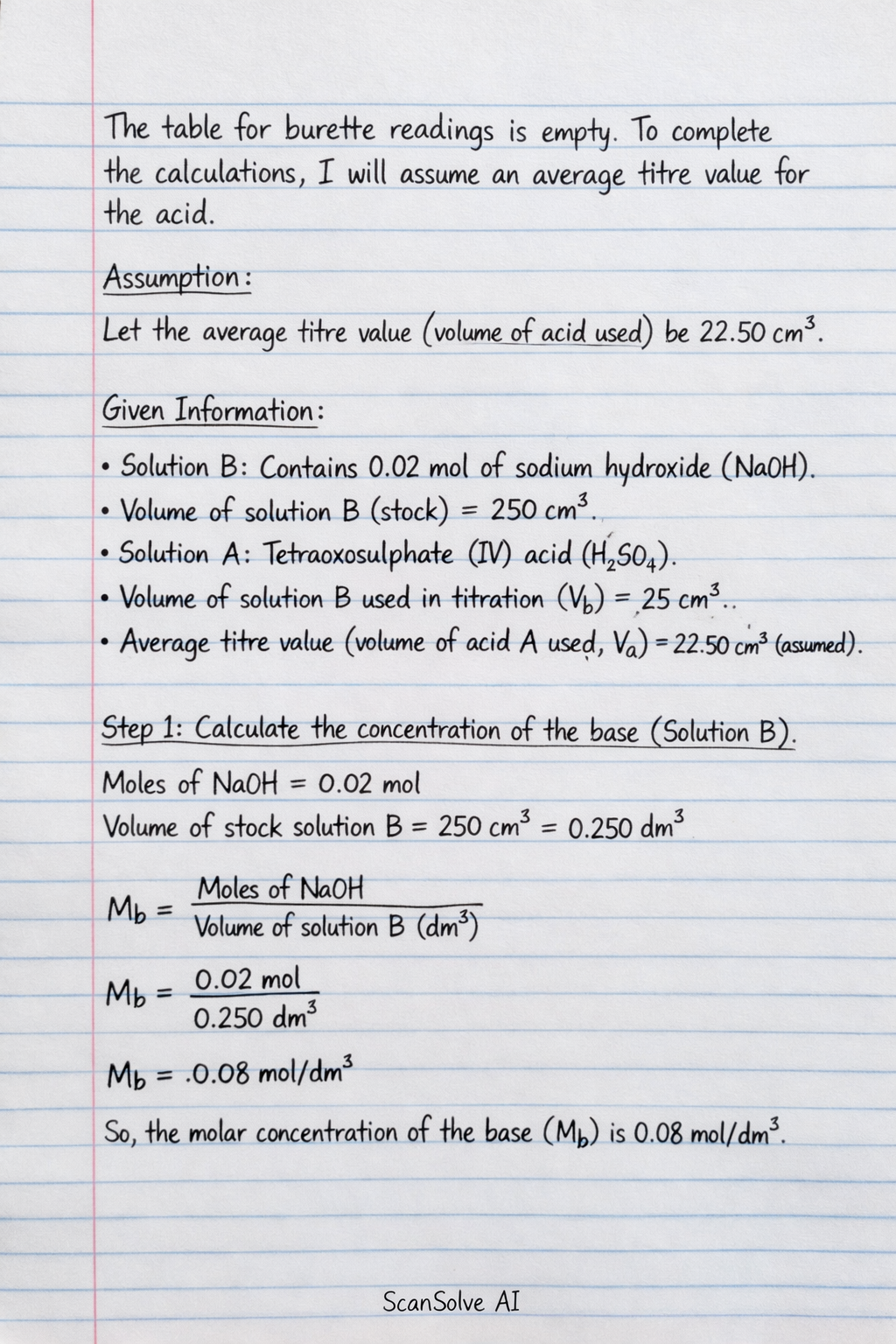
The table for burette readings is empty. To complete the calculations, I will assume an average titre value for the acid.
ScanSolve AI Answer
This answer stops before the end.
It was cut off when it was first written. Ask ScanSolve this question again for the full working.
Step-by-step solution
6 stepsThe table for burette readings is empty. To complete the calculations, I will assume an average titre value for the acid.
Assumption:
Let the average titre value (volume of acid used) be .
Given Information:
- Solution B: Contains 0.02 mol of sodium hydroxide (NaOH).
- Volume of solution B (stock) = 250 cm³.
- Solution A: Tetraoxosulphate (IV) acid ().
- Volume of solution B used in titration () = 25 cm³.
- Average titre value (volume of acid A used, ) = 22.50 cm³ (assumed).
Step 1: Calculate the concentration of the base (Solution B).
Moles of NaOH = 0.02 mol
Volume of stock solution B = 250 cm³ = 0.250 dm³
So, the molar concentration of the base () is .
Step 2: Write the balanced chemical equation for the reaction.
The reaction is between sulfuric acid () and sodium hydroxide (NaOH).
From the balanced equation:
- Moles of acid () = 1
- Moles of base () = 2
Part i· 2 steps
**The molar concentration of the acid.
Convert volumes to dm³.
Use the titration formula.
Rearrange to solve for :
Substitute the known values:
Rounding to three significant figures:
Part ii· 2 steps
**The concentration mass of the acid.
Calculate the molar mass of .
Atomic masses: H = 1.01 g/mol, S = 32.07 g/mol, O = 16.00 g/mol
Calculate the mass concentration.
Rounding to three significant figures:
Part iii· 2 steps
**From a balanced chemical equation, determine the mole ratio of the base.
Write the balanced chemical equation.
Determine the mole ratio.
The stoichiometric coefficient for the base (NaOH) is 2.
The mole ratio of acid to base () is .
The mole ratio of the base (NaOH) in the reaction is .
Part iv
**Sketch the titration curve of the acid-base titration against the pH.
This is a titration of a strong base (NaOH) with a strong acid (). The base is initially in the conical flask, and the acid is added from the burette.
Characteristics of the curve:
- Initial pH: High (basic), as the solution starts with NaOH. Initial pH of 0.08 M NaOH: , so .
- Equivalence point: At pH 7.0, because it's a strong acid-strong base titration.
- Shape: The pH decreases gradually, then sharply drops around the equivalence point (pH 7), and then continues to decrease gradually as excess acid is added.
- Final pH: Low (acidic), as excess is added.
Here is a sketch of the titration curve:
\begin{tikzpicture}[scale=0.8]
\draw[->] (0,0) -- (10,0) node[below] {Volume of Acid (cm$^3$)};
\draw[->] (0,0) -- (0,10) nodeStill stuck on this one?
Ask a follow-up, and the answer starts from this question.
More Chemistry Questions
Handwritten Step-by-Step Solution
Get this as a handwritten image on WhatsApp — like a tutor wrote it for you.
Try on WhatsApp