
Define mixture and compound Explain the type of mixture with example Differentiate between mixture and compound Differentiate between physical and chemical changes State the steps in scientific method Give five importance of science State the chemical properties of acids Name all the organic acid and third souce
ScanSolve AI Answer
Here are the answers to your chemistry questions:
1. Define mixture and compound
- A mixture is a substance containing two or more different substances that are physically combined but not chemically bonded. Each substance retains its individual chemical properties.
- A compound is a substance formed when two or more different chemical elements are chemically bonded together in a fixed ratio. The compound has properties distinct from its constituent elements.
2. Explain the type of mixture with example
There are two main types of mixtures:
- Homogeneous mixture: This type of mixture has a uniform composition and appearance throughout. The components are evenly distributed and cannot be easily distinguished from one another. An example is salt dissolved in water (saline solution).
- Heterogeneous mixture: This type of mixture has a non-uniform composition, and its components are not evenly distributed. The different components can often be seen and easily separated. An example is sand mixed with water.
3. Differentiate between mixture and compound
- Mixture:
- Components are physically combined.
- Components retain their individual properties.
- Can be separated by physical means (e.g., filtration, evaporation).
- Proportions of components can vary.
- Compound:
- Elements are chemically bonded.
- Has new properties different from its constituent elements.
- Can only be separated by chemical reactions.
- Elements combine in fixed proportions.
4. Differentiate between physical and chemical changes
- Physical change: A change in the form or appearance of a substance, but not its chemical composition. No new substances are formed. Examples include melting ice or dissolving sugar.
- Chemical change: A change that results in the formation of new substances with different chemical properties. This involves the breaking and forming of chemical bonds. Examples include burning wood or rusting iron.
5. State the steps in scientific method
The general steps in the scientific method are:
- Observation: Noticing a phenomenon or problem.
- Question: Formulating a question about the observation.
- Hypothesis: Proposing a testable explanation or prediction.
- Experiment: Designing and conducting an experiment to test the hypothesis.
- Analysis: Interpreting the data collected from the experiment.
- Conclusion: Drawing a conclusion based on the analysis, supporting or refuting the hypothesis.
6. Give five importance of science
Five importance of science include:
- Advancement of Technology: Science drives innovation, leading to new technologies that improve daily life.
- Medical Breakthroughs: It is fundamental to understanding diseases and developing treatments, vaccines, and cures.
- Environmental Understanding: Science helps us comprehend natural processes and address environmental challenges like climate change.
- Problem-Solving: It fosters critical thinking and systematic approaches to solve complex problems in various fields.
- Informed Decision-Making: Scientific knowledge provides a basis for making informed decisions in public policy, health, and personal choices.
7. State the chemical properties of acids
Acids typically exhibit the following chemical properties:
- They react with active metals to produce hydrogen gas and a salt.
- They react with bases (neutralization reaction) to form salt and water.
- They react with carbonates and bicarbonates to produce carbon dioxide gas, water, and a salt.
- They turn blue litmus paper red.
- They are generally corrosive to organic matter and some metals.
8. Name all the organic acid and third source
Assuming "third source" means "their source", here are some common organic acids and their sources:
- Formic acid: Found in ant stings and stinging nettles.
- Acetic acid: Found in vinegar.
- Citric acid: Found in citrus fruits like lemons, oranges, and limes.
- Lactic acid: Found in sour milk and produced in muscles during intense exercise.
- Butyric acid: Found in rancid butter and some cheeses.
- Oxalic acid: Found in rhubarb and spinach.
Still stuck on this one?
Ask a follow-up, and the answer starts from this question.
More Chemistry Questions
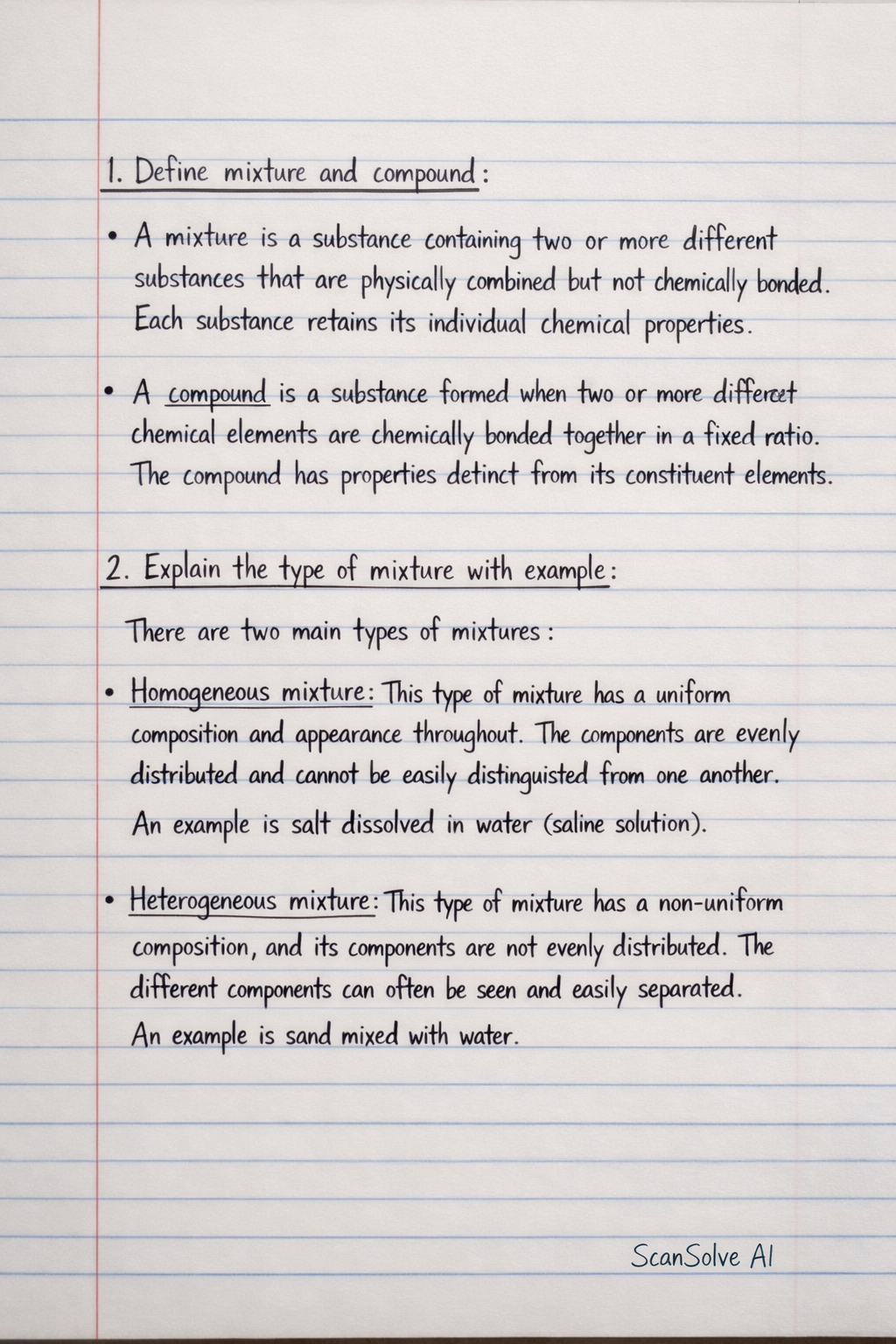
Handwritten Step-by-Step Solution
Get this as a handwritten image on WhatsApp — like a tutor wrote it for you.
Try on WhatsApp