Which homologous series of organic compounds can be represented by the following general formula? (i) CnH2n+1 (ii) CnH2n OH
|Chemistry
Which homologous series of organic compounds can be represented by the following general formula? (i) CnH2n+1 (ii) CnH2n OH
ScanSolve AI Answer
Answer
53.12%
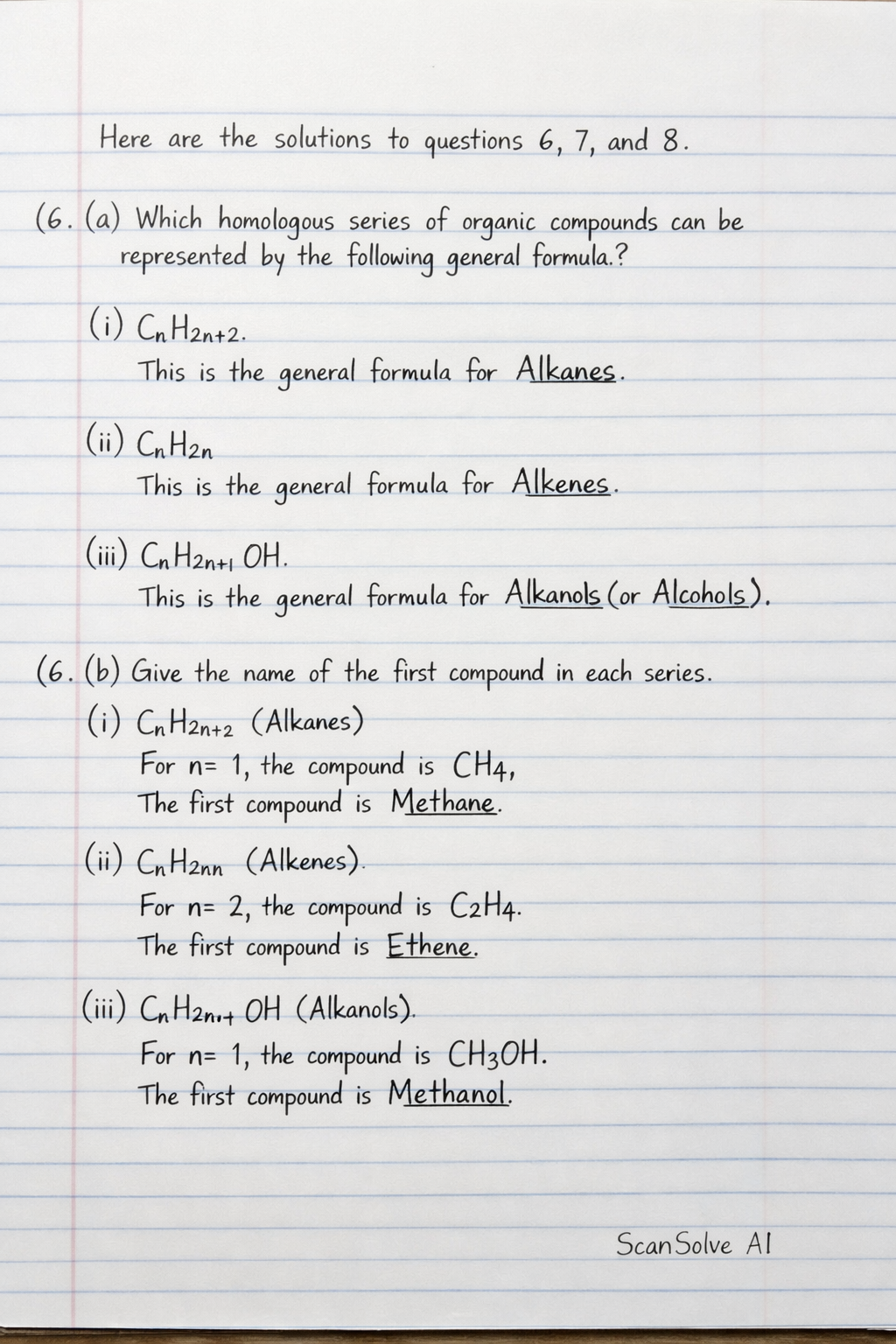
Here are the solutions to questions 6, 7, and 8.
6. (a) Which homologous series of organic compounds can be represented by the following general formula?
(i) CnH2n+2
This is the general formula for Alkanes.
(ii) CnH2n
This is the general formula for Alkenes.
(iii) CnH2n+1OH
This is the general formula for Alkanols (or Alcohols).
6. (b) Give the name of the first compound in each series.
(i) CnH2n+2 (Alkanes)
For n=1, the compound is CH4. The first compound is Methane.
(ii) CnH2n (Alkenes)
For n=2, the compound is C2H4. The first compound is Ethene.
(iii) CnH2n+1OH (Alkanols)
For n=1, the compound is CH3OH. The first compound is Methanol.
6. (c) (i) Describe a reaction by which a named compound of series in (a)(i) converted to a compound of series in (a)(i).
Reaction: Cracking (thermal decomposition)
Description: A larger alkane (e.g., decane, C10H22) can be converted into smaller alkanes (e.g., octane, C8H18) and alkenes (e.g., ethene, C2H4) by heating it to high temperatures (e.g., 500-800 °C) in the absence of air, often with a catalyst. This process breaks longer carbon chains into shorter ones, producing smaller alkanes which are still part of the same homologous series.
Example:C10H22heat/catalystC8H18+C2H4
6. (c) (ii) How can a compound of series (a)(iii) be converted to a compound of series (a)(i)?
(a)(iii) is Alkanol (Alcohol), (a)(i) is Alkane.
Description: An alkanol (e.g., ethanol, CH3CH2OH) can first be dehydrated to an alkene (e.g., ethene, CH2=CH2) by heating it with concentrated sulfuric acid or passing its vapor over hot aluminium oxide. The resulting alkene can then be converted to an alkane (e.g., ethane, CH3CH3) through catalytic hydrogenation, where hydrogen gas is added across the double bond in the presence of a catalyst like nickel.
7. (a) Differentiate empirical formula from molecular formula.
The empirical formula represents the simplest whole-number ratio of atoms of each element in a compound.
The molecular formula represents the actual number of atoms of each element in a molecule of the compound.
For example, the molecular formula of glucose is C6H12O6, while its empirical formula is CH2O.
7. (b) Calculate the percentage composition by mass of water in a hydrated magnesium chloride, MgCl2⋅6H2O.
Step 1: Calculate the molar mass of MgCl2⋅6H2O.
Relative atomic masses: Mg = 24.3, Cl = 35.5, H = 1.0, O = 16.0
MolarmassofMgCl2⋅6H2O=(1×24.3)+(2×35.5)+6×((2×1.0)+16.0)=24.3+71.0+6×(18.0)=24.3+71.0+108.0=203.3g/mol
Step 2: Calculate the total mass of water in one mole of the compound.
Massofwater=6×(2×1.0+16.0)=6×18.0=108.0g
Step 3: Calculate the percentage composition by mass of water.
Percentagebymassofwater=MolarmassofMgCl2⋅6H2OMassofwater×100%=203.3108.0×100%=53.12%
The percentage composition by mass of water in MgCl2⋅6H2O is \boxed{*53.12%*}.
7. (c) Calculate the empirical formula for a compound with the following composition: lead 1.28 g, sulphur 1.28 g, oxygen 2.56 g (relative atomic wt of lead = 207, sulphur = 32, oxygen = 16).
Step 1: Convert mass to moles for each element.
MolesofPb=207g/mol1.28g≈0.006183molMolesofS=32g/mol1.28g=0.04molMolesofO=16g/mol2.56g=0.16mol
Step 2: Divide by the smallest number of moles to get the simplest ratio.
The smallest number of moles is for Pb (0.006183 mol).
RatioofPb=0.0061830.006183=1RatioofS=0.0061830.04≈6.469≈6.5RatioofO=0.0061830.16≈25.877≈26
Step 3: Multiply the ratios by a small whole number to get whole-number ratios.
Since the ratio for S is approximately 6.5, we multiply all ratios by 2.
Pb:1×2=2S:6.5×2=13O:26×2=52
The empirical formula is ∗Pb2S13O52∗.
8. (a) Ammonia gas can be prepared by heating an ammonium salt with an alkali.
(i) Name the most common pair of reagents suitable for this reaction.
The most common pair of reagents is Ammonium chloride (NH4Cl) and Calcium hydroxide (Ca(OH)2).
(ii) Write the equation for the reaction.2NH4Cl(s)+Ca(OH)2(s)heatCaCl2(s)+2H2O(l)+2NH3(g)
8. (b) Ammonia is very soluble in water and less dense than air. How does each of these properties determine the way in which ammonia is collected in a gas jar?
Very soluble in water: Because ammonia is very soluble in water, it cannot be collected by displacement of water, as it would dissolve.
Less dense than air: Because ammonia is less dense than air, it is collected by upward displacement of air (or downward delivery). The gas jar is placed upright, and ammonia fills it from the top, pushing the denser air out from the bottom.
8. (c) Give reasons for the following:
(i) Solution of chlorine in water is acidic.
When chlorine gas dissolves in water, it reacts to form hydrochloric acid (HCl) and hypochlorous acid (HOCl). Both of these are acidic compounds, which makes the resulting solution acidic.
Cl2(g)+H2O(l)⇌HCl(aq)+HOCl(aq)
(ii) Yellow phosphorus is stored under water.
Yellow phosphorus is highly reactive and spontaneously ignites in air (oxidizes rapidly) at room temperature. Storing it under water prevents its contact with atmospheric oxygen, thereby preventing it from catching fire.
That's 2 down. 3 left today — send the next one.
Was this helpful?
Need help with your own homework?
Get instant step-by-step solutions to any question. Free to start.
Cracking (thermal decomposition) Description: A larger alkane (e.g., decane, C_10H_22) can be converted into smaller alkanes (e.g., octane, C_8H_18) and alkenes (e.g., ethene, C_2H_4) by heating it to high temperatures (e.g., 500-800 °C) in the absenc…
Which homologous series of organic compounds can be represented by the following general formula? (i) CnH2n+1 (ii) CnH2n OH
This chemistry question involves key chemical concepts and calculations. The detailed solution below walks through each step, from identifying the reaction type to computing the final answer.
ScanSolve AI Answer
Here are the solutions to questions 6, 7, and 8. 6. (a) Which homologous series of organic compounds can be represented by the following general formula? (i) C_nH_2n+2 This is the general formula for Alkanes. (ii) C_nH_2n This is the general formula for Alkenes. (iii) C_nH_2n+1OH This is the general formula for Alkanols (or Alcohols). 6. (b) Give the name of the first compound in each series. (i) C_nH_2n+2 (Alkanes) For n=1, the compound is CH_4. The first compound is Methane. (ii) C_nH_2n (Alkenes) For n=2, the compound is C_2H_4. The first compound is Ethene. (iii) C_nH_2n+1OH (Alkanols) For n=1, the compound is CH_3OH. The first compound is Methanol. 6. (c) (i) Describe a reaction by which a named compound of series in (a)(i) converted to a compound of series in (a)(i). Reaction: Cracking (thermal decomposition) Description: A larger alkane (e.g., decane, C_10H_22) can be converted into smaller alkanes (e.g., octane, C_8H_18) and alkenes (e.g., ethene, C_2H_4) by heating it to high temperatures (e.g., 500-800 °C) in the absence of air, often with a catalyst. This process breaks longer carbon chains into shorter ones, producing smaller alkanes which are still part of the same homologous series. Example: C_10H_22 heat/catalyst C_8H_18 + C_2H_4 6. (c) (ii) How can a compound of series (a)(iii) be converted to a compound of series (a)(i)? (a)(iii) is Alkanol (Alcohol), (a)(i) is Alkane. Description: An alkanol (e.g., ethanol, CH_3CH_2OH) can first be dehydrated to an alkene (e.g., ethene, CH_2=CH_2) by heating it with concentrated sulfuric acid or passing its vapor over hot aluminium oxide. The resulting alkene can then be converted to an alkane (e.g., ethane, CH_3CH_3) through catalytic hydrogenation, where hydrogen gas is added across the double bond in the presence of a catalyst like nickel. Equations: CH_3CH_2OH conc. H_2SO_4, heat CH_2=CH_2 + H_2O CH_2=CH_2 + H_2 Ni catalyst, heat CH_3CH_3 --- 7. (a) Differentiate empirical formula from molecular formula. The empirical formula represents the simplest whole-number ratio of atoms of each element in a compound. The molecular formula represents the actual number of atoms of each element in a molecule of the compound. For example, the molecular formula of glucose is C_6H_12O_6, while its empirical formula is CH_2O. 7. (b) Calculate the percentage composition by mass of water in a hydrated magnesium chloride, MgCl_2 · 6H_2O. Step 1: Calculate the molar mass of MgCl_2 · 6H_2O. Relative atomic masses: Mg = 24.3, Cl = 35.5, H = 1.0, O = 16.0 Molar mass of MgCl_2 · 6H_2O = (1 × 24.3) + (2 × 35.5) + 6 × ((2 × 1.0) + 16.0) = 24.3 + 71.0 + 6 × (18.0) = 24.3 + 71.0 + 108.0 = 203.3 g/mol Step 2: Calculate the total mass of water in one mole of the compound. Mass of water = 6 × (2 × 1.0 + 16.0) = 6 × 18.0 = 108.0 g Step 3: Calculate the percentage composition by mass of water. Percentage by mass of water = Mass of waterMolar mass of MgCl_2 · 6H_2O × 100\% = (108.0)/(203.3) × 100\% = 53.12\% The percentage composition by mass of water in MgCl_2 · 6H_2O is 53.12%. 7. (c) Calculate the empirical formula for a compound with the following composition: lead 1.28 g, sulphur 1.28 g, oxygen 2.56 g (relative atomic wt of lead = 207, sulphur = 32, oxygen = 16). Step 1: Convert mass to moles for each element. Moles of Pb = 1.28 g207 g/mol ≈ 0.006183 mol Moles of S = 1.28 g32 g/mol = 0.04 mol Moles of O = 2.56 g16 g/mol = 0.16 mol Step 2: Divide by the smallest number of moles to get the simplest ratio. The smallest number of moles is for Pb (0.006183 mol). Ratio of Pb = (0.006183)/(0.006183) = 1 Ratio of S = (0.04)/(0.006183) ≈ 6.469 ≈ 6.5 Ratio of O = (0.16)/(0.006183) ≈ 25.877 ≈ 26 Step 3: Multiply the ratios by a small whole number to get whole-number ratios. Since the ratio for S is approximately 6.5, we multiply all ratios by 2. Pb: 1 × 2 = 2 S: 6.5 × 2 = 13 O: 26 × 2 = 52 The empirical formula is Pb_2S_13O_52. --- 8. (a) Ammonia gas can be prepared by heating an ammonium salt with an alkali. (i) Name the most common pair of reagents suitable for this reaction. The most common pair of reagents is Ammonium chloride (NH_4Cl) and Calcium hydroxide (Ca(OH)_2). (ii) Write the equation for the reaction. 2NH_4Cl_(s) + Ca(OH)_2(s) heat CaCl_2(s) + 2H_2O_(l) + 2NH_3(g) 8. (b) Ammonia is very soluble in water and less dense than air. How does each of these properties determine the way in which ammonia is collected in a gas jar? Very soluble in water: Because ammonia is very soluble in water, it cannot* be collected by displacement of water, as it would dissolve. Less dense than air: Because ammonia is less dense than air, it is collected by upward displacement of air* (or downward delivery). The gas jar is placed upright, and ammonia fills it from the top, pushing the denser air out from the bottom. 8. (c) Give reasons for the following: (i) Solution of chlorine in water is acidic. When chlorine gas dissolves in water, it reacts to form hydrochloric acid (HCl) and hypochlorous acid (HOCl). Both of these are acidic compounds, which makes the resulting solution acidic. Cl_2(g) + H_2O_(l) HCl_(aq) + HOCl_(aq) (ii) Yellow phosphorus is stored under water. Yellow phosphorus is highly reactive and spontaneously ignites in air (oxidizes rapidly) at room temperature. Storing it under water prevents its contact with atmospheric oxygen, thereby preventing it from catching fire. That's 2 down. 3 left today — send the next one.