
I need a very good summary on the laboratory hydrogen halide
ScanSolve AI Answer
Answer
The laboratory preparation of hydrogen halides () depends on the specific halide.
-
Hydrogen Fluoride () and Hydrogen Chloride () are typically prepared by reacting their respective halide salts (e.g., , ) with concentrated sulfuric acid (). Sulfuric acid acts as a non-volatile acid, displacing the more volatile or .
-
Hydrogen Bromide () and Hydrogen Iodide () cannot be prepared using concentrated sulfuric acid because is a strong oxidizing agent and would oxidize to and to . Instead, they are prepared by reacting their halide salts (e.g., , ) with a non-oxidizing acid like concentrated phosphoric acid ().
Alternatively, and can be prepared by the hydrolysis of phosphorus trihalides (e.g., , ) formed in situ from red phosphorus and the respective halogen in the presence of water.
Still stuck on this one?
Ask a follow-up, and the answer starts from this question.
More Chemistry Questions
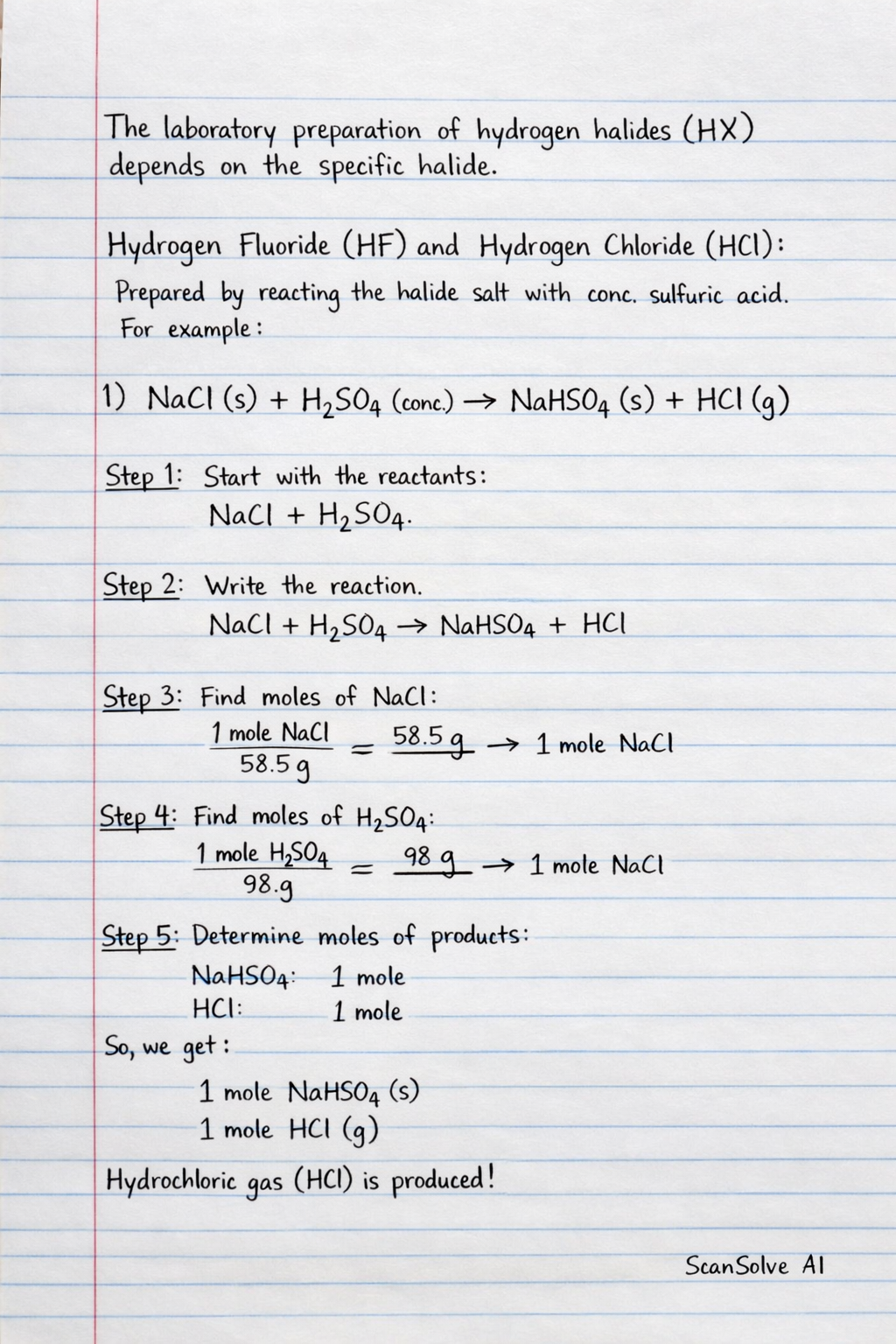
Handwritten Step-by-Step Solution
Get this as a handwritten image on WhatsApp — like a tutor wrote it for you.
Try on WhatsApp