This chemistry question involves key chemical concepts and calculations. The detailed solution below walks through each step, from identifying the reaction type to computing the final answer.
ScanSolve AI Answer
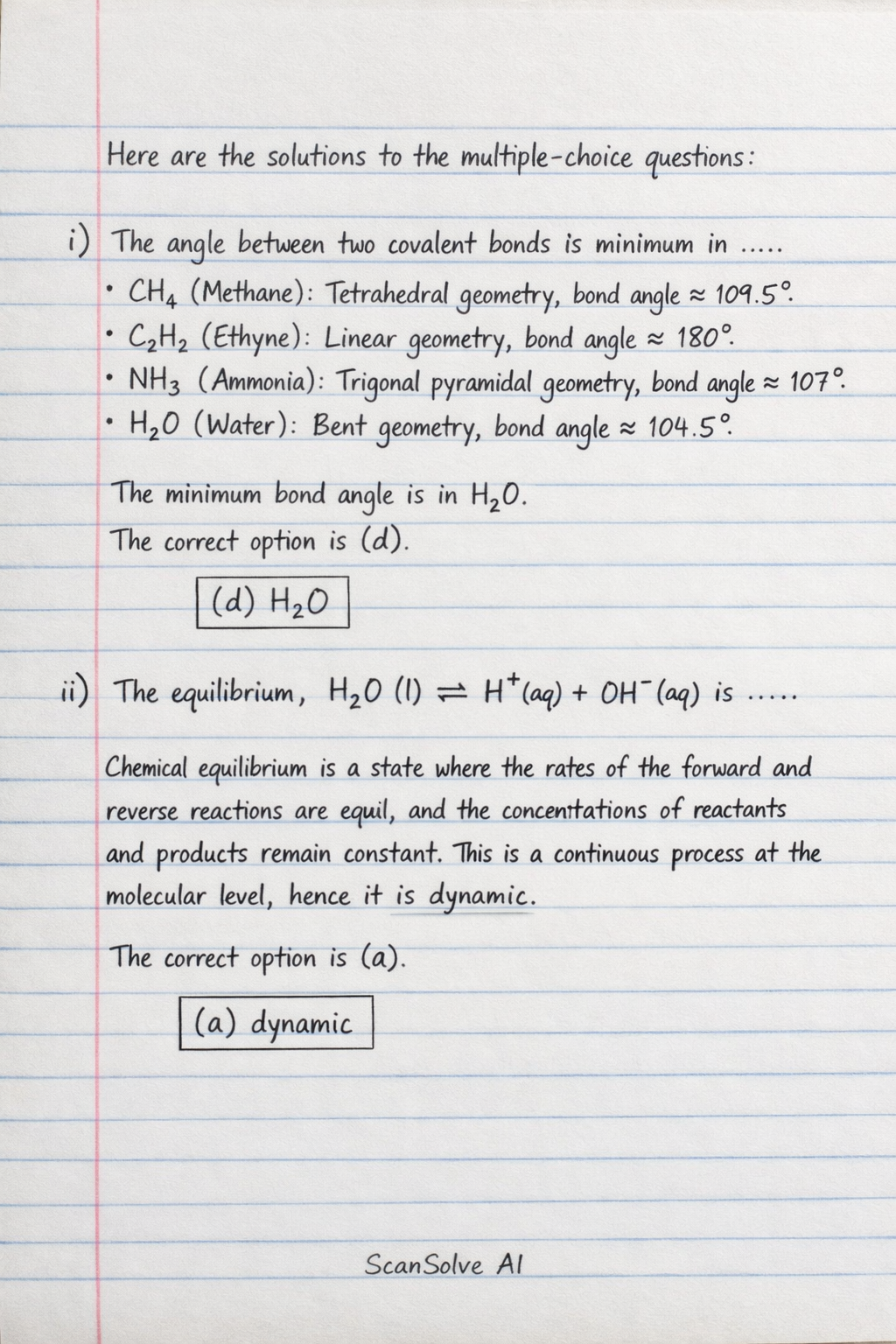
Here are the solutions to the multiple-choice questions:
i) The angle between two covalent bonds is minimum in ......
CH$_4$ (Methane): Tetrahedral geometry, bond angle $\approx 109.5^\circ$.
C$_2$H$_2$ (Ethyne): Linear geometry, bond angle $180^\circ$.
NH$_3$ (Ammonia): Trigonal pyramidal geometry, bond angle $\approx 107^\circ$.
H$_2$O (Water): Bent geometry, bond angle $\approx 104.5^\circ$.
The minimum bond angle is in H$_2$O.
The correct option is (d).
$\boxed{\text{*(d) H}_2\text{O}}$
ii) The equilibrium, H$_2$O (l) $\rightleftharpoons$ H$^+$ (aq) + OH$^-$ (aq) is ......
Chemical equilibrium is a state where the rates of the forward and reverse reactions are equal, and the concentrations of reactants and products remain constant. This is a continuous process at the molecular level, hence it is dynamic.
The correct option is (a).
$\boxed{\text{(a) dynamic}}$
iii) Which of the following is Lewis acid?
A Lewis acid is an electron pair acceptor.
BaCl$_2$, KCl, LiCl are ionic compounds and typically do not act as Lewis acids.
BeCl$_2$ has beryllium with only 4 valence electrons, making it electron-deficient and capable of accepting an electron pair. Therefore, BeCl$_2$ is a Lewis acid.
The correct option is (c).
$\boxed{\text{*(c) BeCl}_2}$
iv) Which technique is widely used in industry to separate components of mixture and also to purify them?
Chromatography* is a versatile technique widely used in various industries for both separating components of complex mixtures and purifying substances based on differential partitioning between a stationary and a mobile phase.
The correct option is (b).
$\boxed{\text{(b) Chromatography}}$
v) Which one of the following property of matter is not quantitative in nature?
Quantitative properties* are measurable and expressed with a numerical value (e.g., Mass, Length, Volume).
Qualitative properties* are descriptive and observed without measurement (e.g., Colour, Odour).
Among the given options, Colour is a qualitative property.
The correct option is (c).
$\boxed{\text{(c) Colour}}$
vi) .......... is inorganic graphite.
Boron nitride (BN)* exists in a hexagonal form (h-BN) that has a layered structure similar to graphite, with strong covalent bonds within layers and weak van der Waals forces between layers. It is often referred to as "inorganic graphite" due to its structural and lubricating similarities.
The correct option is (c).
$\boxed{\text{(c) boran nitride}}$
vii) The radioactive isotope used in the treatment of Leukemia is ......
Phosphorus-32 ($^{32}$P)* is a beta-emitting radioisotope used in the treatment of certain blood disorders, including polycythemia vera and sometimes chronic myeloid leukemia.
The correct option is (c).
$\boxed{\text{*(c) }^{32}\text{P}}$
viii) 1-chloropropane on treatment with alc. KOH produces ......
This is an elimination reaction (dehydrohalogenation) where a hydrogen atom from an adjacent carbon and the chlorine atom are removed, forming a double bond.
$$ \text{CH}_3\text{CH}_2\text{CH}_2\text{Cl} \xrightarrow{\text{alc. KOH}} \text{CH}_3\text{CH=CH}_2 + \text{KCl} + \text{H}_2\text{O} $$
The product is propene.
The correct option is (b).
$\boxed{\text{(b) propene}}$
ix) Find odd one out from the following?
Dettol, Chloroxylenol (active ingredient in Dettol), and Trichlorophenol* are all antiseptics or disinfectants, used to kill or inhibit the growth of microorganisms on surfaces or skin.
Paracetamol* (acetaminophen) is an analgesic (pain reliever) and antipyretic (fever reducer), used as a medication for internal consumption.
Therefore, Paracetamol is the odd one out.
The correct option is (c).
$\boxed{\text{(c) paracetamol}}$
x) Which of the atomic number represent the s-block elements?
S-block elements are those in Group 1 (alkali metals) and Group 2 (alkaline earth metals) of the periodic table.
a) 7 (Nitrogen, p-block), 15 (Phosphorus, p-block)
b) 3 (Lithium, s-block), 12 (Magnesium, s-block)
c) 6 (Carbon, p-block), 14 (Silicon, p-block)
d) 9 (Fluorine, p-block), 17 (Chlorine, p-block)
Only option (b) contains atomic numbers corresponding to s-block elements.
The correct option is (b).
$\boxed{\text{(b) 3, 12}}$
i) The angle between two covalent bonds is minimum in ......
|Chemistry
i) The angle between two covalent bonds is minimum in ......
ScanSolve AI Answer
Here are the solutions to the multiple-choice questions:
i)The angle between two covalent bonds is minimum in ......
CH4 (Methane): Tetrahedral geometry, bond angle ≈109.5∘.
C2H2 (Ethyne): Linear geometry, bond angle 180∘.
NH3 (Ammonia): Trigonal pyramidal geometry, bond angle ≈107∘.
H2O (Water): Bent geometry, bond angle ≈104.5∘.
The minimum bond angle is in H2O.
The correct option is (d).
∗(d)H2O
ii)The equilibrium, H2O (l) ⇌ H+ (aq) + OH− (aq) is ......
Chemical equilibrium is a state where the rates of the forward and reverse reactions are equal, and the concentrations of reactants and products remain constant. This is a continuous process at the molecular level, hence it is dynamic.
The correct option is (a).
∗(a)dynamic∗
iii)Which of the following is Lewis acid?
A Lewis acid is an electron pair acceptor.
BaCl2, KCl, LiCl are ionic compounds and typically do not act as Lewis acids.
BeCl2 has beryllium with only 4 valence electrons, making it electron-deficient and capable of accepting an electron pair. Therefore, BeCl2 is a Lewis acid.
The correct option is (c).
∗(c)BeCl2
iv)Which technique is widely used in industry to separate components of mixture and also to purify them?
Chromatography is a versatile technique widely used in various industries for both separating components of complex mixtures and purifying substances based on differential partitioning between a stationary and a mobile phase.
The correct option is (b).
∗(b)Chromatography∗
v)Which one of the following property of matter is not quantitative in nature?
Quantitative properties are measurable and expressed with a numerical value (e.g., Mass, Length, Volume).
Qualitative properties are descriptive and observed without measurement (e.g., Colour, Odour).
Among the given options, Colour is a qualitative property.
The correct option is (c).
∗(c)Colour∗
vi).......... is inorganic graphite.
Boron nitride (BN) exists in a hexagonal form (h-BN) that has a layered structure similar to graphite, with strong covalent bonds within layers and weak van der Waals forces between layers. It is often referred to as "inorganic graphite" due to its structural and lubricating similarities.
The correct option is (c).
∗(c)borannitride∗
vii)The radioactive isotope used in the treatment of Leukemia is ......
Phosphorus-32 (32P) is a beta-emitting radioisotope used in the treatment of certain blood disorders, including polycythemia vera and sometimes chronic myeloid leukemia.
The correct option is (c).
∗(c)32P
viii)1-chloropropane on treatment with alc. KOH produces ......
This is an elimination reaction (dehydrohalogenation) where a hydrogen atom from an adjacent carbon and the chlorine atom are removed, forming a double bond.
CH3CH2CH2Clalc.KOHCH3CH=CH2+KCl+H2O
The product is propene.
The correct option is (b).
∗(b)propene∗
ix)Find odd one out from the following?
Dettol, Chloroxylenol (active ingredient in Dettol), and Trichlorophenol are all antiseptics or disinfectants, used to kill or inhibit the growth of microorganisms on surfaces or skin.
Paracetamol (acetaminophen) is an analgesic (pain reliever) and antipyretic (fever reducer), used as a medication for internal consumption.
Therefore, Paracetamol is the odd one out.
The correct option is (c).
∗(c)paracetamol∗
x)Which of the atomic number represent the s-block elements?
S-block elements are those in Group 1 (alkali metals) and Group 2 (alkaline earth metals) of the periodic table.
a) 7 (Nitrogen, p-block), 15 (Phosphorus, p-block)
b) 3 (Lithium, s-block), 12 (Magnesium, s-block)
c) 6 (Carbon, p-block), 14 (Silicon, p-block)
d) 9 (Fluorine, p-block), 17 (Chlorine, p-block)
Only option (b) contains atomic numbers corresponding to s-block elements.
The correct option is (b).
∗(b)3,12∗
Need help with your own homework?
Get instant step-by-step solutions to any question. Free to start.