
We read your photo as:
I) The Group VII elements (Halogens) in order of increasing atomic number with their physical states at room temperature are:
ScanSolve AI Answer
Here are the solutions to the questions:
a)
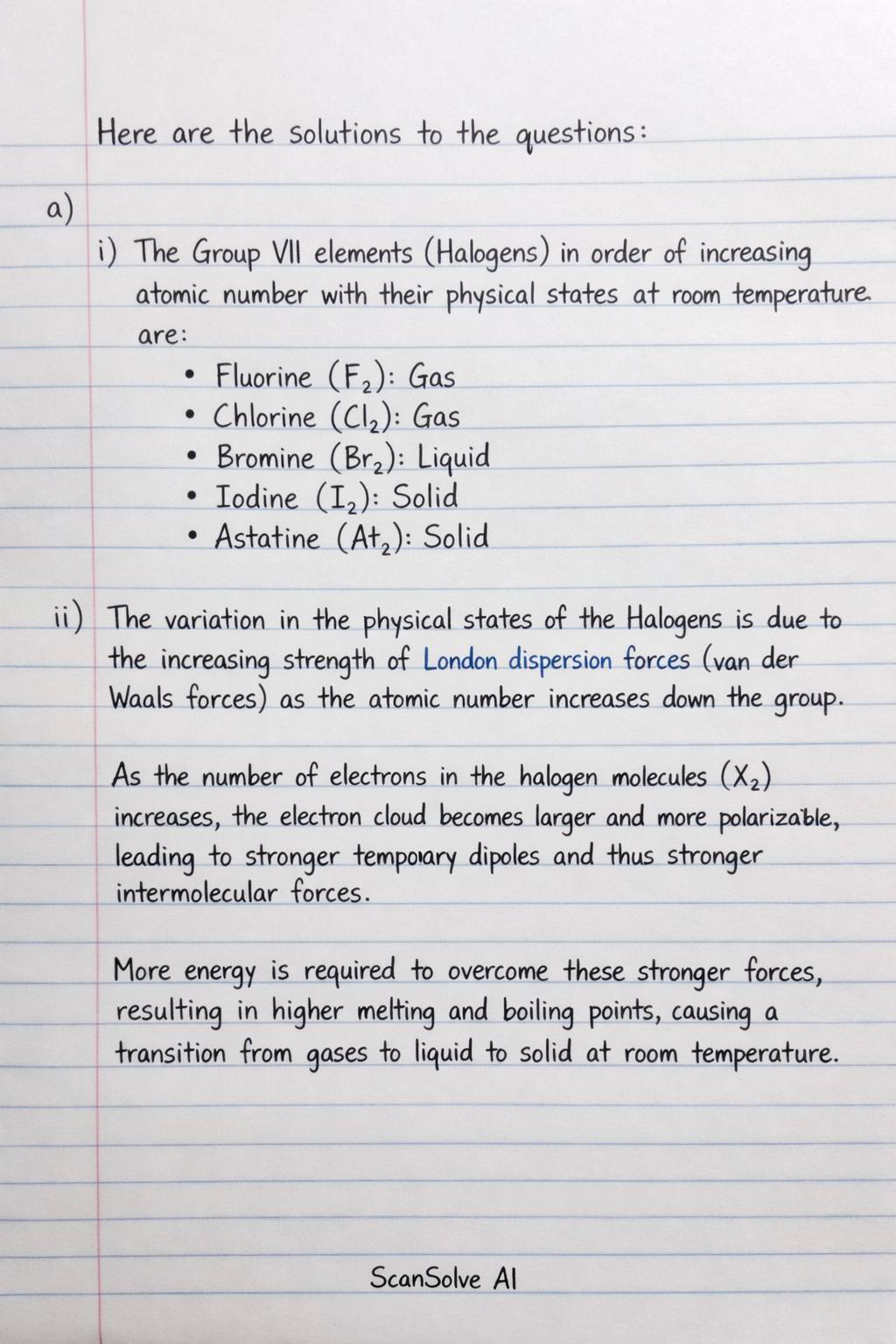
i) The Group VII elements (Halogens) in order of increasing atomic number with their physical states at room temperature are:
- Fluorine (): Gas
- Chlorine (): Gas
- Bromine (): Liquid
- Iodine (): Solid
- Astatine (): Solid
ii) The variation in the physical states of the Halogens is due to the increasing strength of London dispersion forces (van der Waals forces) as the atomic number increases down the group. As the number of electrons in the halogen molecules () increases, the electron cloud becomes larger and more polarizable, leading to stronger temporary dipoles and thus stronger intermolecular forces. More energy is required to overcome these stronger forces, resulting in higher melting and boiling points, causing a transition from gases to liquid to solid at room temperature.
b)
i) Hydrogen bromide () and hydrogen iodide () cannot be prepared conveniently by reacting their corresponding potassium salts with concentrated sulphuric acid because concentrated sulphuric acid () is a strong oxidizing agent. Bromide ions () and especially iodide ions () are reducing agents, with their reducing power increasing down the group. When or react with concentrated , the and formed are subsequently oxidized by the sulphuric acid to elemental bromine () and iodine () respectively, contaminating the desired product.
ii) A balanced chemical equation showing how hydrogen bromide can be prepared in the laboratory using a non-oxidizing acid like phosphoric acid:
c)
i) Fluorinating toothpaste: The importance of fluorinating toothpaste is to prevent tooth decay (dental caries). Fluoride ions () react with the hydroxyapatite in tooth enamel to form fluoroapatite, which is more resistant to acid attack by bacteria in the mouth, thereby strengthening the enamel and reducing cavities.
ii) Iodinating kitchen salt: The importance of iodinating kitchen salt is to prevent iodine deficiency disorders. Iodine is an essential trace element required by the thyroid gland to produce hormones that regulate metabolism, growth, and development. A lack of iodine can lead to conditions such as goitre (enlargement of the thyroid gland) and cretinism (severe developmental issues in children).
Still stuck on this one?
Ask a follow-up, and the answer starts from this question.
More Chemistry Questions
Handwritten Step-by-Step Solution
Get this as a handwritten image on WhatsApp — like a tutor wrote it for you.
Try on WhatsApp