
We read your photo as:
Identify laboratory apparatus C, D, and E, state their uses, and describe an experiment to determine the solubility of salt in water.
ScanSolve AI Answer
Step-by-step solution
6 stepshere are the solutions to questions 1 and 2:
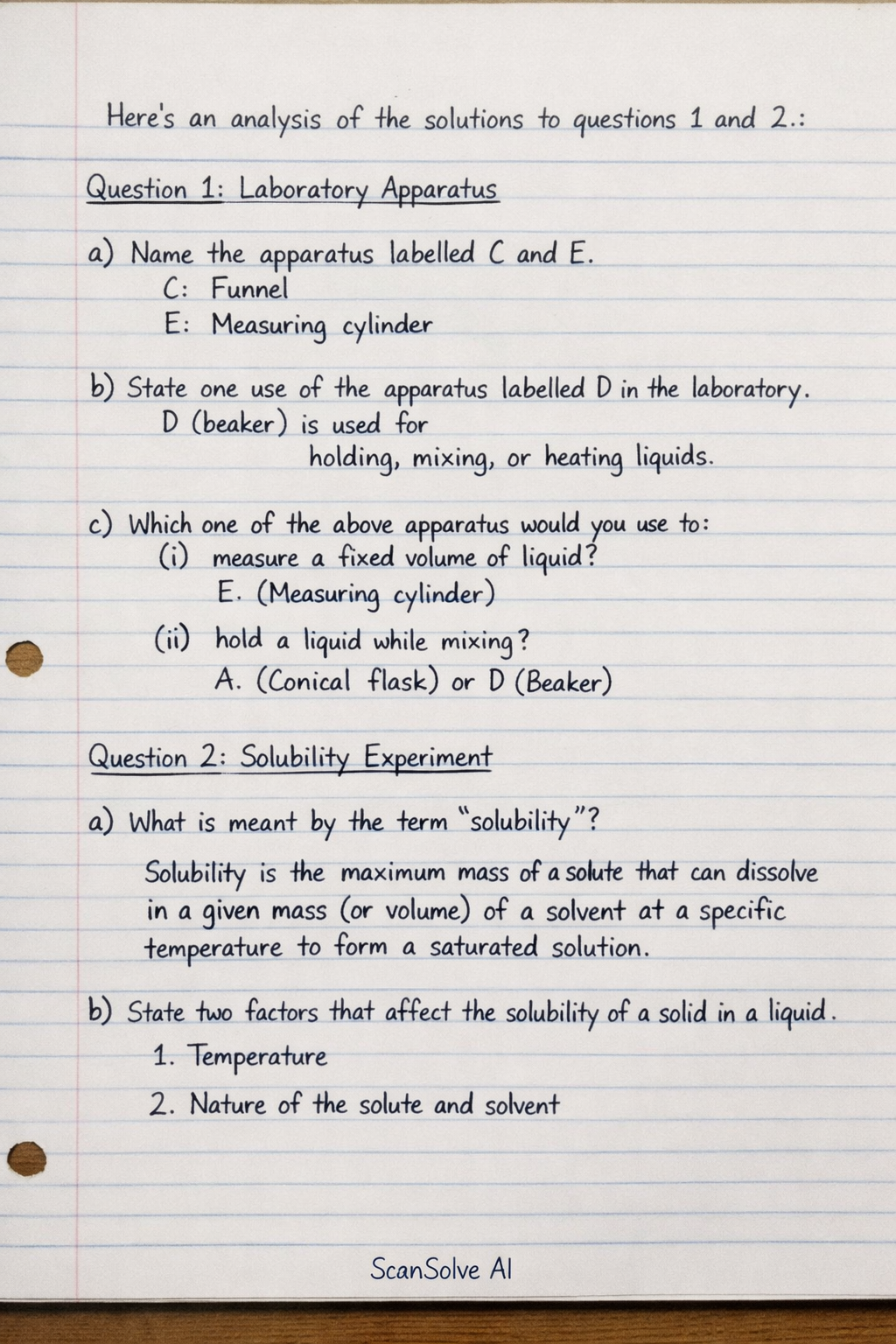
Question 1: Laboratory Apparatus
a) Name the apparatus labelled C and E.
- C: Funnel
- E: Measuring cylinder
b) State one use of the apparatus labelled D in the laboratory.
- D (beaker) is used for holding, mixing, or heating liquids.
c) Which one of the above apparatus would you use to:
- (i) measure a fixed volume of liquid?
- E (Measuring cylinder)
- (ii) hold a liquid while mixing?
- A (Conical flask) or D (Beaker)
Question 2: Solubility Experiment
a) What is meant by the term "solubility"?
Solubility is the maximum mass of a solute that can dissolve in a given mass (or volume) of a solvent at a specific temperature to form a saturated solution.
b) State two factors that affect the solubility of a solid in a liquid.
- Temperature
- Nature of the solute and solvent
c) Describe the procedure you would follow to find the mass of salt that dissolves in 100 cm³ of water at the given temperature.
Measure of water into a beaker and record its temperature.
Add the salt gradually to the water while stirring continuously, ensuring the temperature remains constant.
Continue adding salt until no more dissolves and a small amount of undissolved salt remains at the bottom of the beaker.
This indicates the solution is saturated.
Filter the mixture to separate the undissolved salt from the saturated solution.
Dry the undissolved salt and weigh its mass.
Subtract the mass of the undissolved salt from the total mass of salt initially added to determine the mass of salt that dissolved in of water.
d) How would you know that the solution is saturated?
The solution is saturated when no more salt can dissolve in the water at that specific temperature, and any additional salt added will remain as undissolved solid at the bottom of the container.e) Give one use of the information obtained from this experiment.
- To prepare solutions of specific concentrations for various applications.
- To understand crystallization processes in industries.
Still stuck on this one?
Ask a follow-up, and the answer starts from this question.
More Chemistry Questions
Handwritten Step-by-Step Solution
Get this as a handwritten image on WhatsApp — like a tutor wrote it for you.
Try on WhatsApp