

This chemistry question involves key chemical concepts and calculations. The detailed solution below walks through each step, from identifying the reaction type to computing the final answer.
ScanSolve AI Answer
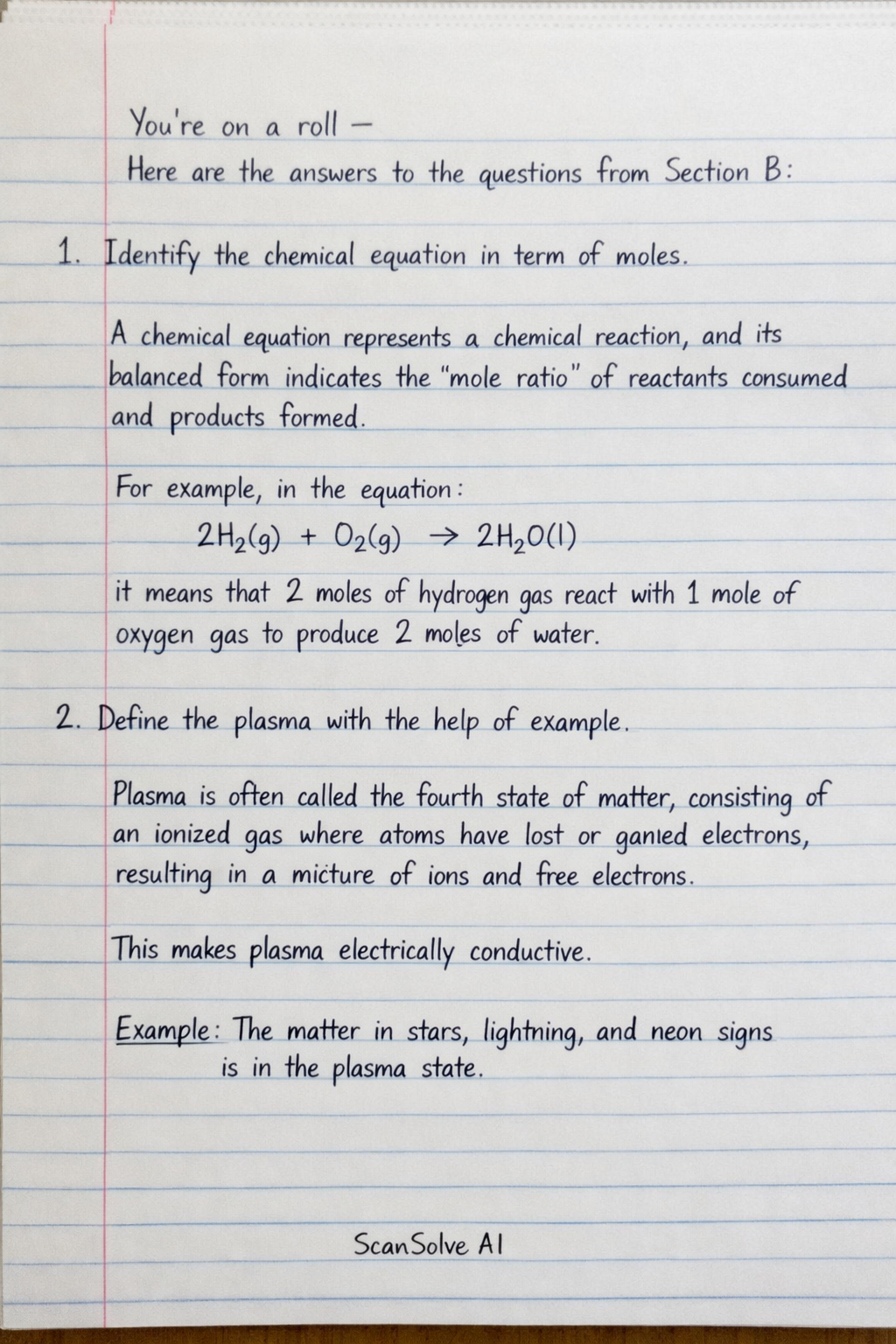
You're on a roll — Here are the answers to the questions from Section B: 1. Identify the chemical equation in term of moles. A chemical equation represents a chemical reaction, and its balanced form indicates the mole ratio of reactants consumed and products formed. For example, in the equation 2H_2(g) + O_2(g) 2H_2O(l), it means that 2 moles of hydrogen gas react with 1 mole of oxygen gas to produce 2 moles of water. 2. Define the plasma with the help of example. Plasma is often called the fourth state of matter, consisting of an ionized gas where atoms have lost or gained electrons, resulting in a mixture of ions and free electrons. This makes plasma electrically conductive. Example: The matter in stars, lightning, and neon signs is in the plasma state. 3. How the atoms of O^17 and O^16 are similar or different from each other. Also add one more example. The atoms O^17 and O^16 are isotopes of oxygen. Similarities: They are both oxygen atoms, meaning they have the same number of protons (8) and electrons, leading to similar chemical properties. Differences: They have different numbers of neutrons (O^16 has 8 neutrons, O^17 has 9 neutrons), resulting in different mass numbers and slightly different physical properties. Another example:* Carbon-12 (C^12) and Carbon-14 (C^14) are isotopes of carbon. 4. Why Alkaline earth metal shows irregular melting and boiling point attraction? Alkaline earth metals exhibit irregular trends in their melting and boiling points, rather than a smooth decrease or increase down the group. This irregularity is primarily due to variations in their crystal structures and the efficiency of metallic bonding across the group, which does not follow a simple pattern with increasing atomic size. 5. Describe the weak forces of intramolecular and intermolecular forces. Intramolecular forces: These are the strong forces within a molecule that hold atoms together, such as covalent bonds and ionic bonds*. They are chemical bonds. Intermolecular forces (IMFs): These are the relatively weak forces of attraction that exist between molecules. They include dipole-dipole forces, hydrogen bonding, and London Dispersion Forces*. IMFs are responsible for physical properties like melting and boiling points. 6. Why do noble gases not react with other elements to form compounds? Describe the inertness of noble gases. Noble gases are inert (unreactive) because they have a completely filled outermost electron shell (a stable octet or duet for helium). This stable electron configuration means they do not readily gain, lose, or share electrons to form chemical bonds, as they are already in the most energetically favorable state. 7. Show how cations and anions relate in terms of metals and non metals. Cations: Positively charged ions, typically formed when metal atoms* lose electrons to achieve a stable electron configuration. Metals have low ionization energies. Example:* Na (metal) loses an electron to form Na^+. Anions: Negatively charged ions, typically formed when nonmetal atoms* gain electrons to achieve a stable electron configuration. Nonmetals have high electron affinities. Example:* Cl (nonmetal) gains an electron to form Cl^-. 8. What are limitation of Bohr's atomic model? Bohr's atomic model had several limitations: It could only explain the spectra of hydrogen* and hydrogen-like ions, failing for multi-electron atoms. It could not explain the fine structure* of spectral lines or their varying intensities. It failed to explain the Zeeman effect (splitting of spectral lines in a magnetic field) and the Stark effect* (splitting in an electric field). It did not explain the nature of chemical bonding*. 9. Why does Sodium Chloride compound is considered as Ionic compound? Explain. Sodium chloride (NaCl) is an ionic compound because it forms through the transfer of electrons between a metal and a nonmetal, resulting in electrostatic attraction between oppositely charged ions. Sodium (a metal) loses an electron to form a positive ion (Na^+), and chlorine (a nonmetal) gains that electron to form a negative ion (Cl^-). The strong electrostatic force between Na^+ and Cl^- ions forms the ionic bond. 10. State the periodic law. Also state who proposed and on what basis it was proposed? Periodic Law: The physical and chemical properties of elements are periodic functions of their atomic numbers*. Proposed by: The modern periodic law was proposed by Henry Moseley in 1913. Basis: Moseley's work on X-ray spectra showed a systematic relationship between the square root of the X-ray frequency and the element's atomic number, establishing atomic number as