
We read your photo as:
Identify the following samples as metals or non-metals and describe their characteristic properties: A (nail/iron), B (copper), C (sulphur), and D (carbon/charcoal).
Chemistry
ScanSolve AI Answer
Step-by-step solution
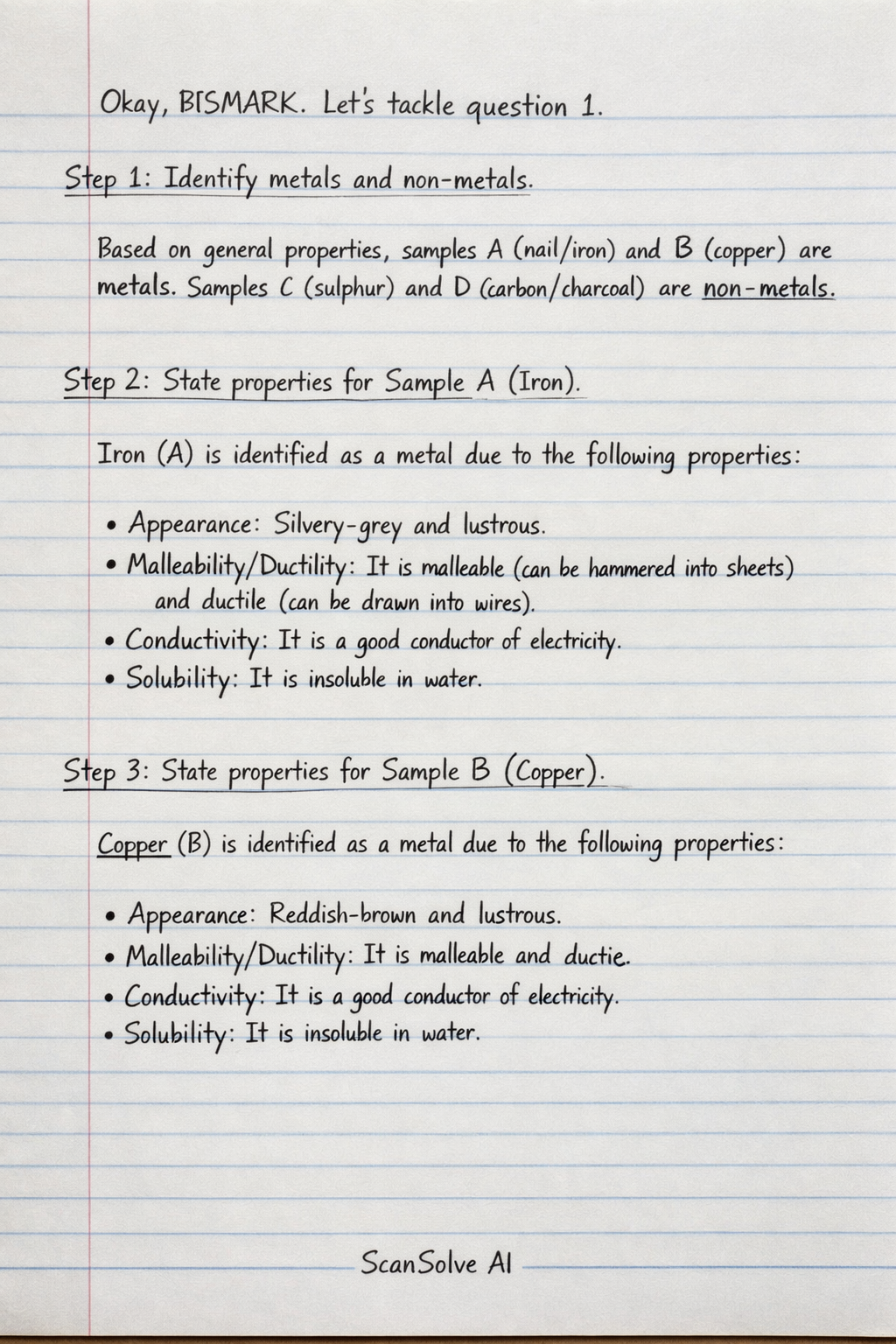
5 stepsOkay, BISMARK. Let's tackle question 1.
Identify metals and non-metals.
Based on general properties, samples A (nail/iron) and B (copper) are metals. Samples C (sulphur) and D (carbon/charcoal) are non-metals.
State properties for Sample A (Iron).
Iron (A) is identified as a metal due to the following properties:
- Appearance: Silvery-grey and lustrous.
- Malleability/Ductility: It is malleable (can be hammered into sheets) and ductile (can be drawn into wires).
- Conductivity: It is a good conductor of electricity.
- Solubility: It is insoluble in water.
State properties for Sample B (Copper).
Copper (B) is identified as a metal due to the following properties:
- Appearance: Reddish-brown and lustrous.
- Malleability/Ductility: It is malleable and ductile.
- Conductivity: It is a good conductor of electricity.
- Solubility: It is insoluble in water.
State properties for Sample C (Sulphur).
Sulphur (C) is identified as a non-metal due to the following properties:
- Appearance: Yellow and dull.
- Malleability/Ductility: It is brittle (breaks easily, not malleable or ductile).
- Conductivity: It is a poor conductor of electricity.
- Solubility: It is insoluble in water.
State properties for Sample D (Carbon/Charcoal).
Carbon (D) is identified as a non-metal due to the following properties:
- Appearance: Black and dull.
- Malleability/Ductility: It is brittle.
- Conductivity: It is a poor conductor of electricity.
- Solubility: It is insoluble in water.
Was this helpful?
Still stuck on this one?
Ask a follow-up, and the answer starts from this question.
Got a different question?Ask your own question
More Chemistry Questions
QList 4 examples each of metals and non-metals, and describe 4 differences between them.QClassify the elements as metals, non-metals, or metalloids and identify their positions in the…QIdentify the two metals and one non-elemental gas from the provided list for Item 3.QWhich element is the jeweller most likely using? A. Silver B. Copper C. Iron D. GoldQThe table below shows some properties of four substances, A, B, C and D. (a) Complete the table by…
Handwritten Step-by-Step Solution
Get this as a handwritten image on WhatsApp — like a tutor wrote it for you.
Try on WhatsApp