
We read your photo as:
Compare the properties of iron, aluminium, and copper, including appearance, state of matter, magnetic attraction, melting point, and electrical conductivity.
Chemistry
ScanSolve AI Answer
here are the comparisons of the properties of iron, aluminium, and copper again:
-
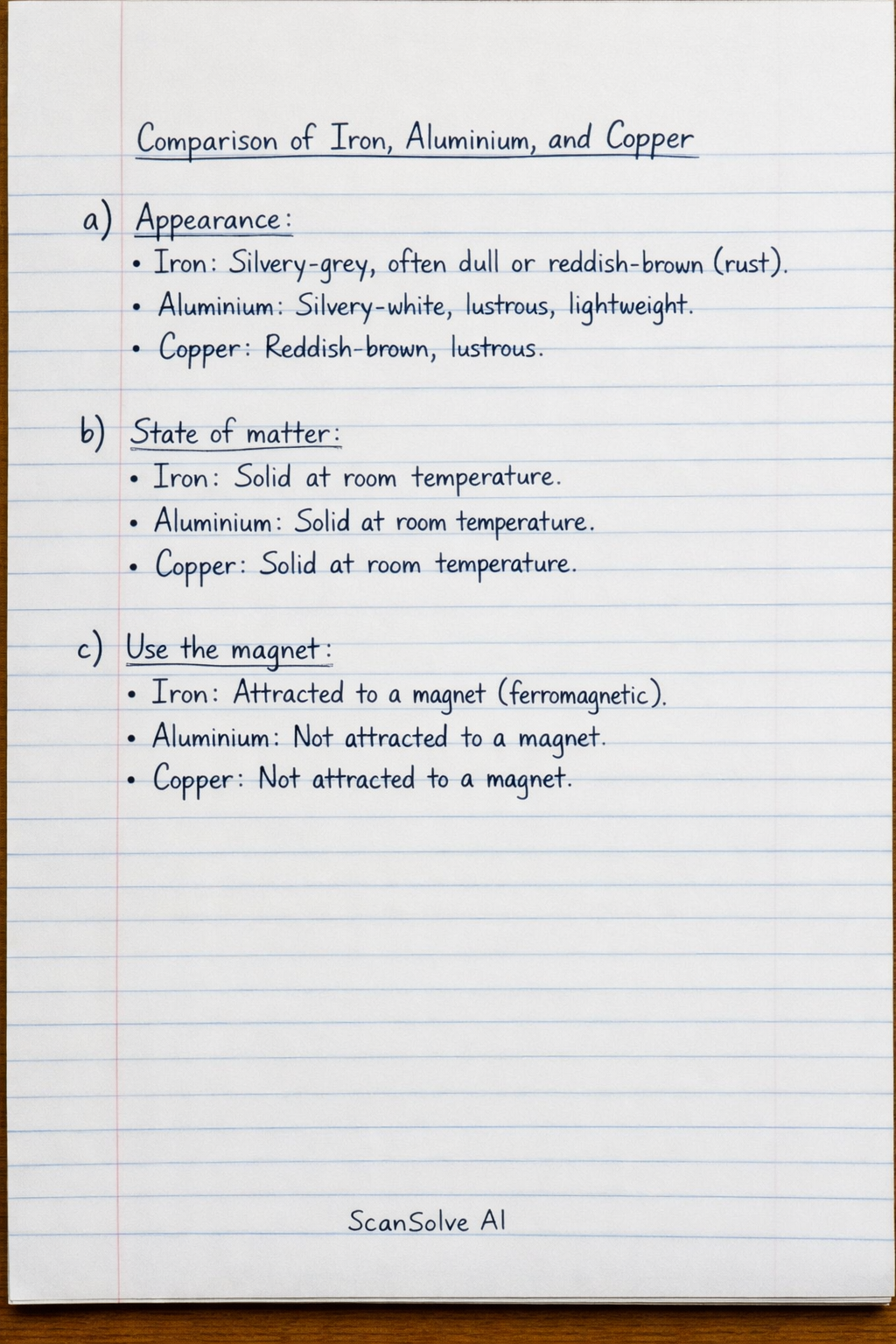
a) Appearance:
- Iron: Silvery-grey, often appears dull or reddish-brown due to rust.
- Aluminium: Silvery-white, lustrous, lightweight.
- Copper: Reddish-brown, lustrous.
-
b) State of matter:
- Iron: Solid at room temperature.
- Aluminium: Solid at room temperature.
- Copper: Solid at room temperature.
-
c) Use the magnet:
- Iron: Attracted to a magnet (ferromagnetic).
- Aluminium: Not attracted to a magnet.
- Copper: Not attracted to a magnet.
-
d) Heat them in a test tube. Do they melt easily and quickly, or not?
- Iron: Does not melt easily or quickly with a Bunsen burner due to its high melting point ().
- Aluminium: Does not melt easily or quickly with a Bunsen burner due to its high melting point ().
- Copper: Does not melt easily or quickly with a Bunsen burner due to its high melting point ().
-
e) Connect each metal to a cell and bulb with wires and crocodile clips. What do you observe?
- Iron: The bulb will light up, indicating it is a good electrical conductor.
- Aluminium: The bulb will light up, indicating it is a good electrical conductor.
- Copper: The bulb will light up, indicating it is a good electrical conductor.
-
f) Can you bend the metals? Do they break?
- Iron: Can be bent with significant force; it is malleable but less so than aluminium or copper. It does not typically break when bent.
- Aluminium: Easily bent and shaped (highly malleable). It does not break.
- Copper: Easily bent and shaped (highly malleable). It does not break.
-
g) Can you stretch the metals? Do they break?
- Iron: Can be stretched (ductile) but requires significant force. It does not typically break when stretched.
- Aluminium: Can be stretched (highly ductile). It does not break.
- Copper: Can be stretched (highly ductile). It does not break.
Was this helpful?
Still stuck on this one?
Ask a follow-up, and the answer starts from this question.
Got a different question?Ask your own question
More Chemistry Questions
QSummarize the properties of materials, including melting point, boiling point, and conductivity, and…QDescribe the physical properties of metals, including lustre, malleability, and ductility. Include…QConfirm that iron is stronger than wood, and briefly give the primary reason for the difference in…QClassify metals as ferrous or non-ferrous and explain two properties of aluminium for engine…QComplete the table below, detailing the object, its use, and its properties: a) Copper wire, b)…
Handwritten Step-by-Step Solution
Get this as a handwritten image on WhatsApp — like a tutor wrote it for you.
Try on WhatsApp